Boom, Shortage, Price
Agave Shortages and Price Cycles
Between planting and harvest, Blue Agave needs six to eight years. This delay creates a recurring rhythm of shortage and oversupply that puts pressure on prices, and sometimes on wild agaves in the mountains as well.
The Rhythm of Shortage and Surplus
When demand for tequila rises, the price of agave almost always rises with it, because the supply of harvest-ready plants can't grow overnight. Farmers respond by planting significantly more hijuelos to profit from the higher prices once those plants mature.
The problem: it takes six to eight years for a newly planted agave to become harvest-ready. If that huge new crop then meets demand that has shifted in the meantime, the market can quickly swing in the opposite direction. Too many ripe piñas at once cause prices to collapse, which in turn makes new planting unattractive, and the cycle starts all over again.
When Espadín runs short
The mezcal industry sees similar swings with Espadín, though it's generally less vulnerable than the tequila industry with its single permitted plant, thanks to its greater diversity of species. When Espadín becomes scarce or expensive, some producers switch to other, more readily available agaves or turn increasingly to wild agaves to keep up with demand.
That may sound like a clever solution at first, but it simply shifts the problem onto another plant. As earlier chapters have shown, wild agaves often take ten, twenty, or even thirty years to reach maturity, and they can't simply be replanted in large numbers to close short-term gaps.
Wild agaves grow slower than they're harvested
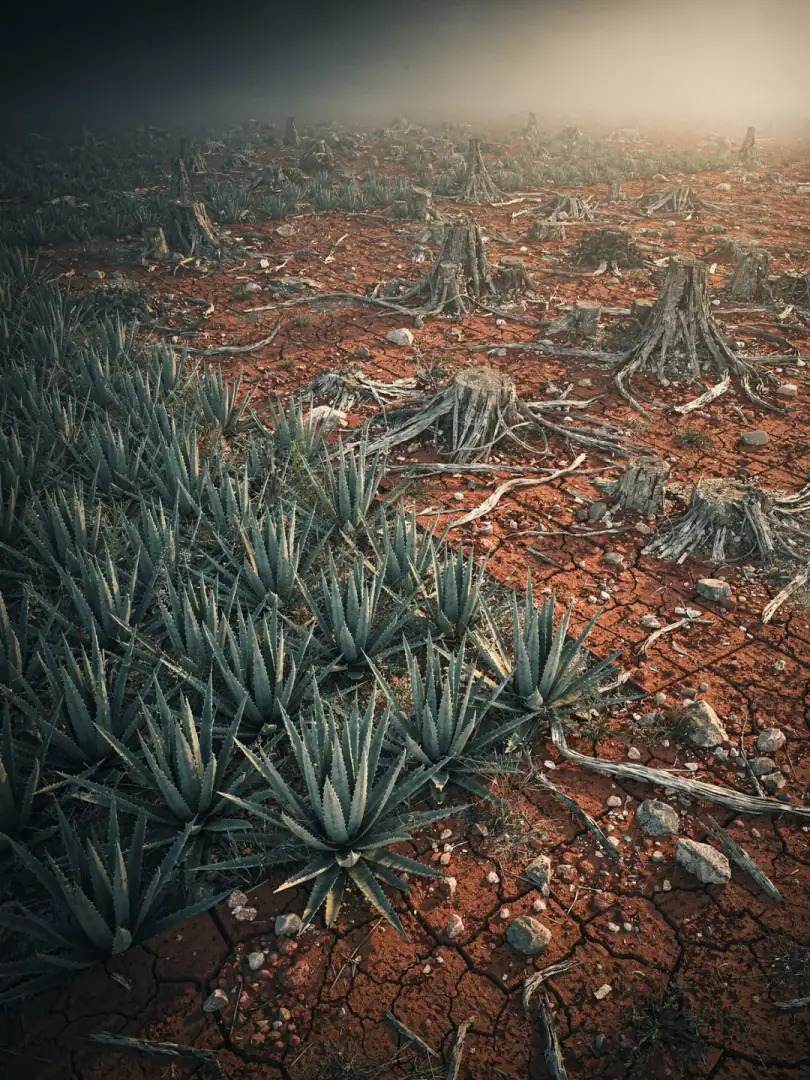
If demand for mezcal made from rare species like Tobalá or Tepeztate rises faster than these plants can regrow, their wild populations decline. Unlike Blue Agave, there's no six-to-eight-year waiting period here, but often one to three decades, during which an overharvested population can barely recover.
This is exactly what makes wild agaves a genuine conservation issue, far beyond questions of flavor alone. If a species at a given site is harvested more heavily than new plants can grow back over the years, the local population can effectively vanish long before anyone officially calls it an endangered species.
What helps counter overuse
Several initiatives are now trying to counteract this trend: some producers commit to planting new agaves or scattering seeds for every wild agave harvested, while others support botanical gardens that preserve the genetic material of rare species. The bat-friendly movement described in the previous chapter also helps indirectly, since natural flowering allows plants to produce seeds again, enabling new, wild-growing plants.
Reliable figures on the scale of the threat are scarce, but experts agree that the combination of long growth cycles and fluctuating demand is the real root of the problem. In the end, anyone seeking sustainable mezcal or tequila is buying less a bottle than a bet that the agave behind it was given time to regrow.
How contracts help cushion prices
To soften these fluctuations, some distilleries now sign long-term supply contracts with agave farmers, buying less often on the open market. A fixed price over several years gives both sides planning security. The farmer knows what he's planting for. The distillery knows its costs in advance, even if the market price swings wildly in the meantime.
Still, this model isn't widespread everywhere. Many small producers continue to buy wherever piñas happen to be available, leaving them quickly exposed to pressure in weak years. Cooperatives and larger brands are increasingly experimenting with such contracts. Some also aim to source wild agaves from more stable supplies rather than depleting individual populations in the mountains.