Dry, Cool, Screw-Capped
Winemaking
Riesling is vinified here as soberly as almost any great white grape variety gets. The grapes come off the press early in the morning, often still cold from the night temperature, and are pressed gently so that as little bitterness as possible passes from the skin into the juice. Fermentation happens exclusively in stainless steel tanks at low temperature. A new oak barrel has never had any business here.
Malolactic fermentation, which softens many white wines, is deliberately suppressed. The sharp malic acid is meant to remain, rather than convert into softer lactic acid. The result is a wine that comes in with practically no residual sugar — and unlike German Riesling, which often retains a fine sweetness, Clare Valley Riesling stays deliberately and completely dry.
The second technical shift concerns not the tank, but the bottle. Since the turn of the millennium, almost all Riesling producers in the valley have sealed their wines with screw caps instead of cork, since cork can occasionally oxidize at random and ruin the aroma. Under screw cap, the wine ages reductively, meaning almost without oxygen. It develops its famous petrol note only after years in the cellar, not just months in the bottle.
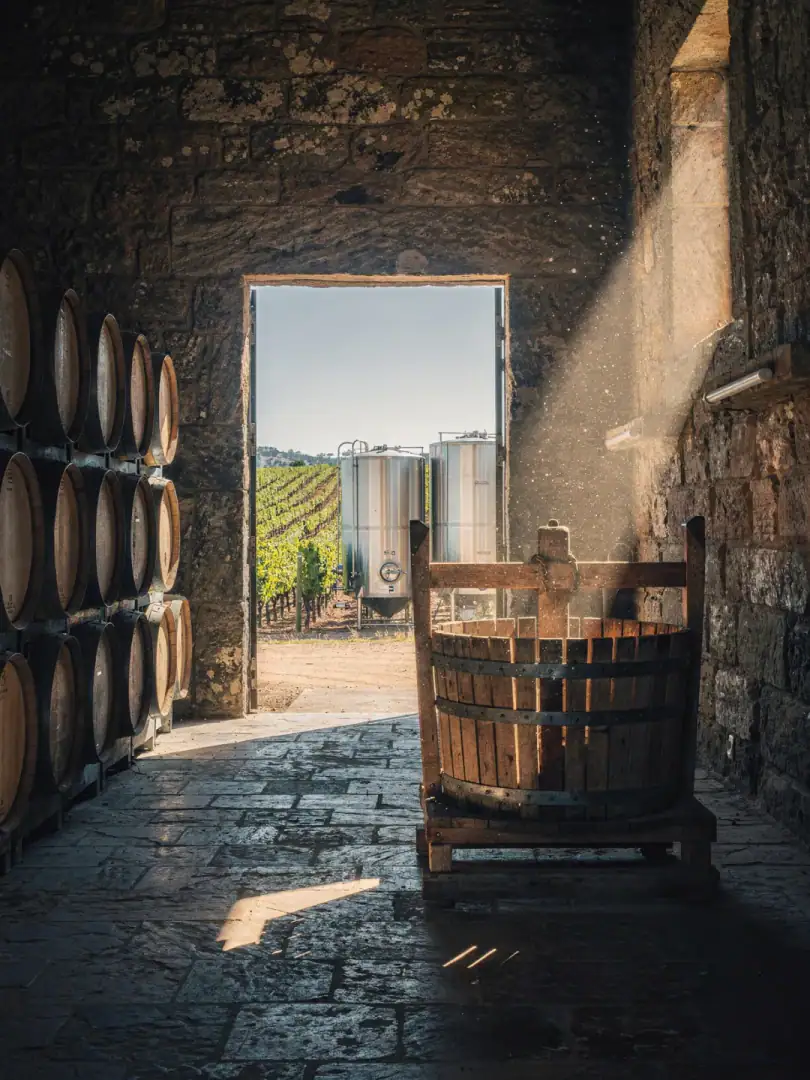
With the old red wines, almost everything works differently. Almost as it did a hundred years ago. At Wendouree, grapes are hand-picked, fermented in open vats, and pressed in a basket press, a technique barely any other Australian winery still uses. Maturation happens in large, old oak casks, which give the wine air but no new oak flavor.
So within the same valley, two entirely different crafts sit side by side. Highly modern, sterile Riesling technique on one side, almost archaic red-wine handwork on the other. Both pursue the same goal — to stand as little in the wine's way as possible and let the grapes tell their own story.