Convict and Textile Manufacturer
Region & History
A convicted forger planted Tasmania's first vineyard. Bartholomew Broughton arrived in Hobart in 1820 as a convict, aboard a ship called the Dromedary, sentenced in London for embezzlement. He was later granted land on the banks of the Derwent, which he named Prospect. There he planted vines in 1823, and by 1827 he was already offering a wine he himself marketed as an imitation of Champagne. Six years later he was dead, and with him, for decades, went winegrowing along that river too.
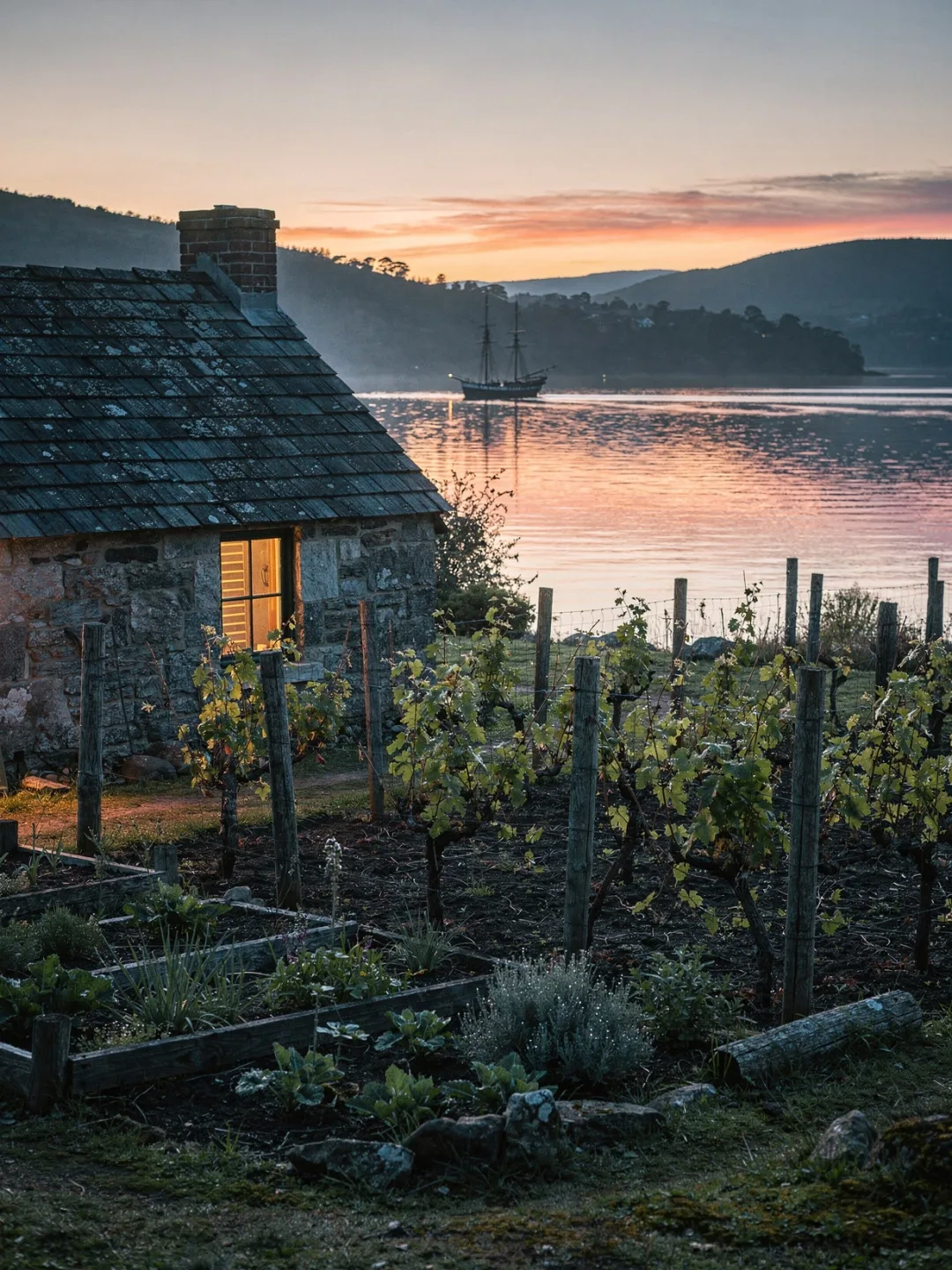
The thread didn't snap entirely, but it grew very thin. It wasn't retied until 1956, by a Frenchman named Jean Miguet. He had come to Tasmania five years earlier as a welder for the hydroelectric authority, and now bought a plot of land thirty kilometres north of Launceston in the Tamar Valley, planting Pinot Noir, Chardonnay, Chasselas and Grenache there. He called the property La Provence. Two years later, the Italian textile manufacturer Claudio Alcorso moved in near Hobart, on a peninsula where a museum now stands.
Provenance didn't become a legal requirement until 1994. On 26 January that year, Tasmania was registered as its own Geographical Indication, an officially protected designation of origin now held in Wine Australia's register. Since then, only wine made from grapes grown on the island may carry this name. One region, one name, no official subdivision into districts. Yet in everyday conversation, winemakers have long spoken of Coal River Valley or Pipers River as though they were separate countries. The label doesn't recognize these names. The soil certainly does.
Two farms became an industry, albeit a small one. In the 1970s, more winemakers arrived, including Andrew Pirie in the north and the Bull couple on the east coast. They were the first to compare Tasmania to Bordeaux and Burgundy, because temperature patterns and rainfall here actually lay closer to France than to South Australia. Today the island supplies a tiny fraction of Australia's wine harvest, yet a strikingly large share of its most expensive bottles. It remains small to this day.