Main, Monasteries, Bocksbeutel
Region & History
Charlemagne owned his own vineyards in Franconia. Two deeds of donation from his era are the oldest written evidence of viticulture here. The first dates to 777 in Hammelburg, the second two years later in Würzburg. Vines stood on the slopes above the Main long before anyone had heard of Sangiovese or Riesling. Twelve hundred years later, some of these vines still grow on those very same slopes.
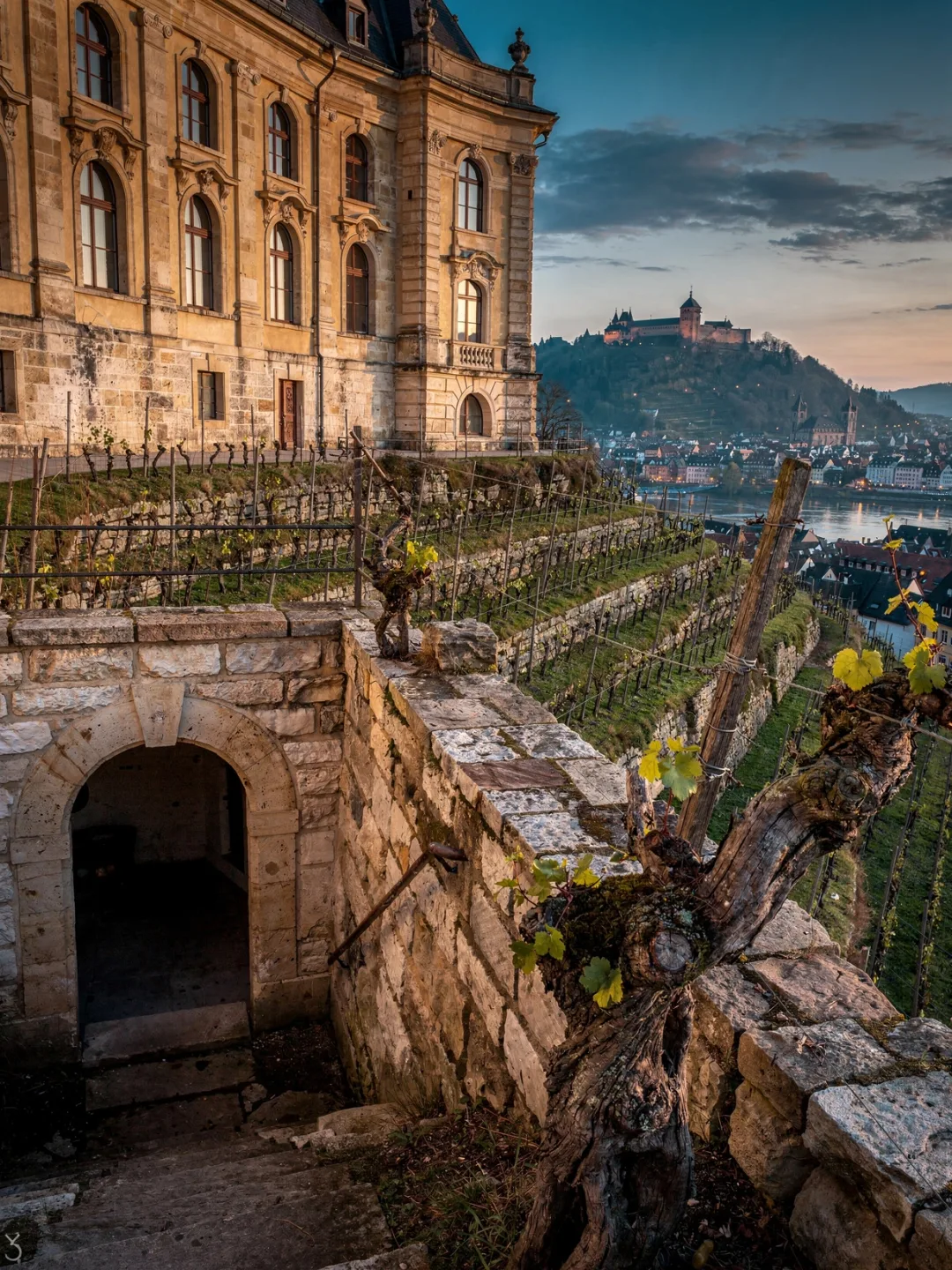
In the Middle Ages, this grew into the largest wine region in the Holy Roman Empire north of the Alps — up to forty thousand hectares, more than six times today's area. Monasteries and prince-bishops grew the wine, sold it, and used the proceeds to finance churches, hospitals, and wars. Prince-Bishop Julius Echter von Mespelbrunn founded the Juliusspital in 1576, a charitable foundation for the sick and needy. Its winery still farms its own vineyard sites today, and the proceeds continue to fund the foundation, just as they did at its founding. Few institutions link charity and winemaking so directly.
The Bocksbeutel itself emerged from a case of fraud. In the eighteenth century, innkeepers were selling cheap wine of unknown origin as fine Franconian wine, and the reputation of genuine Steinwein suffered as a result. In 1728, the Würzburg city council therefore decided that wine from the Würzburger Stein could only be sold in a rounded, sealed bottle — the Bocksbeutel. Whether an earlier depiction on the Juliusspital's founding charter from 1576 already shows the same shape remains disputed among experts. What is certain is this: since 1989, the shape has been protected across the EU, and almost exclusively Franconia and a small part of Baden are still allowed to fill it.
Then came the collapse, not once but twice. Secularization stripped the monasteries of their land around 1803, and around the turn of the century, phylloxera ravaged the remaining vineyards. By the mid-twentieth century, only about two thousand of the original forty thousand hectares remained, before the area began growing slowly and steadily again from the 1970s onward, eventually more than tripling. Today, around 6,040 hectares are under vine, spread across more than two hundred individual vineyard sites between Aschaffenburg and Schweinfurt.
One date sticks in memory: April 6, 1659. On this day, the Castell noble family had Germany's first Silvaner vines planted, then still traded under the name Österreicher. From this single planting grew the variety that defines Franconia today like no other region. Everything else follows from there.