Silvaner & Domina
Grape Varieties
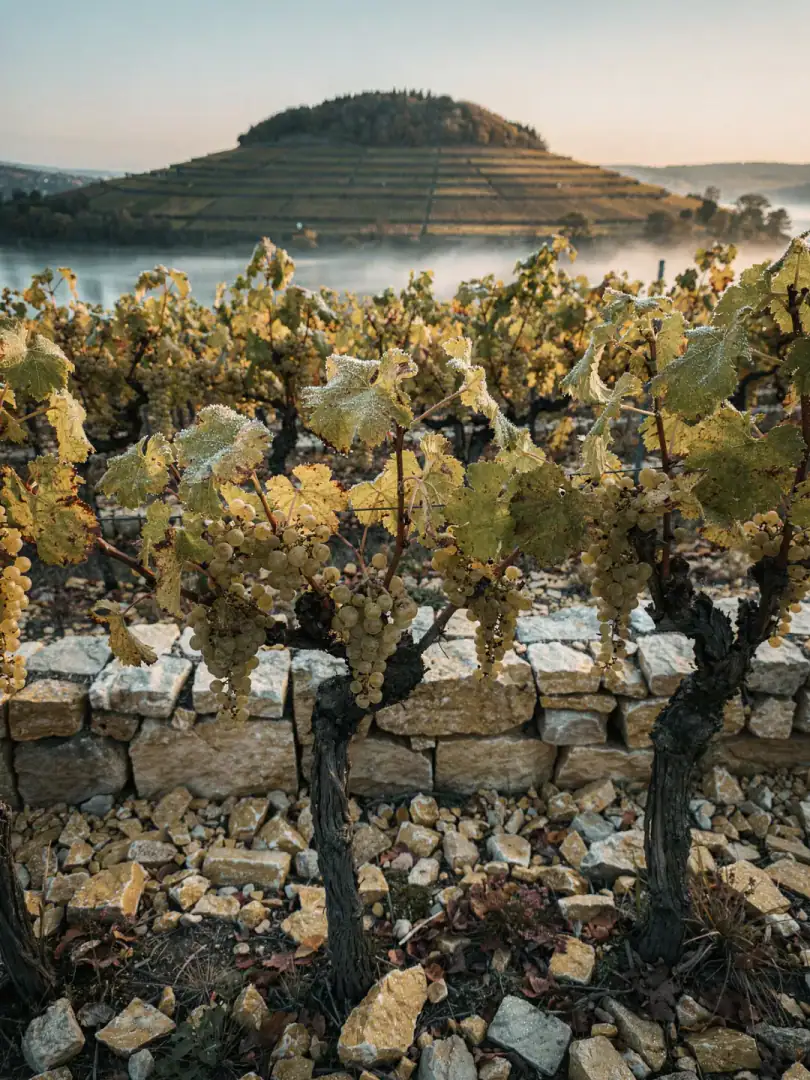
One variety defines Franconia almost as strongly as Sangiovese defines Tuscany: Silvaner. It covers a good quarter of Franconia's vineyard area, more than any other variety. Yet it tastes more restrained than most white varieties — a subtle hint of green apple, sometimes herbs, rarely loud. This very quietness in the glass is considered by many to be its greatest talent.
On April 6, 1659, the Castell noble family planted Germany's first Silvaner vines, then still called Österreicher. From there, the variety spread across all of Franconia. Today it ripens on the limestone soils of the Maindreieck into wines regarded internationally as benchmarks — dense, saline on the finish, yet never lacking in fruit.
Close behind is Müller-Thurgau, at roughly twenty-three percent nearly on par. The variety ripens early, delivers reliable yields, and tastes lightly of muscat and meadow flowers — uncomplicated, but rarely exciting. Bacchus, an aromatic crossing from the twentieth century, follows with roughly twelve percent of the area. It often smells of blackcurrant and freshly cut grass.
Red wine is the exception here, but one with its own distinct character. Domina, bred in 1927 from Portugieser and Spätburgunder, grows almost nowhere else — of the roughly four hundred hectares planted in Germany, over eighty percent are in Franconia. It yields dark, tannic wines with cherry aromas. Spätburgunder itself, the international variety behind Pinot Noir, accounts for just under five percent and thrives best where the soil is sandstone rather than limestone.
Riesling remains a niche player at around five and a half percent. But it flourishes exactly where Silvaner shines: on steep sites like the Escherndorfer Lump. In the end, the statistics paint a clear picture. Around eighty-three percent of all vines in Franconia bear white grapes, and no other German wine region depends so heavily on a single variety as Franconia does on Silvaner.