Sauerbraten & Zwiebelkuchen
Wine & Food
Hearty and often sweet-and-sour, that's how people eat along the Middle Rhine. The wine served alongside needs enough acidity to hold its own. This is no coincidence: in a valley that rarely had meat in abundance, people long preserved, pickled, and sweetened whatever the winter would otherwise have spoiled. The Riesling served with it had to withstand this sweetness and sharpness without disappearing itself.
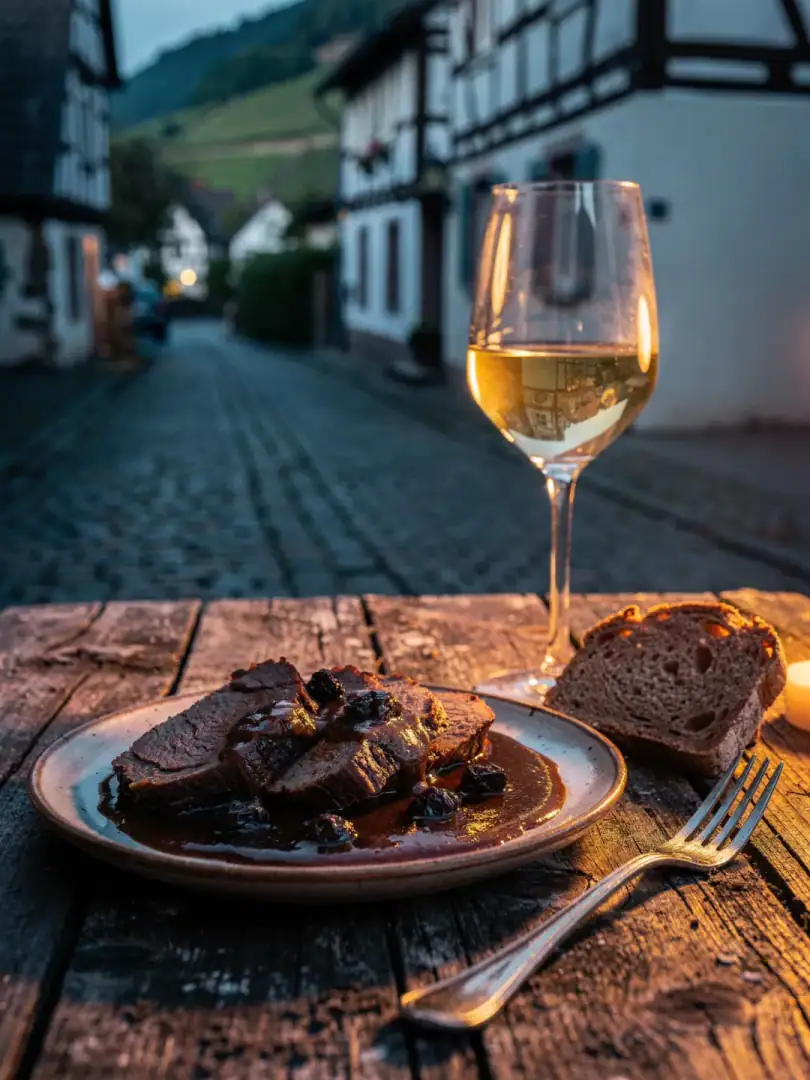
Rheinischer Sauerbraten embodies this like no other dish. The beef marinates for days in vinegar, wine, and spices. The sauce afterward is sweetened with raisins, gingerbread, and sugar beet syrup until sweet and sour become almost impossible to tell apart. A wine that's too soft would get lost in this sauce. An off-dry Riesling with robust acidity holds its ground instead, without being overwhelmed by the sweetness.
In autumn, once the harvest is done, Zwiebelkuchen comes to the table, a hearty yeast-dough tart with fried onions, bacon, and cream. Traditionally, it's paired with Federweißer, the young, still-fermenting grape juice with a noticeable fizz. Those who prefer finished wine reach for a young, dry Kabinett. Its freshness cuts through the richness of the cream just as the carbonation of Federweißer does.
Fish from the Rhine was part of the cuisine in the river towns between Bacharach and Boppard for centuries, fried or braised in white wine sauce. Today the fish rarely comes straight from the river itself. But the preparation has remained the same. A dry Riesling from the Loreley suits pan-fried pike-perch or trout better than almost any other white wine. Its acidity lifts the delicate flesh rather than overwhelming it.
Two rules are enough to navigate the Middle Rhine without going astray. Sweetness and acidity in food demand a wine with at least as much of both, otherwise the wine ends up tasting thin and flat beside it. And lean fish from cool waters almost always pairs with that same lean, cool wine that comes from this very valley and tastes like nowhere else.