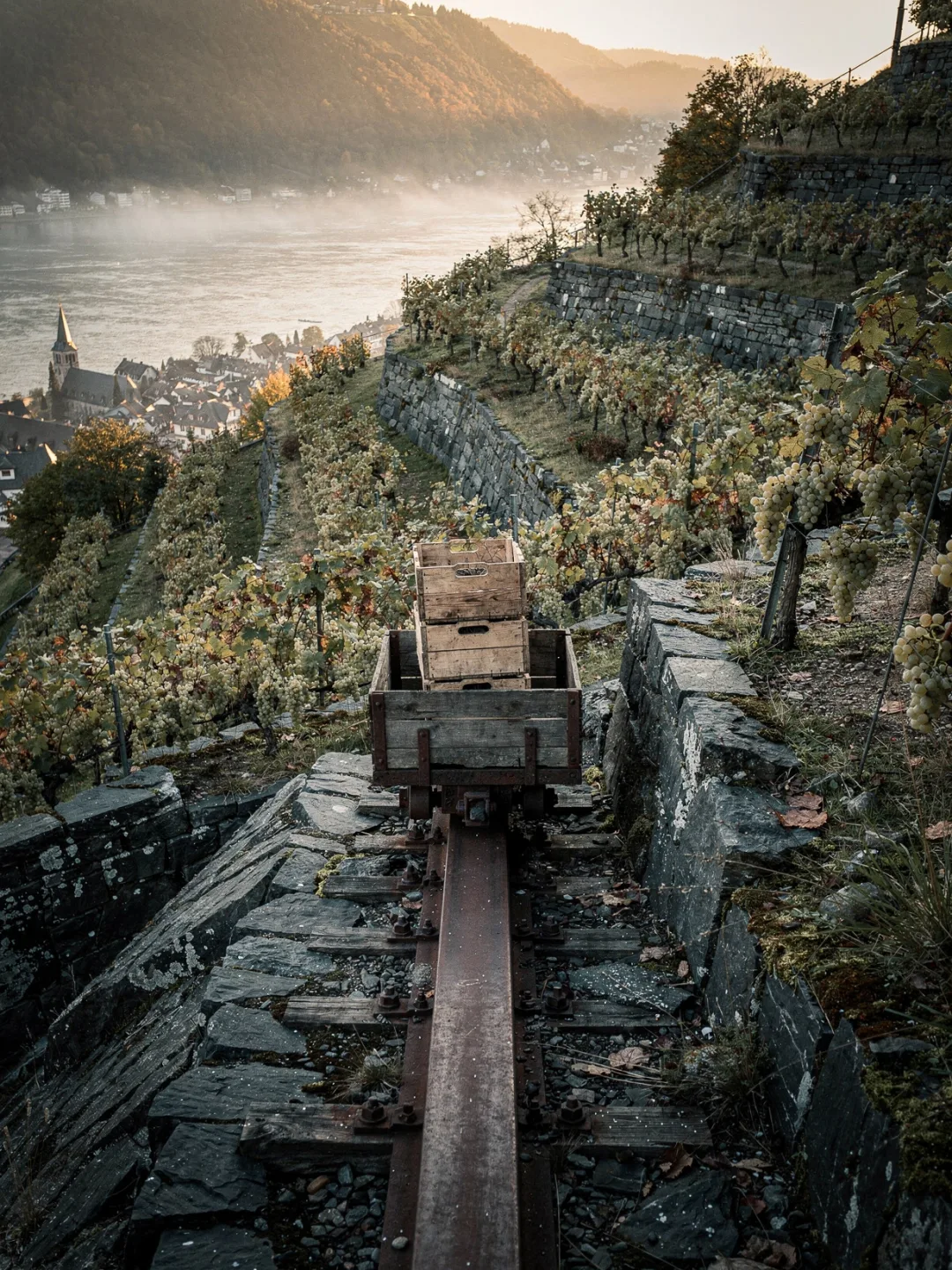
Handwork on the Steep Slopes
Winemaking
Anyone harvesting along the Mittelrhein does it by hand, bucket by bucket, often on slopes with a forty- or fifty-degree incline, as in the Bopparder Hamm. Tractors can't manage these hills. Where funding allows, narrow monorail systems haul the crates up and down the slope, small open rail cars running on a single track. Without them, winegrowers would have to carry every crate of grapes themselves, hundreds of meters of elevation change in a single day.
In the cellar, things run differently than they used to. Whole clusters go gently into the press without prior crushing, so as few bitter compounds as possible pass from the skins into the juice. This stands in stark contrast to the medieval fire wine once cooked over wood embers in Bacharach until the must bubbled. Today everything proceeds cool and slow, at temperatures just above freezing during clarification.
Fermentation itself stretches over weeks, kept cool at fourteen to eighteen degrees Celsius so the delicate fruit aromas don't cook off. Most estates use stainless steel tanks. A few traditional producers still rely on large, old wooden casks, known as Fuder, which release almost no flavor of their own and let the wine breathe only slowly. Both approaches yield Riesling, just with a different idea of how much the cellar should contribute to the wine.
How sweet or dry a wine ends up being is decided even before fermentation begins. Depending on the must weight of the grapes, a wine may be sold as Kabinett, Spätlese, or Auslese, graded by ripeness and sugar content at harvest. A winegrower can halt fermentation early, leaving residual sugar in the wine, or let it run to completion for a fully dry style. Both are traditional along the Mittelrhein, not the exception.
What's allowed on the label today has been governed since May 2024 by EU Regulation 2024/1143, which protects designations of origin like Mittelrhein uniformly across Europe. For the winegrower on the steep slope, this changes little in daily life. Come spring, they're still out on the hillside with a hoe, and come autumn, bucket in hand, just as it has been done here for centuries.