Porphyry & Slate
Soils
Dig a hole anywhere in the middle Nahe, and you'll hit something different from what your neighbor finds a hundred meters away. Over 180 distinct soil types have been mapped between Bingen and Kirn alone, more than in any other German wine region of comparable size. The reason is a volcano. It was active around 270 million years ago, and its remnants still shape the landscape today.
Its most visible legacy is the Rotenfels near Bad Münster am Stein-Ebernburg, a wall of reddish rhyolite, also called quartz porphyry, standing over 200 meters tall — the highest rock face north of the Alps. It's made of solidified lava that once oozed thick and viscous from the earth. As it cooled, it took on its hard, splintering structure. At its base, some of the region's most heat-loving Rieslings grow.
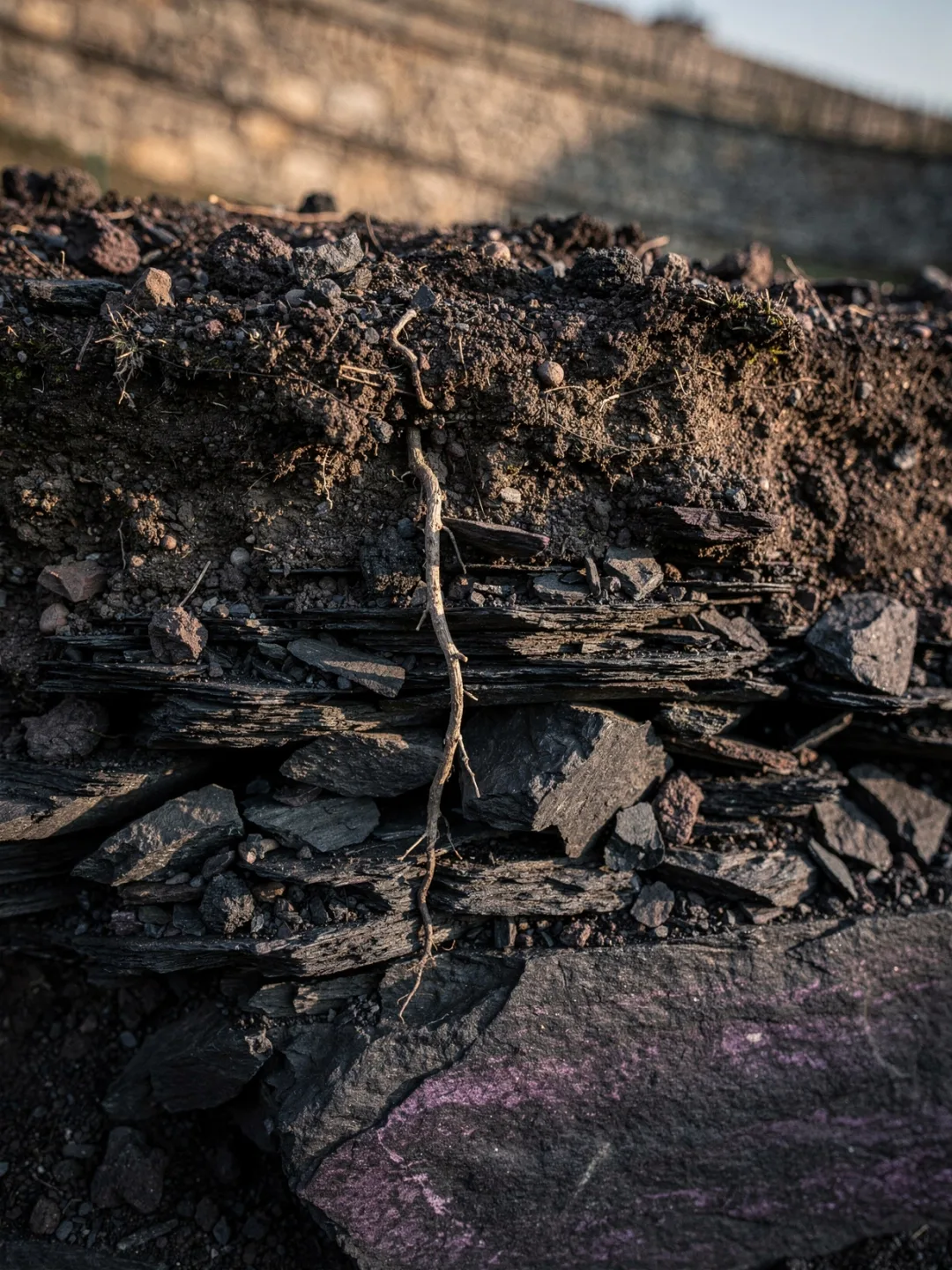
A few kilometers further, near Schlossböckelheim, lies the Kupfergrube. It's named after the copper mine that operated here until 1901. Beneath a thin layer of humus comes weathered melaphyre, a dark volcanic rock, topped by a layer of carbonaceous slate. The vine's roots must work their way through both, finding little nourishment but plenty of warmth, which the dark rock stores by day and releases again at night.
Further downstream, the picture changes entirely. Between Bad Kreuznach and the river's mouth at Bingen, loess, loam, and weathered sandstone sit atop older quartz and slate. These softer soils hold more water and produce rounder, less angular wines. Anyone driving from Schlossböckelheim to Bingen in a single day crosses more geological ages than many a cross-country train ride would.
One misconception refuses to die. It concerns the smoky note many people insist on tasting in wines from the Kupfergrube. The soil itself doesn't flavor the wine — the amounts of dissolved minerals in the juice are far too tiny for that. What actually matters is heat storage, water balance, and how deep the roots must dig: the detour through the rock, not the rock itself.
A thin dark layer of leaf and root remains, barely a hand's width deep on the steep terraced slope of the Kupfergrube.
The root: This is where the fine roots sit, soaking up whatever rare rain arrives.