Monastery & Copper Mine
Region & History
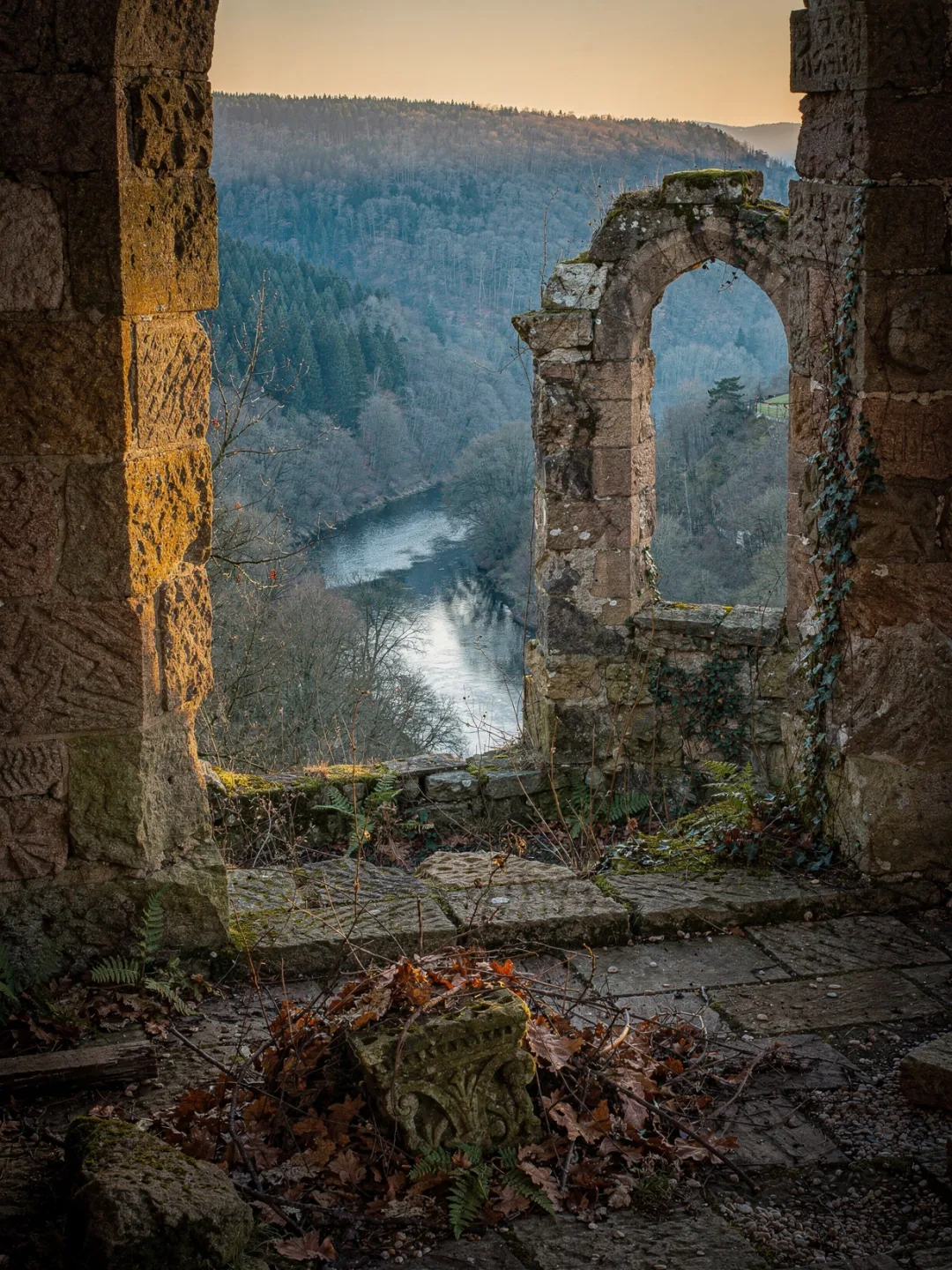
The Romans brought viticulture to the Nahe roughly two thousand years ago. Yet the first written trace is far more recent: a 766 document from Lorsch Abbey mentioning the village of Norheim in connection with vineyards. Four hundred years later a second monastery arrived, perched high above the confluence of the Glan and the Nahe. In 1112, the community on the Disibodenberg took in three young women as recluses, among them the fourteen-year-old Hildegard von Bingen. She stayed for roughly thirty-five years and began writing down her first visions there.
Around 1500, the region's first notable export wine left the valley: Monziger Feuerwein from Monzingen, loaded onto ships bound for the Rhine at the Binger Kran crane. From the same era come what are probably Germany's oldest surviving vines, discovered by chance on a steep slope near Odernheim am Glan. Nobody had even known they were missing. Testing revealed the rare Weißer Orléans variety, estimated to be several hundred years old.
Things turned political again in 1520 at Ebernburg Castle near Bad Münster am Stein. The knight Franz von Sickingen opened his castle to early followers of Martin Luther, among them the humanist Ulrich von Hutten, who called it the 'Refuge of Justice.' Sickingen even offered Luther shelter on his way to the Diet of Worms in 1521. Luther went on to the Wartburg instead, but the name stuck to the castle above the Nahe.
The next upheaval came from mining rather than politics: copper was extracted near Schlossböckelheim until 1901. Then the newly founded Prussian State Domaine Niederhausen-Schlossböckelheim took over the site and, through painstaking manual labor, turned it into terraces. In 1921, the effort paid off. The Kupfergrube vineyard yielded a Trockenbeerenauslese at 308 degrees Oechsle, more than double what's required for the highest Prädikat level. The site was famous overnight.
Even so, Nahe wine was sold under a borrowed name for another fifty years, officially as Rhine wine. It wasn't until the 1971 wine law that the Nahe became its own designated wine region. Since then, the rise of estates like Dönnhoff in Oberhausen an der Nahe has been chronicled steadily in the wine press. What was once a footnote has become one of Germany's most densely concentrated regions for top vineyard sites.