Terraces & Prädikat
Production
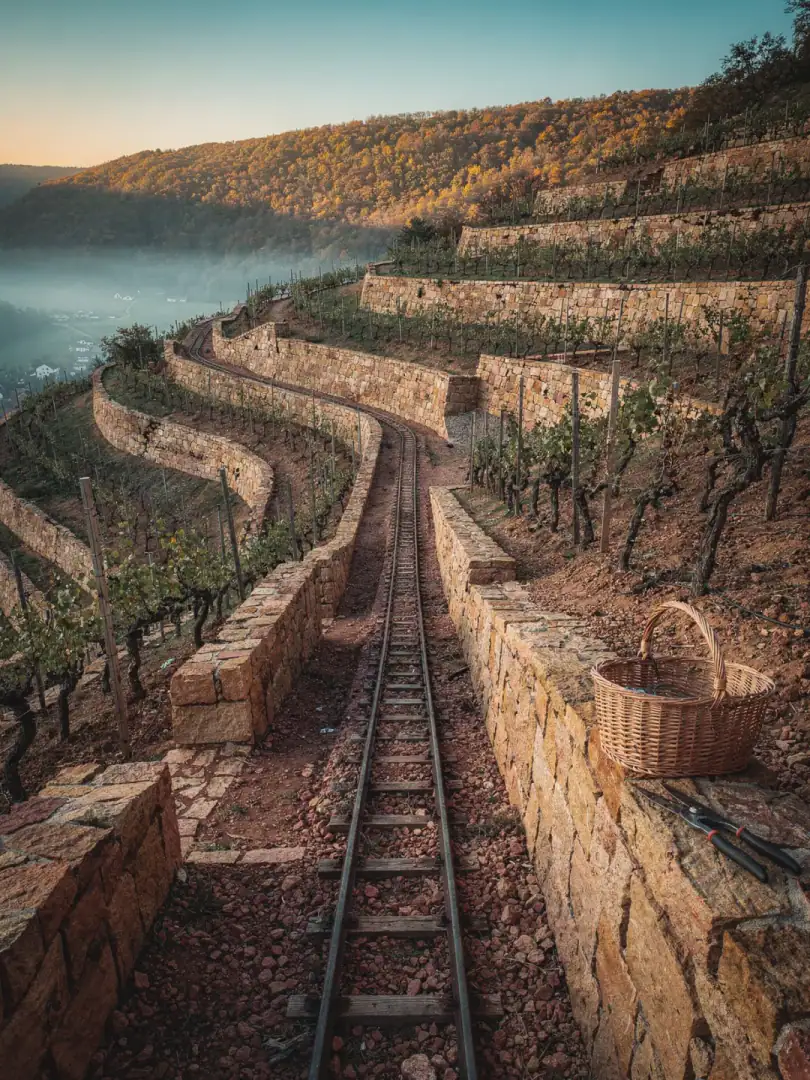
Steep slopes like the Kupfergrube near Schlossböckelheim can't simply be planted. After the copper mine closed in 1901, it took decades of hard manual labor to shape the rugged terrain into terraces. To this day, no tractor can drive on them. Almost everything there is still done by hand, from pruning to harvest, because there's no alternative.
Harvesting usually happens in multiple passes. Go through the rows only once, and you'll miss either the crisp, acid-driven grapes needed for a dry Kabinett or the overripe, raisined berries needed for an Auslese. Both often hang on the very same vine, just weeks apart, and experience alone determines when each branch gets cut.
In the cellar, Riesling is largely left to its own devices. Fermentation takes place in stainless steel tanks at cool, controlled temperatures, sometimes supplemented by old large wooden casks known as Fuder, holding around a thousand liters, which impart barely any flavor and let the wine breathe only slowly. Small new barriques, familiar from Bordeaux, are almost never seen on the Nahe. They would bury Riesling's delicate fruit under vanilla and toast.
Presiding over all of this is Germany's Prädikat system, measured in degrees Oechsle, named after the physical weight of the grape must. Kabinett marks the lowest level, followed by Spätlese and Auslese with increasing must weight. A Trockenbeerenauslese requires at least 150 degrees. The 308 degrees of the legendary 1921 Kupfergrube remain an exception to this day, one every vintage since has been measured against.
Alongside this, many top sites now bottle dry wines as Grosses Gewächs, harvested by hand. They're released only in September after harvest, a full year later than a simple Kabinett. Between these two worlds — the historical Prädikat with residual sweetness and the modern dry top wine — must weight alone has long since stopped being the deciding factor on the Nahe. What decides it now is the site, and the style the winemaker chooses to draw from it.