Shell limestone & dry-stone walls
Soils
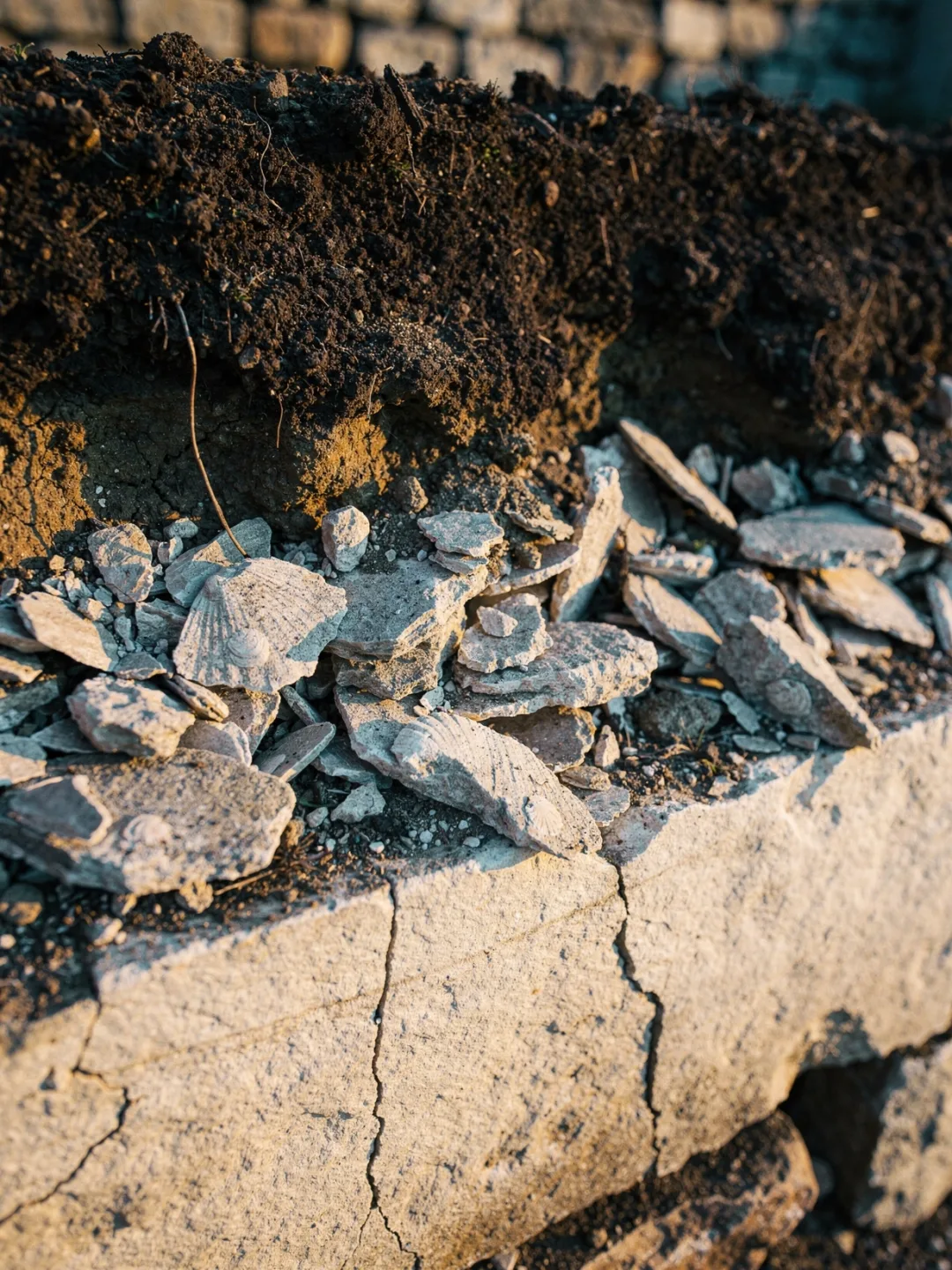
Dig a hole in a vineyard near Freyburg and you'll soon hit rock. Beneath a thin layer of topsoil lies broken, pale gray limestone in thick slabs — shell limestone, the rock that gives the slopes of Saale and Unstrut their character.
The shell limestone formed roughly 240 million years ago at the bottom of a shallow sea that once covered central Germany. The shells of countless mussels and microorganisms settled and compacted into rock, and when the sea eventually retreated, it left behind a massive limestone layer that now forms the region's steep slopes. It's ancient stuff.
For a vine's roots, this is tough going. They push through cracks and fissures, finding little nutrient and even less water there, and so they dig deep — exactly the effort that produces a wine with structure rather than mere sweetness. Not every root manages it. Where the rock is too solid, only a thin layer of soil remains, and that's exactly where winegrowers prefer to plant.
Alongside the shell limestone, two other soils appear in the region. Bunter sandstone, a reddish, softer rock, shows up mainly along the Unstrut and retains more water than the limestone. It's the exception. Loess loam fills the flatter sites and yields sturdier but also more ordinary wines; the best sites are almost always reserved for shell limestone.
Because the slopes are so steep, the soil couldn't simply be planted as is. For centuries, winegrowers have stacked dry-stone walls from that same shell limestone, without mortar, stone upon stone, creating narrow terraces just wide enough for a rake to fit. Pure handwork. At Freyburg's Schweigenberg alone, roughly ten kilometers of such walls still stand today, along with about ninety small vineyard cottages.
One myth persists stubbornly here too: that the limestone's flavor carries through into the wine. That's not quite true — minerals travel through the roots only in minuscule traces, far too little to actually taste. What shell limestone really delivers is warmth, which it stores during the day and releases again at night, plus a root system forced to fight for every drop of water. It's this detour that shapes the wine, not the rock itself.
A thin, dark layer of decomposed leaves and root remains, rarely more than a hand's width deep on the steep terraces.
The root: This is where the fine roots sit. They draw up whatever the scarce rain has just delivered — and are the first to dry out.