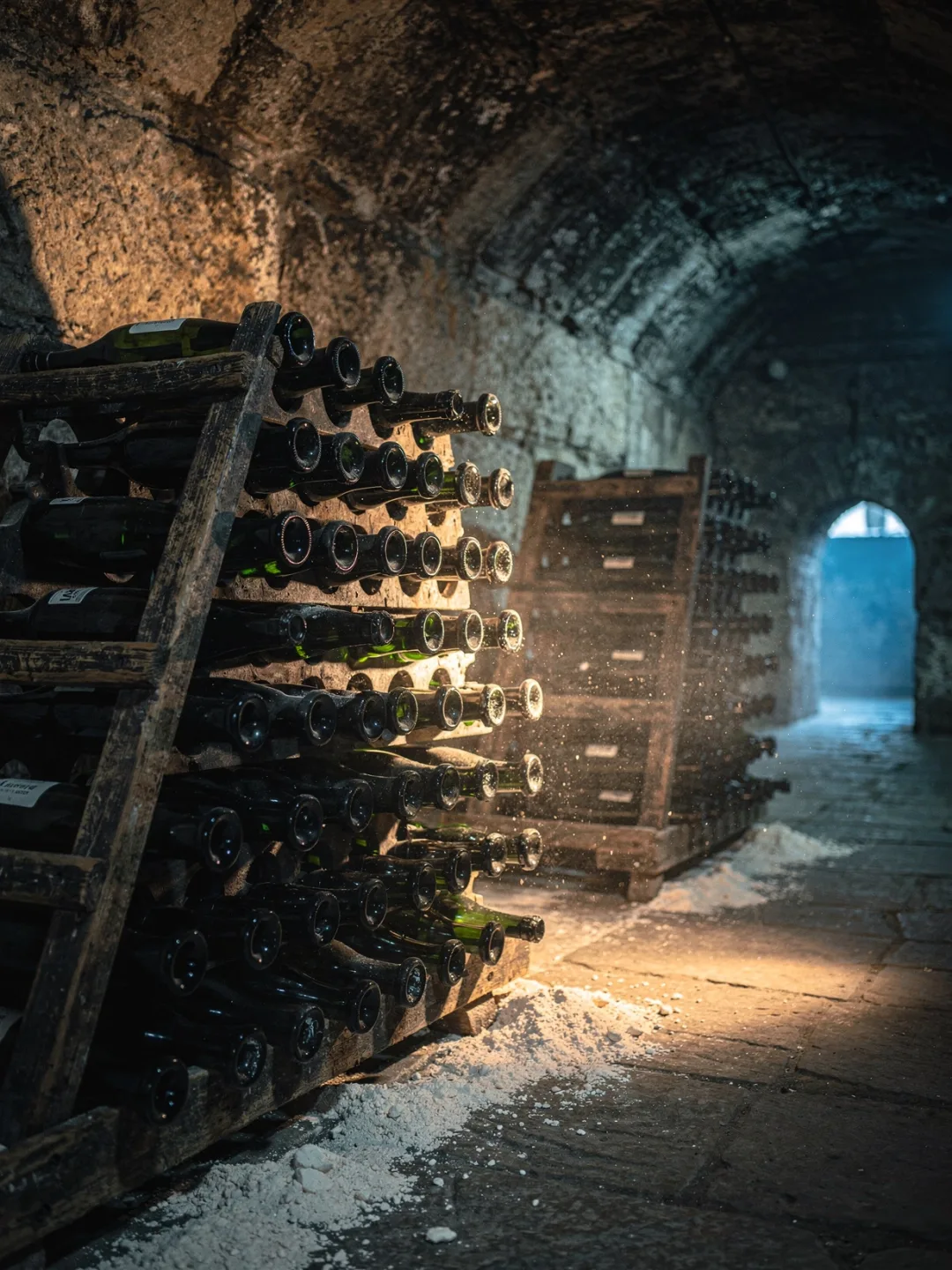
Terraces & bottle fermentation
Production
The steep terraces of Saale and Unstrut can't be harvested by machine. Machines simply can't get through. Where a dry-stone wall carries the next step every few meters, only hands will do — bucket by bucket, often carried up narrow stone steps between the walls. For this reason alone, a wine from here demands far more labor hours than a comparable one from flat land.
In the cellar, nearly everyone follows the same idea: cool and fast. Most winegrowers ferment their must at low temperatures in stainless steel tanks, because heat destroys the delicate apple and citrus aromas of Müller-Thurgau or Pinot Blanc before they ever reach the glass. This protects the aroma. Oak barrels remain the exception, reserved for a handful of more powerful red wines.
Sparkling wine has its own story here. In 1856, the Kloss brothers and their friend Carl Foerster founded a wine merchant house in Freyburg that would later become Rotkäppchen, today one of Germany's largest sparkling wine producers. It happened at breakneck speed. By 1867, just ten years later, the local winegrowers' wine alone was no longer enough to meet demand.
Classic sparkling wine undergoes a second fermentation in the bottle, which is where the carbonation that later forms the bubbles comes from. Rotkäppchen developed its own approach from this: the wine ferments in the bottle but is then transferred under pressure into a tank, filtered, and rebottled — faster than the classic method with its hand-riddling, but yielding the same fine, persistent bubbles. The result holds up regardless.
With still wine, it's ultimately the must weight that determines the quality level on the label — Kabinett, Spätlese, or one of the higher Prädikat tiers — depending on how much sugar the grapes had accumulated by harvest. This is no mere formality. In a region as cool as Saale-Unstrut, even a simple Kabinett wine is a small achievement, not a consolation prize.