Three plus Bacchus
Grape Varieties
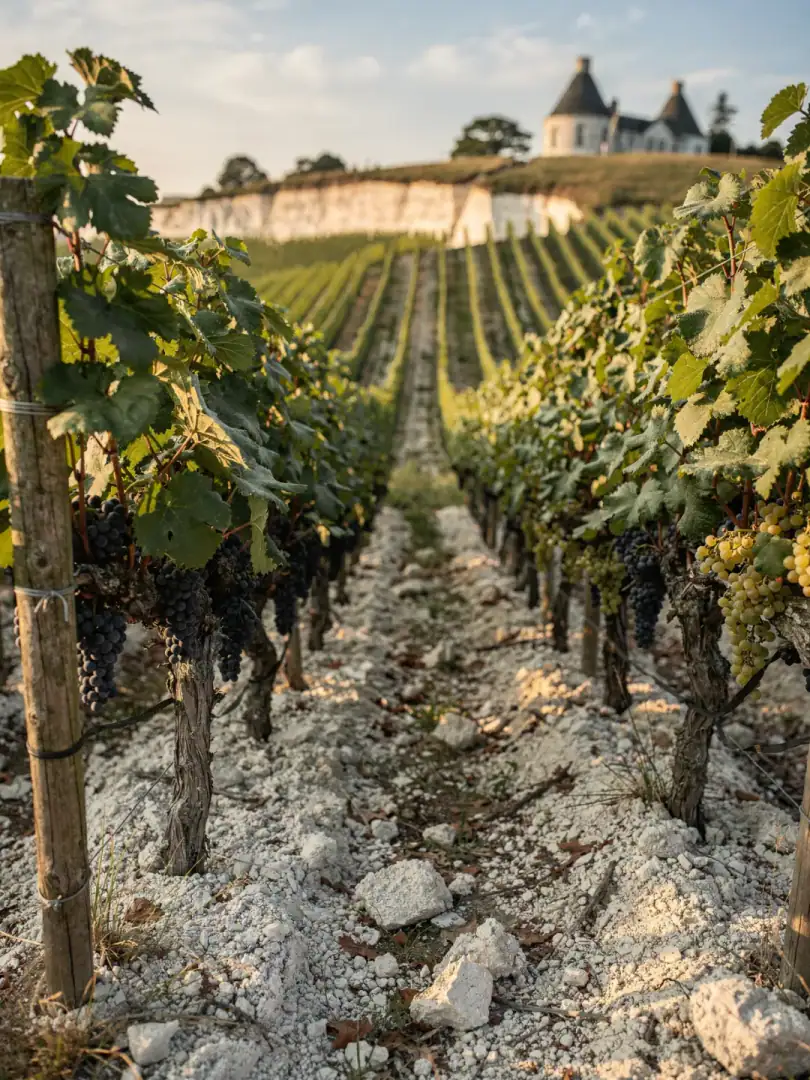
Anyone with a glass of Kentish Sparkling in hand is drinking almost the same trio as in Champagne, since on Kent's chalk soils Chardonnay, Pinot Noir and Pinot Meunier ripen late and unusually sparingly. That very scarcity pays off. Small berries press more acidity and aroma into every sip, giving rise to the fine perlage that English winemakers confidently compare with their French role models. Pinot Meunier still carries a second name here: Schwarzriesling, after its German origin.
Among the still wines, the stage belongs almost entirely to a single grape: Bacchus. Bred in Germany in 1933 from Riesling, Müller-Thurgau and Silvaner, for cool, difficult sites. There it long remained a wallflower with plenty of sugar and little acidity, while in the considerably cooler Kent it became something of a star. The acidity stays high. The scent of elderflower and gooseberry comes across as almost perfumed, which is why many connoisseurs now call the wine England's answer to Sauvignon Blanc.
Kent's early winemakers, by contrast, relied on hardier, older varieties. The Barnes family in Biddenden, for instance, put their faith in Ortega, a variety bred to ripen extremely early and still deliver reliable sugar levels even in wet, cool years. That is why Ortega still makes up half of Biddenden's vines today. Seyval Blanc also belongs to this older stock, a fungus-resistant hybrid with no pure Vitis vinifera parentage at all.
For England's highest wine tier, however, such robust hybrids don't count. Only six grape varieties are permitted there: Chardonnay, Pinot Noir, Pinot Meunier, Pinot Noir Précoce, Pinot Blanc and Pinot Gris. Seyval Blanc and Ortega are confined to the more open, regional tier, which allows almost ninety varieties and only requires that eighty-five percent of the grapes genuinely come from the named area. Two sets of rules for one county. Both tell the story of just how differently Kent makes its wine.