Gamay in Exile
Region & History
On 31 July 1395, Philip the Bold, Duke of Burgundy, signed a decree that banished an entire grape variety from his duchy. He called Gamay a "very bad and very disloyal plant" and had it uprooted wherever it grew. The wine made from it, the decree claimed, made people sick — an accusation that sounds like an excuse today. In truth, it was about something else entirely: Gamay yielded far more than the delicate Pinot Noir the Duke loved.
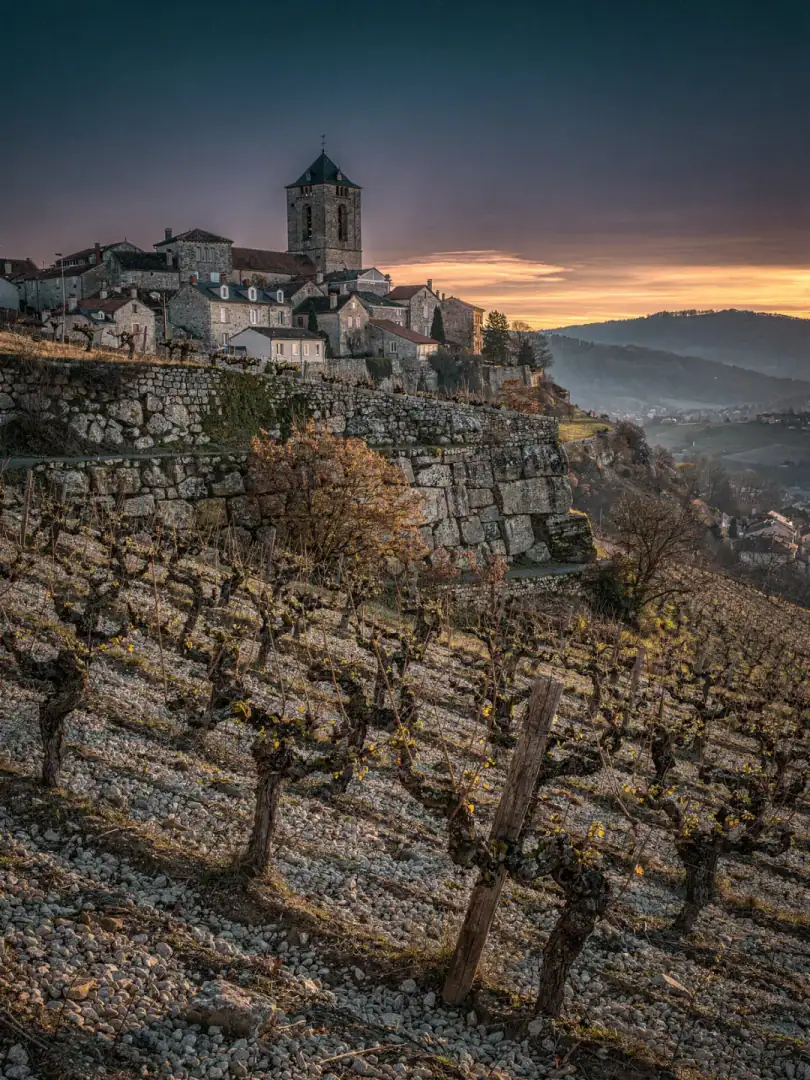
Those who are driven out seek a new home, and Gamay found one just a few kilometers south, on the granite below Mâcon. There began the story of Beaujolais as a wine region in its own right. It owes its name to the Sires de Beaujeu, a noble family from the hilltop town of the same name, which lost its status as chief town to Villefranche-sur-Saône in the 16th century — a town right on the river, and thus closer to Lyon and its buyers.
Lyon was the reason Beaujolais grew at all. The Saône carried the barrels downstream to a city that ate and drank like almost nowhere else, even then. The writer Léon Daudet later summed it up in a single sentence: Lyon, he wrote, is crossed by three great rivers — the Rhône, the Saône, and Beaujolais. Not a river in the geographical sense, but a stream that never ran dry.
All of this only became official quite late. The Beaujolais appellation was created by decree on 12 September 1937, and the ten crus were added one by one between 1936 and 1988, Régnié being the last. In between falls the event that made the region world-famous. In 1951, the winemakers won an exemption from the law that banned the sale of new wines before 15 December. Almost as a side effect, they created Beaujolais Nouveau, whose release date was fixed from 1985 onward: always the third Thursday in November.
A man from Romanèche-Thorins turned it into a global event. Georges Duboeuf, soon nicknamed the "King of Beaujolais," flew to New York in the 1970s with the first cases and threw a party there that, within ten years, had spread to Tokyo and Sydney as well. That success nearly proved the region's undoing. When demand collapsed after 1999, sales and volume halved within a decade, roughly a tenth of the vineyard area was grubbed up, and many winemakers gave up. Anyone drinking Beaujolais today is mostly drinking what survived that crisis: smaller estates betting on the ten crus rather than the quick November celebration.