Gamay, With Little Competition
Grape Varieties
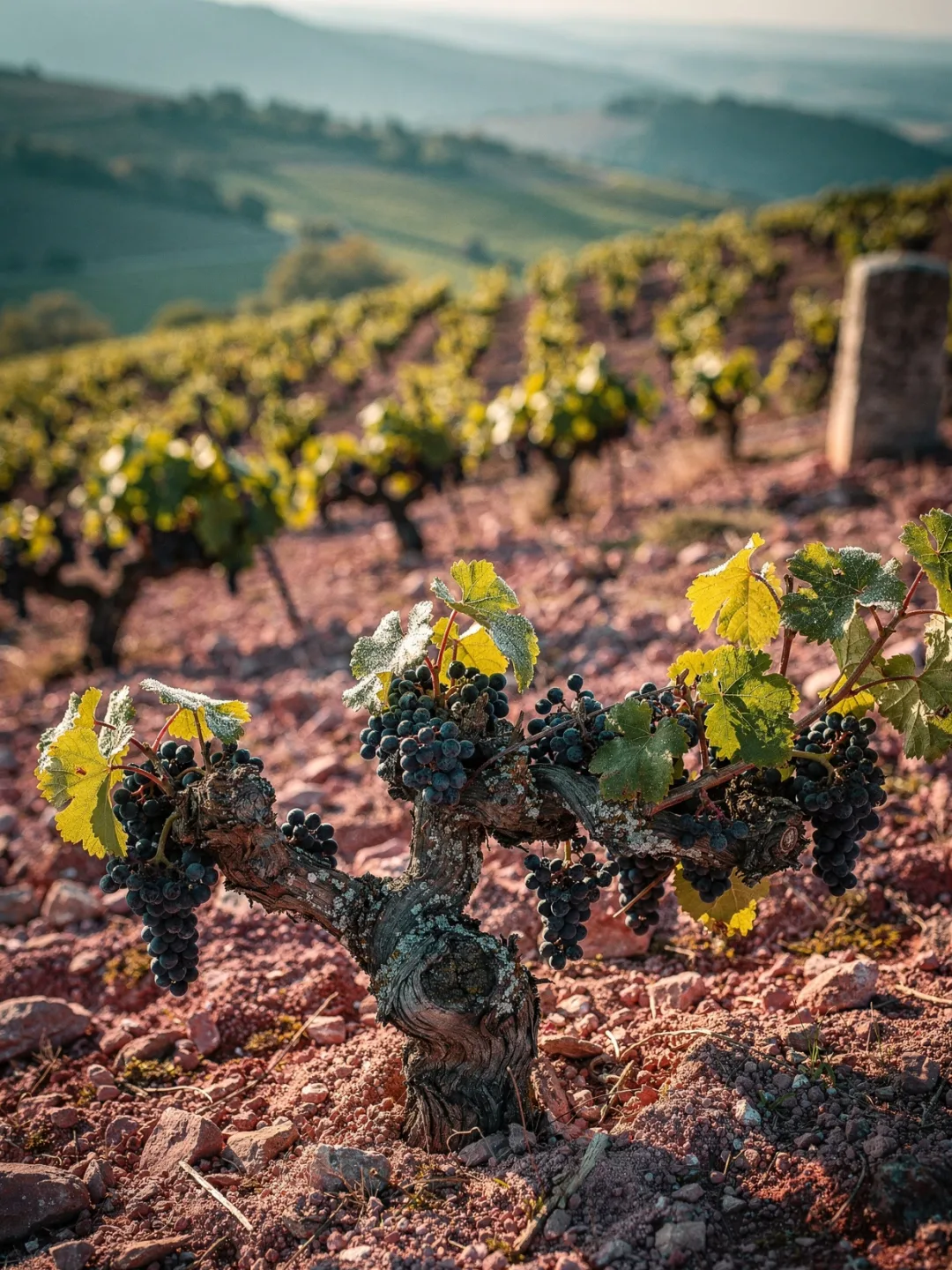
A single grape variety carries almost all of Beaujolais: Gamay. Its full name is Gamay Noir à Jus Blanc. Black skin, but juice that stays colorless, as with almost all red grapes — which makes it the ideal candidate for a method that shapes the whole region, explained in more detail in the Winemaking section. Its skin is thin. It buds early and ripens just as early. An advantage in the cool north, a risk with any late frost.
In 1999, a DNA test settled an old family mystery. Carole Meredith and John Bowers of the University of California, Davis, showed that Gamay descends from a cross between Pinot Noir and an almost forgotten variety called Gouais Blanc, which also gave rise to Chardonnay, Aligoté, and Melon de Bourgogne. Genetically speaking, Gamay and Chardonnay are half-siblings. Anyone tasting a white Chardonnay alongside a red Gamay in Beaujolais is drinking two children of the same family.
Even so, Gamay doesn't stand entirely alone. The appellation rules allow Chardonnay, Aligoté, Melon, Pinot Gris, and even a little Pinot Noir as a blending component, though together no more than fifteen percent of a plot, and only if the vines were already planted there beforehand. There are also two rare relatives with red rather than white juice: Gamay de Bouze and Gamay de Chaudenay. Their share is capped even lower, at ten percent. For white wine, a stricter rule applies: pure Chardonnay, nothing else.
What makes this one variety so special only becomes clear when comparing the ten crus. On the granite of Moulin-à-Vent, that same Gamay turns into a firm, slow-maturing wine. In Chiroubles, by contrast, higher up and cooler, it stays light and fragrant. No other French region lets a single grape variety show so many different characters on so little land — which is exactly why it's worth learning the crus individually rather than treating Beaujolais as a single answer.