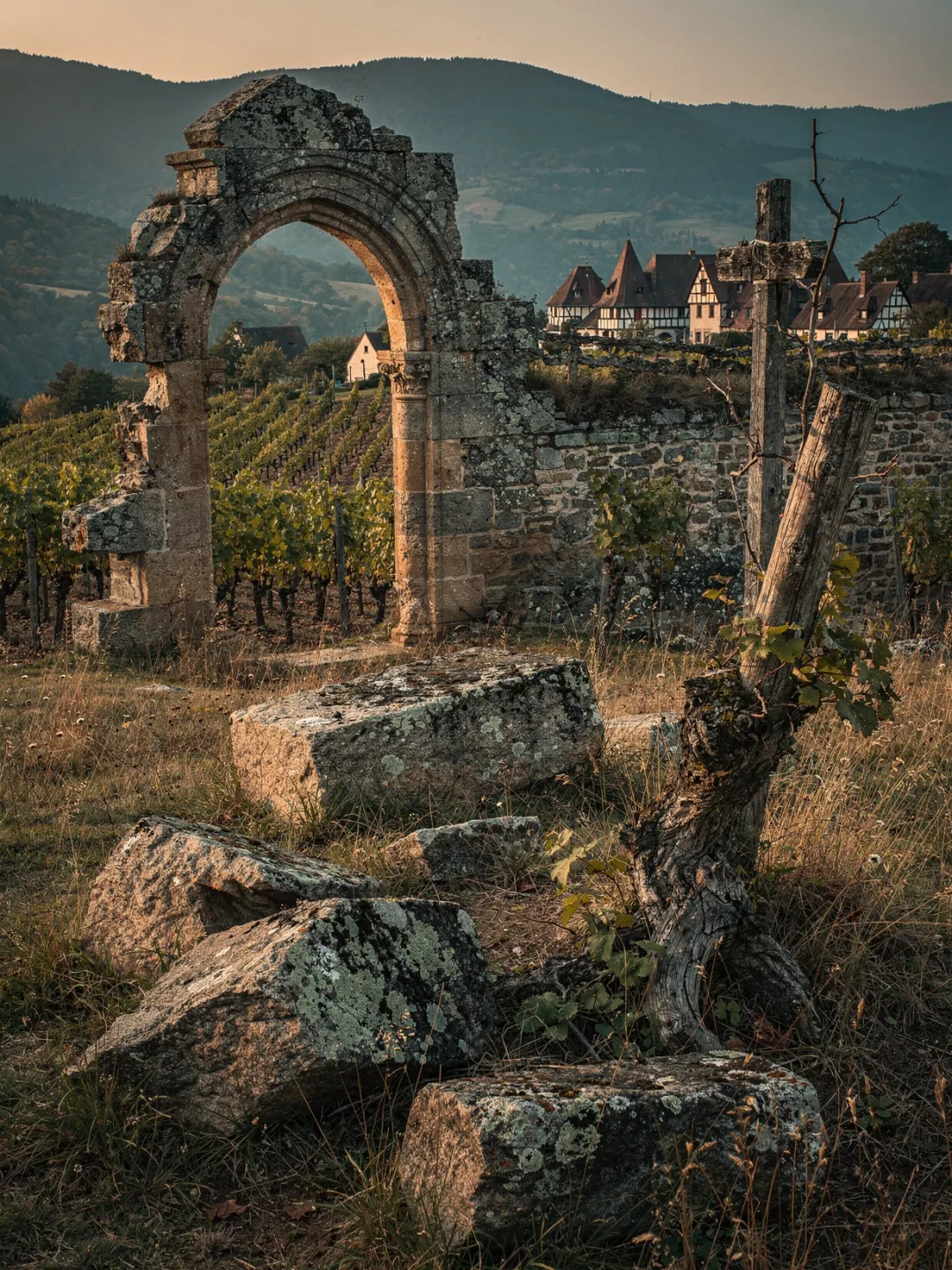
Monastery, war, shifting borders
Region & History
The vines arrived with the Romans. In the second century AD, settlers planted the first vineyards at the foot of the Vosges, as excavations along the old Rhine road confirm. From the third century on, they cleared entire slopes, systematically and on a large scale. That became a tradition that would not break for two thousand years.
Then came the monks. After the fall of Rome, monasteries took over the work, tended the vineyards, and kept records of every harvest. They sent their wine down the Rhine, and by the ninth century it had already reached the Netherlands, Switzerland, and German princely courts. Its reputation kept growing. Between 1200 and 1600, Alsatian wine enjoyed a standing across Europe that's hard to imagine today, shipped as far as Scandinavia and England, traded alongside the finest wines of the Rhine.
Then came the Thirty Years' War. Between 1618 and 1648, fighting and plague emptied entire villages throughout Alsace. Those who survived replanted out of sheer necessity, no longer on the steep, lean slopes but down in the fertile plain. There, each vine yields more grapes. Quality took centuries to recover from that shift.
And then the border, which changed four times. In 1871, after the war against France, Alsace fell to the new German Empire; in 1919 it returned to France; in 1940 Nazi Germany annexed it again; and in 1945 it became French for good. Four changes of nationality in seventy-four years. In the middle of all this, around 1900, phylloxera destroyed nearly the entire vineyard. What remained was a habit from the German side of the border: writing the grape variety on the label, where the rest of France names the place instead.
Reconstruction only began after 1945. On November 2 of that year, a decree created the designation "Vin d'Alsace," and by 1962 it had become a full Appellation d'Origine Contrôlée. In 1953, the Issenheim tourist office founded the Route des Vins d'Alsace during a car rally, a hundred and seventy kilometers from Marlenheim to Thann through more than a hundred wine villages such as Riquewihr and Kaysersberg. Colmar has remained its unofficial capital ever since.