Riesling & Co.
Grape Varieties
Alsace puts the grape variety's name on the label. Elsewhere in France, the vineyard site counts; here, the grape does, a habit left over from the decades under German administration that persisted even though the border has run through French territory again since 1945. Only single-variety wines may bear that name. A blend of several grapes is called Edelzwicker, or, if it contains at least half Riesling, Muscat, Pinot Gris, and Gewürztraminer combined, Gentil.
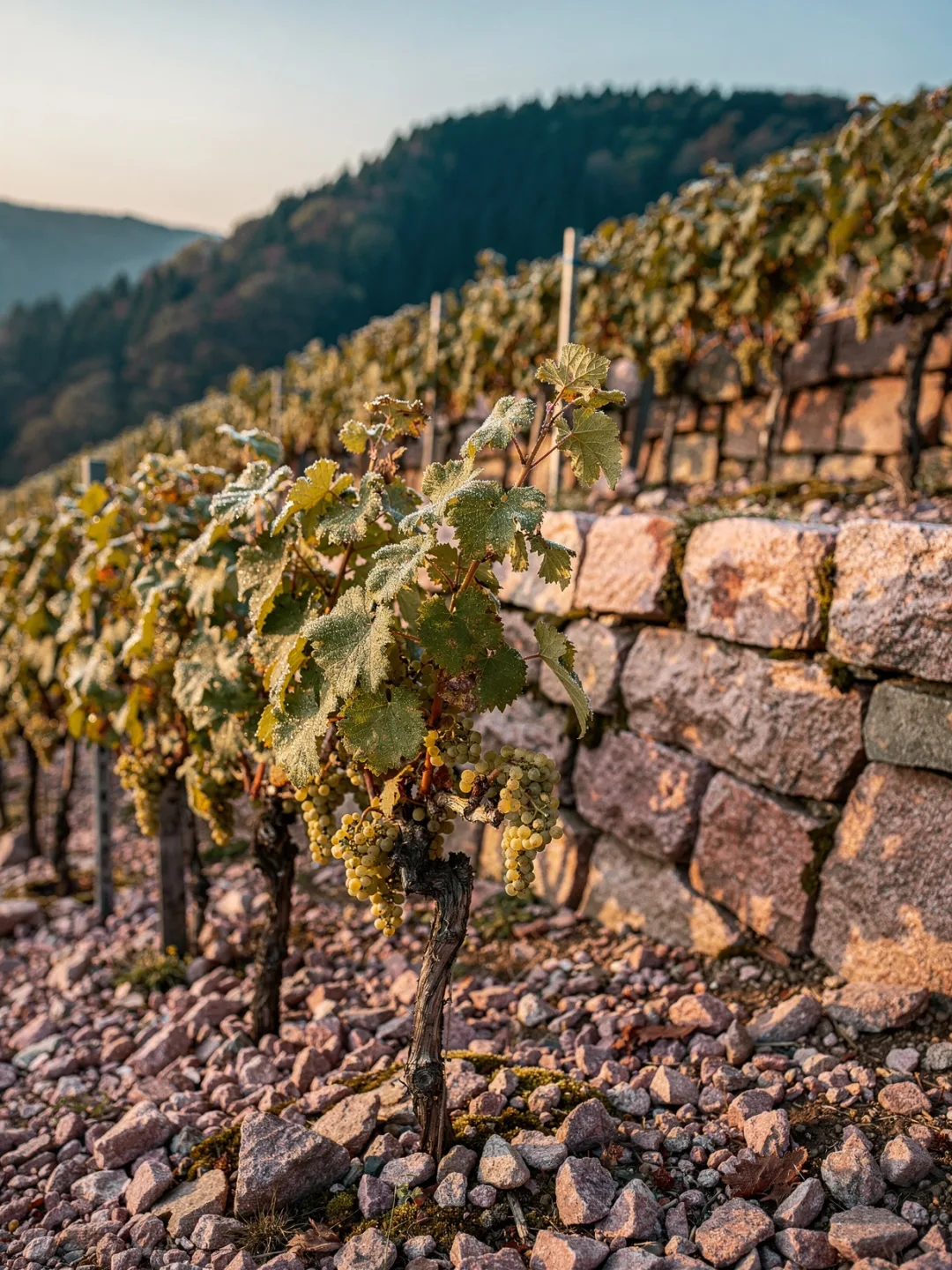
Riesling comes first. It now covers twenty-two percent of the vineyard area, almost double what it was in 1969, and demands the steepest, leanest slopes of granite or schist at the foot of the Vosges. Its acidity is high. Its aroma recalls lemon and stone, and a good Riesling from a Grand Cru can age twenty years and beyond.
Gewürztraminer works quite differently. Its acidity is low, but its aroma is impossible to miss: rose petals, lychee, sometimes ginger, at an intensity no other variety in Alsace reaches. It used to be called simply Traminer. The word for "spice" was added later, precisely to emphasize that spiciness, and to this day it's nearly unbeatable alongside a strong Munster cheese.
Until 2007, Pinot Gris carried the addition "Tokay." The name sounded like Hungary's Tokaji, and when Hungary joined the EU in 2004, it secured that name for itself alone; within three years Alsace had to drop it. The wine itself stayed the same: full-bodied, with notes of smoke and honey.
Muscat is a special case. It smells more unmistakably of fresh grapes than any other wine, yet tastes bone dry, and anyone expecting sweetness after the first sip is surprised every time. It usually appears as an aperitif before the meal rather than alongside it.
Two names are barely known outside the region. Klevener de Heiligenstein grows in only five villages around Heiligenstein, ever since a mayor brought the variety from Tyrol in 1742, under its true name, Savagnin Rose. And Pinot Noir, the only red variety in Alsace, was only permitted in two Grand Crus, Hengst and Kirchberg de Barr, starting with the 2022 harvest.