Comté & Morilles
Wine & Food
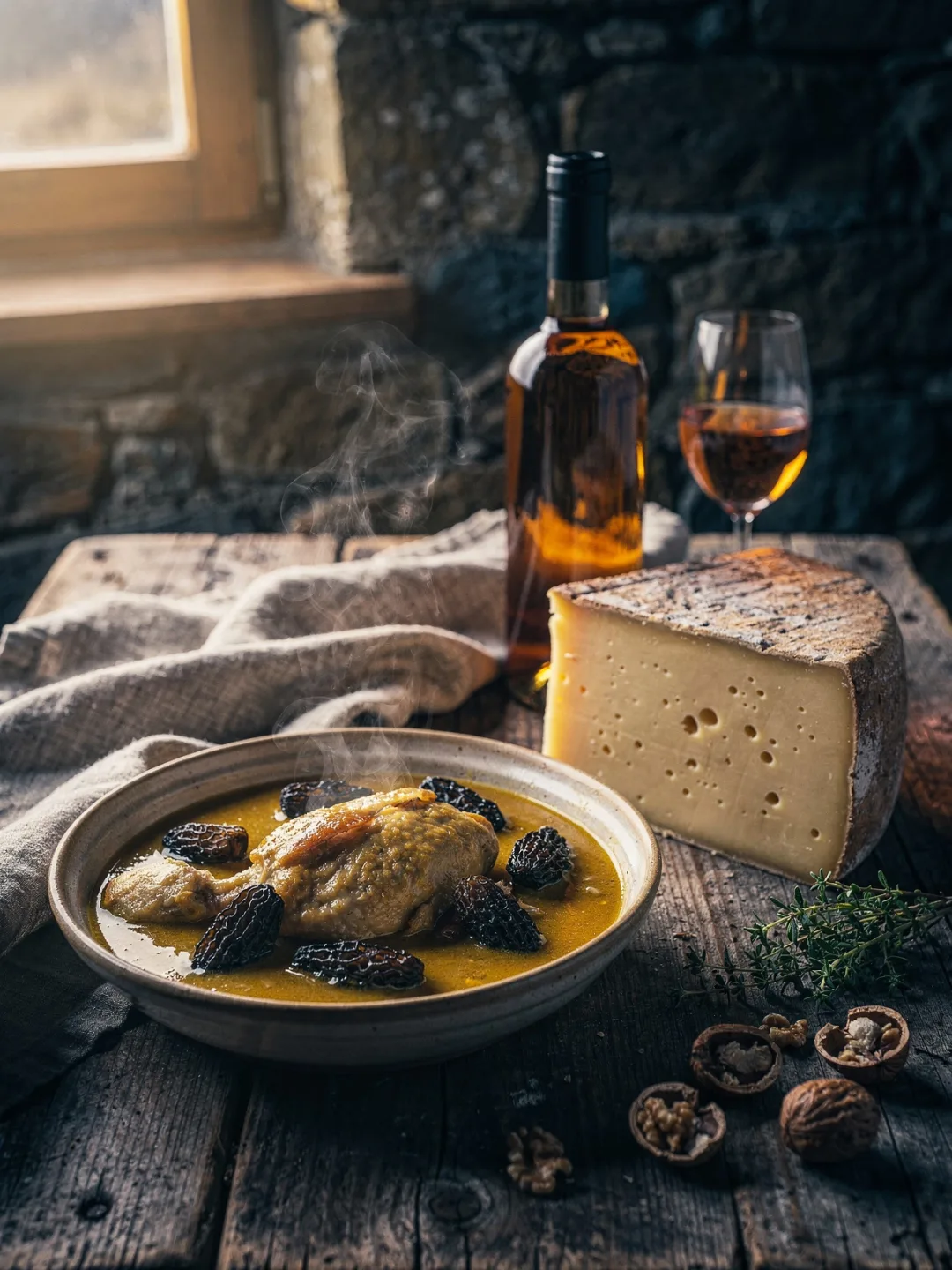
The Jura's most famous dish is almost a statement in itself: Poulet au Vin Jaune et aux Morilles. Chicken in a sauce of cream, Vin Jaune, and morels. The sauce is cooked with the same wine that later sits in the glass. As a result, curry notes and walnut aromas meet twice on the plate, once in the sauce, once in the wine.
This works because morels naturally carry an earthy, slightly nutty tone that heads in exactly the direction Vin Jaune already leans. A regular white wine would seem thin next to this dish. A powerful red wine would overwhelm the morels.
Cheese belongs at the Jura table at least as naturally as wine, and it's usually Comté. It ages further in around one hundred fifty small village dairies across the Jura massif, the so-called fruitières, often for months in cellars built specifically for the purpose. The longer a Comté ages, twelve, eighteen, sometimes twenty-four months, the more it develops toasted and nutty notes of its own. These merge with a Vin Jaune into almost a single flavor.
Different rules apply to the red wines. A light, cool-served Poulsard pairs with cured meats and pale meats, because its fine acidity doesn't have to compete with a heavy sauce. Trousseau, on the other hand, denser and more tannic, calls for grilled dishes or game and holds its own alongside a mature Morbier, another cheese from the same mountain region.
And finally, Vin de Paille, honey-sweet and concentrated enough to stand up even to mature blue cheese, rather than being reserved for dessert alone. In the Jura, a meal rarely ends with something sweet alone. Most often, it ends with another glass.