Nuns to Pasteur
Region & History
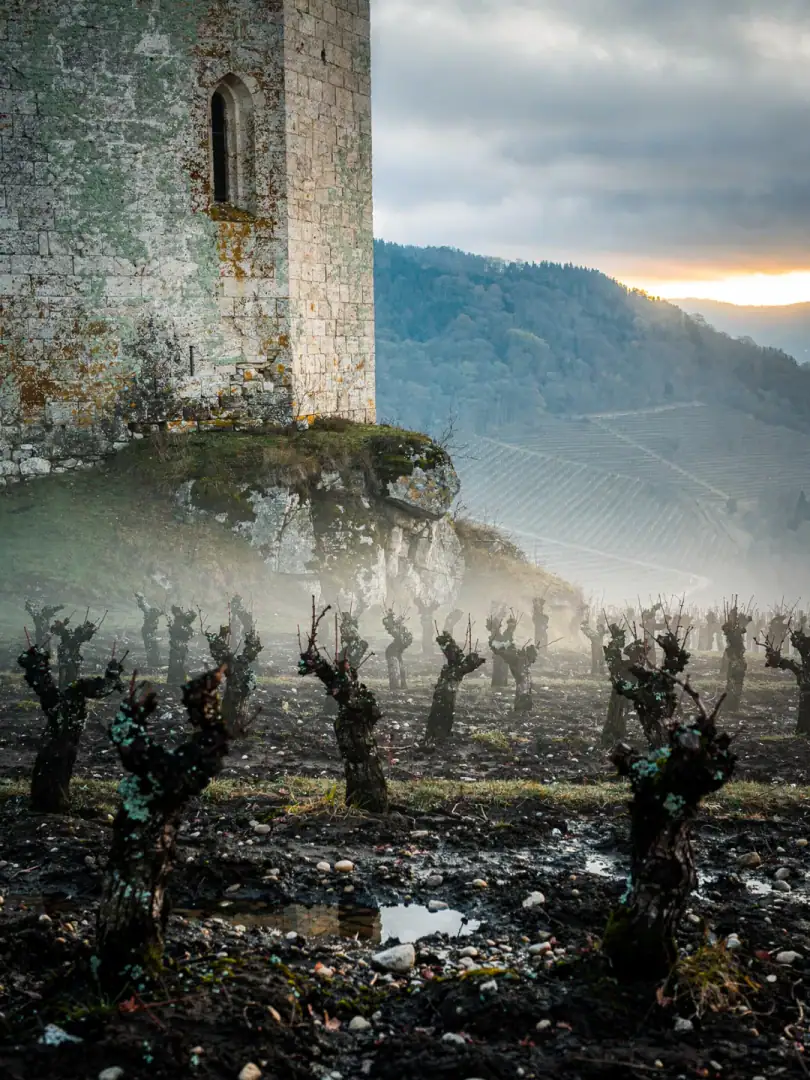
An abbey stood at the beginning, not a winery. The Benedictine nuns of Château-Chalon farmed the slopes above their convent in the Middle Ages, documented as early as 869, and planted a grape variety that almost no one else knew: Savagnin. Without realizing it, they laid the foundation for Vin Jaune, France's rarest and most expensive white wine.
That wine from Arbois became famous early on was thanks to powerful guests. In 1285, the Count of Chiny served his knights Arbois wine at the Tournament of Chauvency, and in the same century King Philip the Fair brought it to the court in Paris. A country wine from the Jura at the table of the crown: no small feat.
Six hundred years later, another visitor arrived, this time from science. In 1863, Napoleon III sent the chemist Louis Pasteur to Arbois, where he had grown up, to find out why wine could turn sour, oily, or bitter. Pasteur set up a laboratory in an old café and found the answer: microorganisms. Every wine disease had its own pathogen. Briefly heating the wine to fifty or sixty degrees killed it off without destroying the flavor. For this process, later named after him, he received the Grand Prix at the World's Fair in 1867.
The next blow came from below, from the earth, invisible. In 1879, phylloxera appeared near Beaufort, a pest introduced from America, and within fifteen years it ate its way through the entire Jura. Of the roughly twenty thousand hectares of vines, barely two thousand remained in the end, a loss of ninety percent. Only grafted, resistant rootstocks, developed by the Jura ampelographer Alexis Millardet, made rebuilding possible at all.
The new beginning received its seal in 1936. On May 15th, Arbois was recognized as an Appellation d'Origine Contrôlée alongside four other regions of France. Because the decrees were published alphabetically, Arbois is often considered the very first AOC in the country. Just two weeks later, at the end of May, Château-Chalon followed with its own, even stricter appellation, which to this day applies exclusively to Vin Jaune. Côtes du Jura and L'Étoile were added in 1937. What remains today is a tiny wine region of around two thousand hectares.