Voile & Passerillage
Production
Red wine is made with skins, white wine usually without. Vin Jaune from the Jura doesn't overturn this simple rule. It adds a third possibility that barely exists anywhere else: pressed, clear Savagnin must. It's fermented like any white wine and then goes into an oak barrel that isn't topped up for six years and three months.
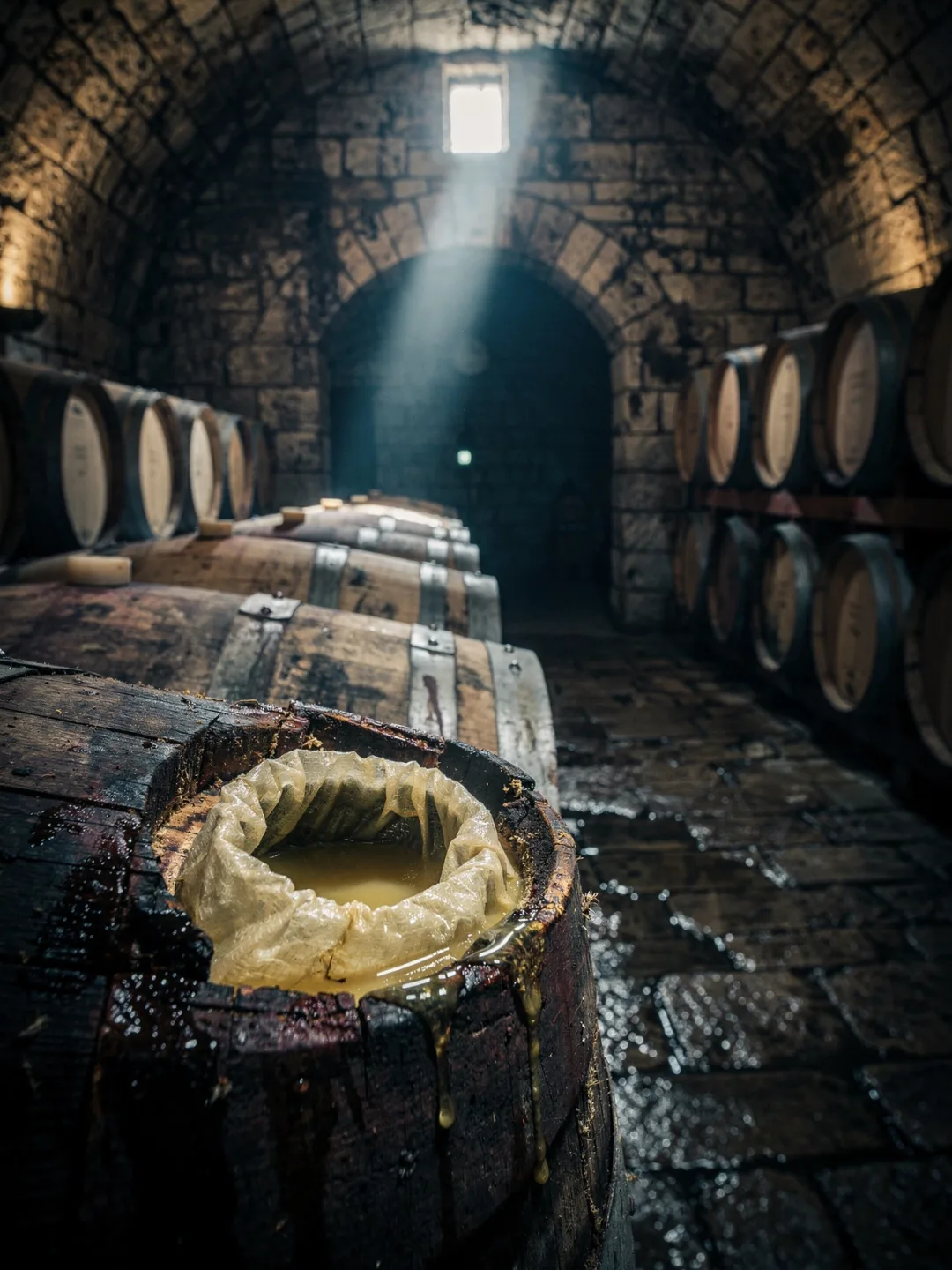
Normally, barrels are regularly topped up, so-called ouillage, because otherwise the air space above turns the wine to vinegar. With Vin Jaune, the opposite happens, and yet the wine doesn't spoil. A thin layer of yeast forms naturally on the surface, the voile, which protects the wine like a lid from full exposure to air while letting it age very slowly at the same time. This isn't a flaw, but a style all its own. It's exactly what sets it apart from orange wine, whose amber color comes from skin contact rather than oxygen in the barrel.
Over those six years, a molecule called sotolon forms, in quantities rarely found elsewhere in wine. This exact molecule tastes of walnut and curry. Because ouillage is completely absent, around 38 percent of the barrel's contents evaporates as well, which is why so little Vin Jaune ends up in the bottle in the end.
Vin de Paille comes about in a completely different way. Selected, healthy grapes, usually Chardonnay, Savagnin, or Poulsard, don't go to the press after harvest. They dry on straw or racks for at least six weeks, often several months. The sugar concentrates so heavily that one hundred kilos of grapes yield only around twenty liters of dense, honey-sweet wine in the end, which then ages in wood for at least another eighteen months.
Not every drop in the Jura begins with fermentation. With Macvin, it's stopped immediately. A third part marc brandy is added to the grape must before the sugar disappears, leaving behind a sweet, powerful mistelle. At least ten months in barrel, and the result is an aperitif between sixteen and twenty-two percent alcohol by volume.