Popes and Barons
Region & History
Two thousand years before France existed as a state, vines were already growing on the slopes above Vienne. Celts had planted them, and then the Romans took over the hills — along with the wine's reputation. In the first century, the naturalist Pliny praised the wines from around Vienne. The historian Plutarch wrote with similar enthusiasm about them, for Rome was proud of its own wine. It tolerated no competition from the provinces.
So the Empire temporarily banned new vineyards outside Italy. It wasn't until Emperor Probus lifted the ban in 280 that vines resumed growing along the Rhône's banks without interruption ever since. Ampuis and the Côte-Rôtie first appear in written records in the sixth century, a period from which little else survives about this landscape. Since then, winegrowing has never left the steep terraces between Vienne and Valence.
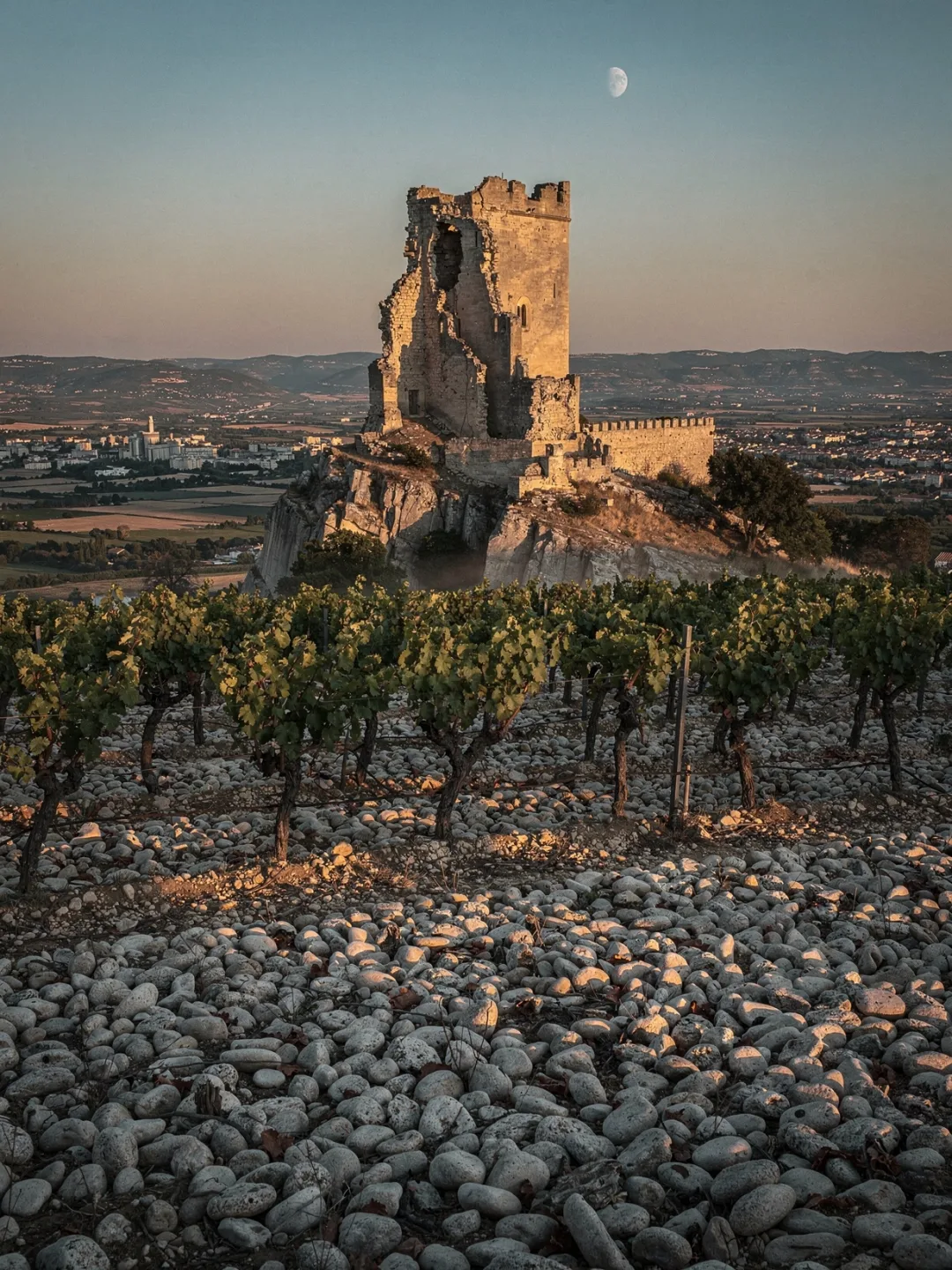
In the south, the great story began a thousand years later, with a move. In 1309, the papacy relocated its seat from Rome to Avignon. From 1317, Pope John XXII had a summer palace built in the vineyards north of the city: Châteauneuf-du-Pape, the pope's new castle. The popes planted new vines, drank their own wine, and sent it as vin du pape — the pope's wine — throughout half of Europe. In 1377, the papal court moved back to Rome, and the castle fell into ruin. During the Revolution, it served as a quarry for the village. Of the former summer residence, only the keep still stands today.
Modern order came from a winegrower with a law degree: in 1923, Baron Le Roy of Château Fortia laid down what could actually go into the bottle in Châteauneuf-du-Pape — a precisely surveyed area, a minimum alcohol content of twelve and a half percent, a list of permitted grape varieties. His rules became the model for all of France, and on May 15, 1936, Châteauneuf-du-Pape was among the first six appellations — the protected designations of origin — that the country ever recognized. The rest of the Rhône Valley followed a year later, with the simpler Côtes du Rhône appellation.