Syrah & Grenache
Grape Varieties
In the northern Rhône Valley, a single red variety reigns supreme, without exception: Syrah. The appellations around Ampuis, Tain-l'Hermitage, and Cornas allow no other red grape. Anyone drinking a red wine here is drinking pure Syrah — dark in color, rich in tannin, the rough grip you feel on your gums after swallowing. Add to that a scent of black pepper, violets, and smoked bacon. Only one exception exists by long-standing tradition: in the Côte-Rôtie, up to twenty percent Viognier may be co-fermented — a white grape that lends the red wine floral aromas and greater richness. In practice, most winemakers use only a tiny fraction of that allowance.
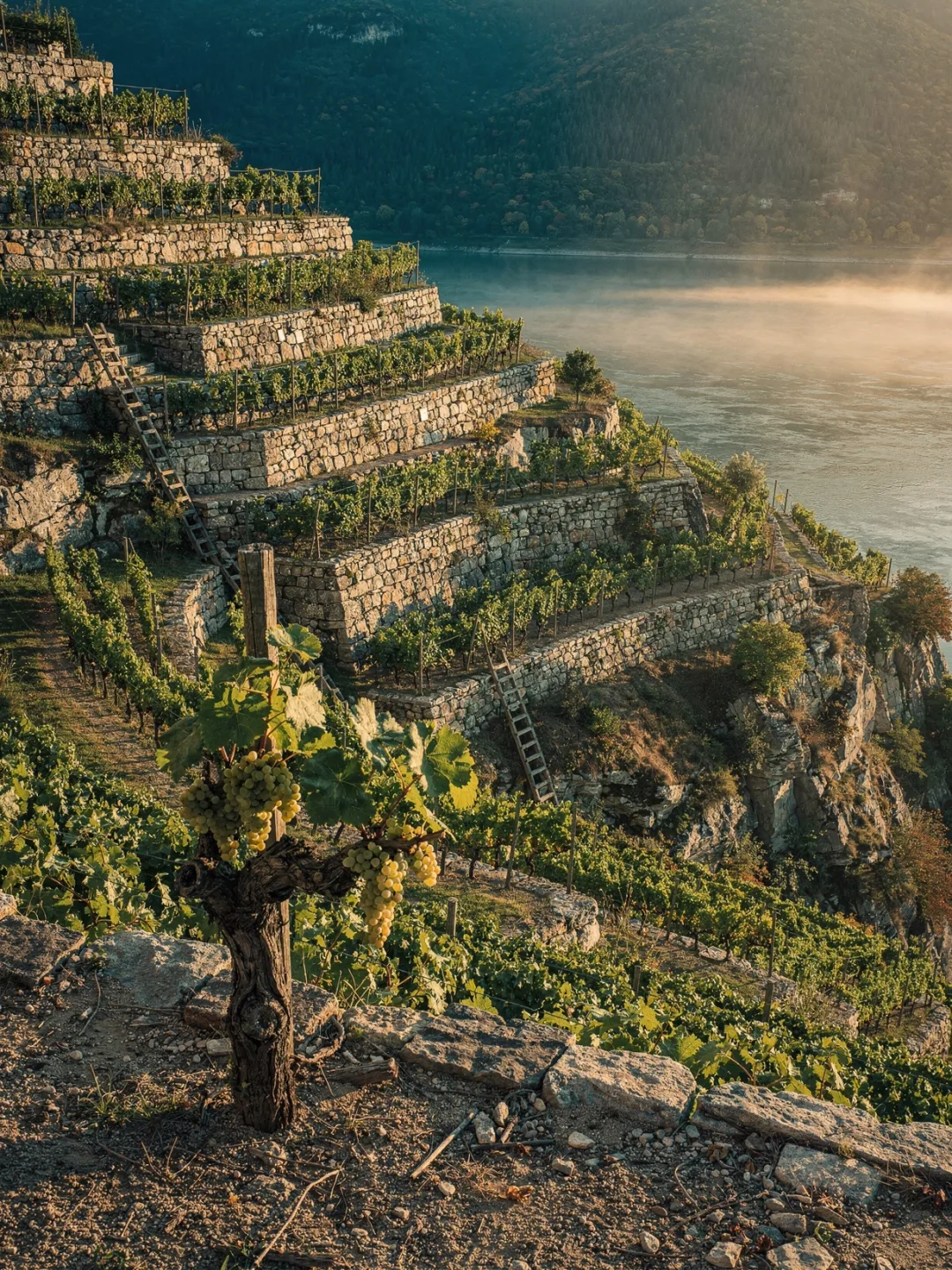
Viognier has a second home too: Condrieu. A tiny appellation on an almost vertical granite slope that produces exclusively white wine from this one grape — creamy, fragrant with apricot and hawthorn blossom. The area was so difficult to farm that by the 1970s it had shrunk to just a few hectares. Only winemakers who stubbornly held onto the terraces saved the variety from disappearing.
Further south, the picture flips entirely. Here Grenache rules, a variety originally from Aragon in Spain, where it's called Garnacha. It loves heat, buds late, and delivers plenty of alcohol and red fruit. Color and acidity, however, it barely brings on its own, which is why it almost never appears alone in the glass. The regulations for Châteauneuf-du-Pape, the so-called cahier des charges, permit eighteen grape varieties — including Syrah for structure, Mourvèdre for depth, and Cinsault for lightness. A single estate rarely uses more than four or five of these.
The reason for this diversity is simple: no vintage is like another, and growers with several varieties in the vineyard can balance weaker ones against stronger ones. Grenache brings the warmth. Mourvèdre supplies dark fruit and ageing potential, Cinsault the freshness. Together they produce a wine that tastes warmer and rounder than any Syrah from the north. The difference between the two ends of the Rhône Valley is often just an hour's drive apart — yet tastes like two different countries.