Etruscans to DOCG
Region & History
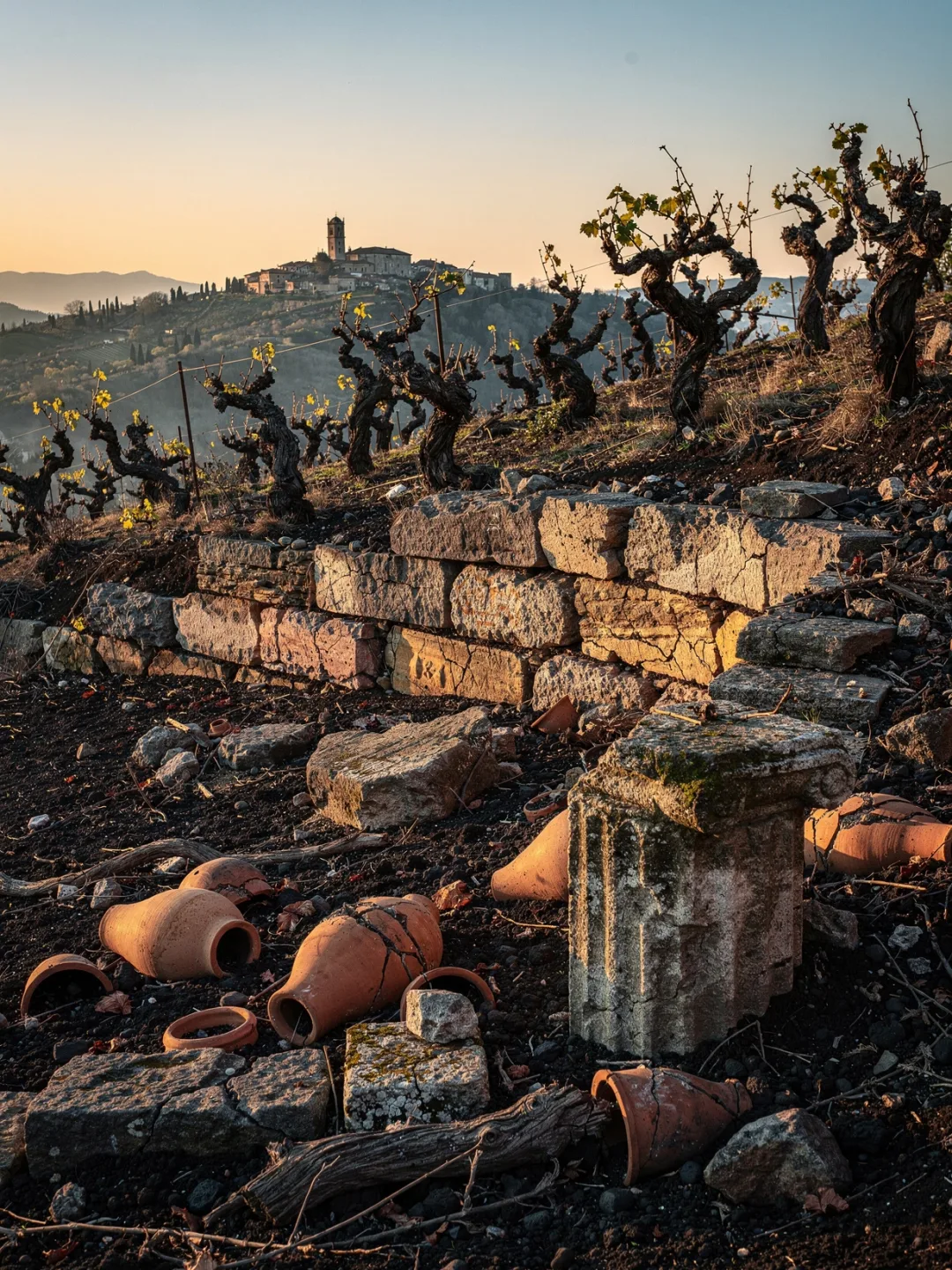
The Etruscans were already planting vines on the slopes of the Alban Hills long before Rome became a world power, and the Romans simply called their wine from the hills near Tusculum Tuscolano. That's the direct ancestor of what today sits in the glass as Frascati. Wine from Lazio was no sideline product back then. It was drunk in the capital, at every table, every day.
In 92 AD so much wine was growing around Rome that Emperor Domitian intervened, banned new plantings in Italy, and had vines uprooted in the provinces, fearing a grain shortage. The decree wasn't repealed until nearly two hundred years later. For the hills around Rome, that still meant this: there was already so much wine here that an emperor felt compelled to rein it in.
North of Rome, on the old pilgrim road Via Francigena, one of Italy's most famous wine legends emerged in 1111. A bishop named Johannes Defuk sent his servant ahead to mark inns with good wine. In Montefiascone the servant wrote Est on the door three times over — there is wine. The bishop stayed there until his death. Whether the story is true, nobody knows anymore. To this day the wine is called Est! Est!! Est!!! His gravestone in the church of San Flaviano tells the punchline itself.
The story only turned modern in 1949, when eighteen winemakers from Frascati founded a protection consortium, and in 1966 came the DOC, one of the very first four in all of Italy. But the fame came at a price. In Rome's fraschette, Frascati was poured out by the litre, mostly young, made from whatever white grapes happened to be at hand, and the reputation suffered for decades under mass production rather than craft.
The turnaround only came with the next generation of winemakers, who gave up on yield and bet on the old Malvasia Puntinata variety instead of the simpler Malvasia di Candia. In 2008 Cesanese del Piglio became the first red wine in Lazio to earn DOCG status. In 2011, Frascati Superiore and the sweet Cannellino di Frascati followed. Two wines, one region, two very different rediscoveries.