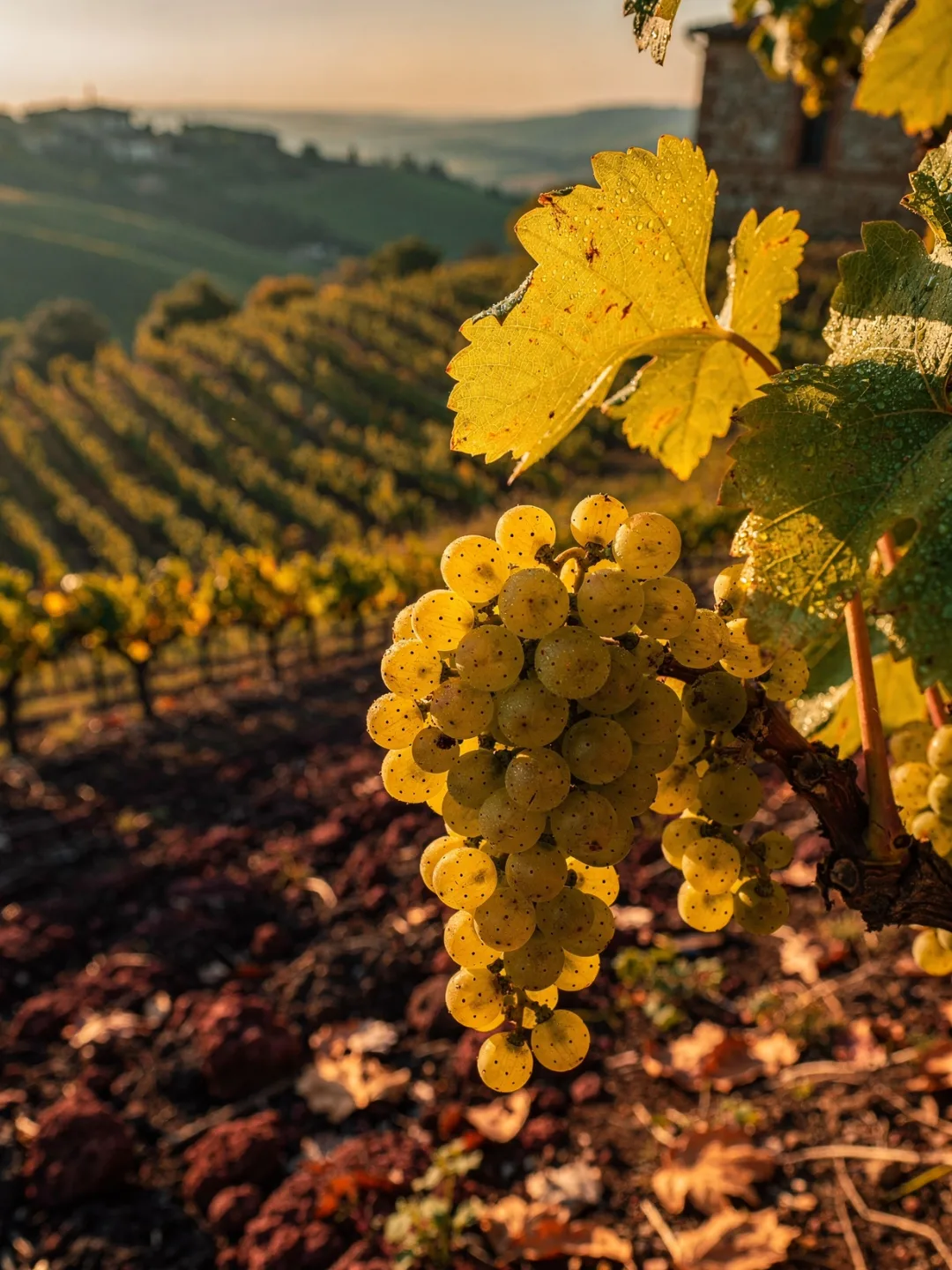
Malvasia and Cesanese
Grape Varieties
Two grapes define the picture, one white and one red, and both carry a place name as their middle name. Malvasia Puntinata, officially Malvasia del Lazio, is named after the small brown dots that sit on the berry skin like freckles. It's considered the more demanding of the two Malvasia varieties in the region.
Its sister, Malvasia Bianca di Candia, gives higher yields and less aroma. That's why it set the tone for decades, back when quantity mattered more than aroma. Only once winemakers turned back to the Puntinata did the floral scent and a slightly bitter, almond-like note return — the very thing that sets a good Frascati apart from any ordinary white country wine. Now that the rules require at least seventy percent Puntinata for DOCG Frascati Superiore, the hierarchy is settled.
Older than both is Bellone. Pliny the Elder is said to have mentioned it under the name Uva Pantastica. Its second name, Cacchione, refers to its unusually large berry. It grows mainly along the coast near Anzio and Nettuno, where it yields a robust, slightly saline white wine — close to the sea, and you can taste it in the glass.
Then come Trebbiano Toscano and its yellow-skinned relative Trebbiano Giallo, known here as Rossetto. Both supply acidity and freshness but stay in the background aromatically. They support Malvasia in the blend, nothing more. The starring role remains reserved for the Puntinata.
When it comes to red wine, there's really only one serious answer: Cesanese, a variety found almost nowhere else in the world. Two versions stand side by side in the vineyard. Cesanese Comune has the large berry, Cesanese d'Affile the small, thicker-skinned one — genetically nearly identical, but different in the glass: Affile delivers the more concentrated, denser wines and is considered the nobler form among winemakers.