From Antiquity to DOCG
Region & History
Even the Romans knew the name of this valley. In his Georgics, Virgil mentions a Rhaetian wine and ranks it right behind Falernian, Rome's most celebrated wine. Pliny the Elder later took up the subject again in his Naturalis Historia. Ancient Rhaetia extended well into what is now Valtellina. Winegrowing here is therefore older than any name it was later given — older, in fact, than the Romans who described it.
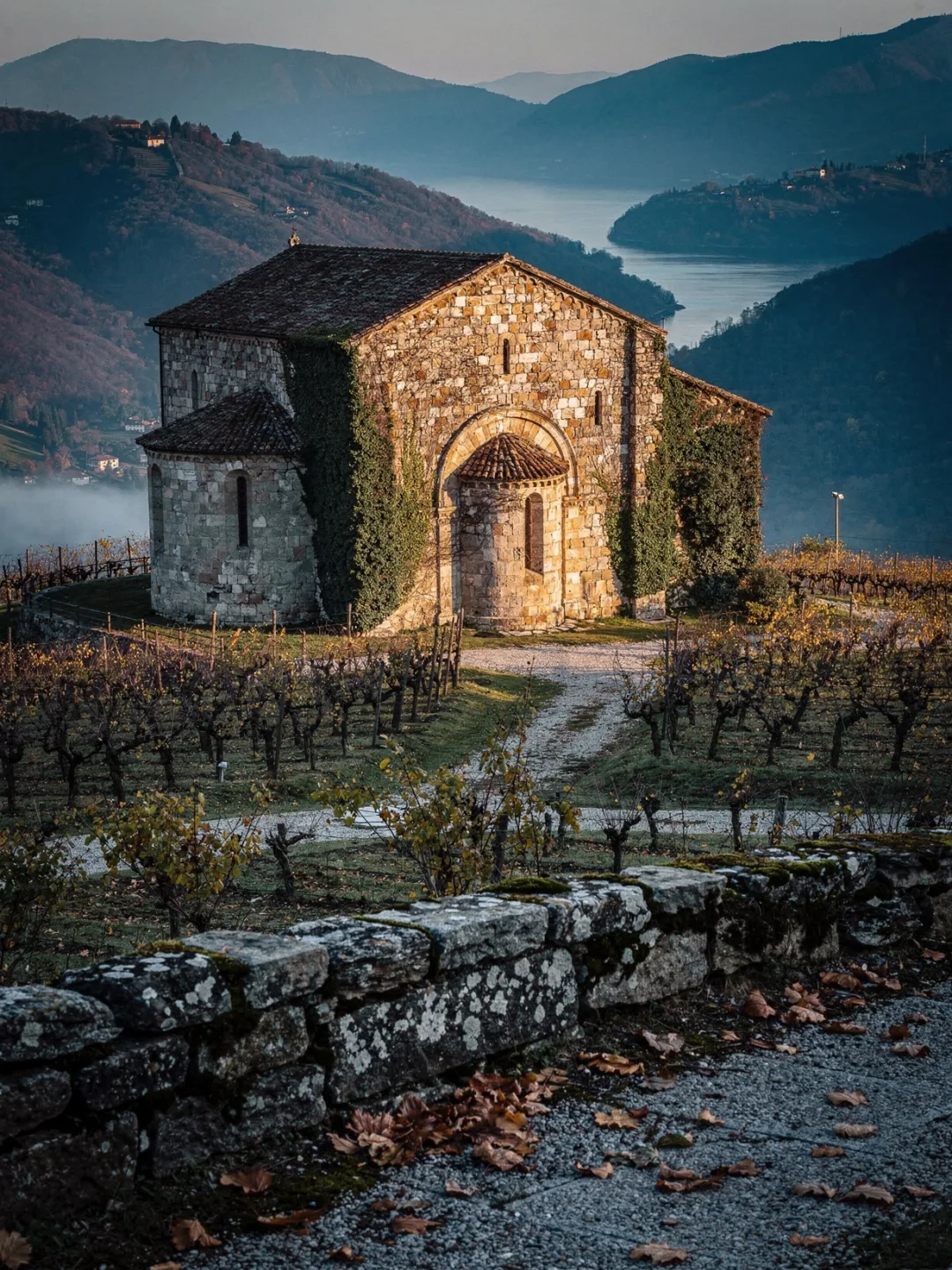
The story at Lake Iseo began quite differently. In the eleventh century, monks from the Abbey of Cluny arrived in the hills south of the lake and founded small, fortified manor farms there. Because these farms were exempt from taxes, they were called francae curtes, free courts. This later became the name Franciacorta. Large-scale wine trade, however, was still a long way off.
Even Leonardo da Vinci noted how hard the work was on Valtellina's steep slopes. He passed through the valley at the end of the fifteenth century as an engineer in the service of the Dukes of Milan. In the Codex Atlanticus, he recorded that Valtellina lay surrounded by high, terrifying mountains. Yet it produced very powerful wines — vini potentissimi, as he wrote. Little has changed in that observation since.
Official recognition didn't arrive until the twentieth century, and even then in several stages. Valtellina received its first designation of origin in 1968, Valtellina Superiore was elevated to Italy's highest classification in 1998, and Sforzato followed in 2003. At Lake Iseo, things moved even faster: starting in 1961, winemaker Franco Ziliani produced the first Italian sparkling wine there using classic bottle fermentation, following the Champagne model. Six years later the region received its DOC, and in 1995 Franciacorta became the very first Italian sparkling wine region to be elevated to DOCG status.
Two stories, one single region. On one side, a mountain wine that has grown almost unchanged since antiquity. On the other, a sparkling wine barely sixty years old that now stands alongside Champagne. In between lies Lombardy — which, in truth, isn't a single region at all, but several that happen to share the same name.