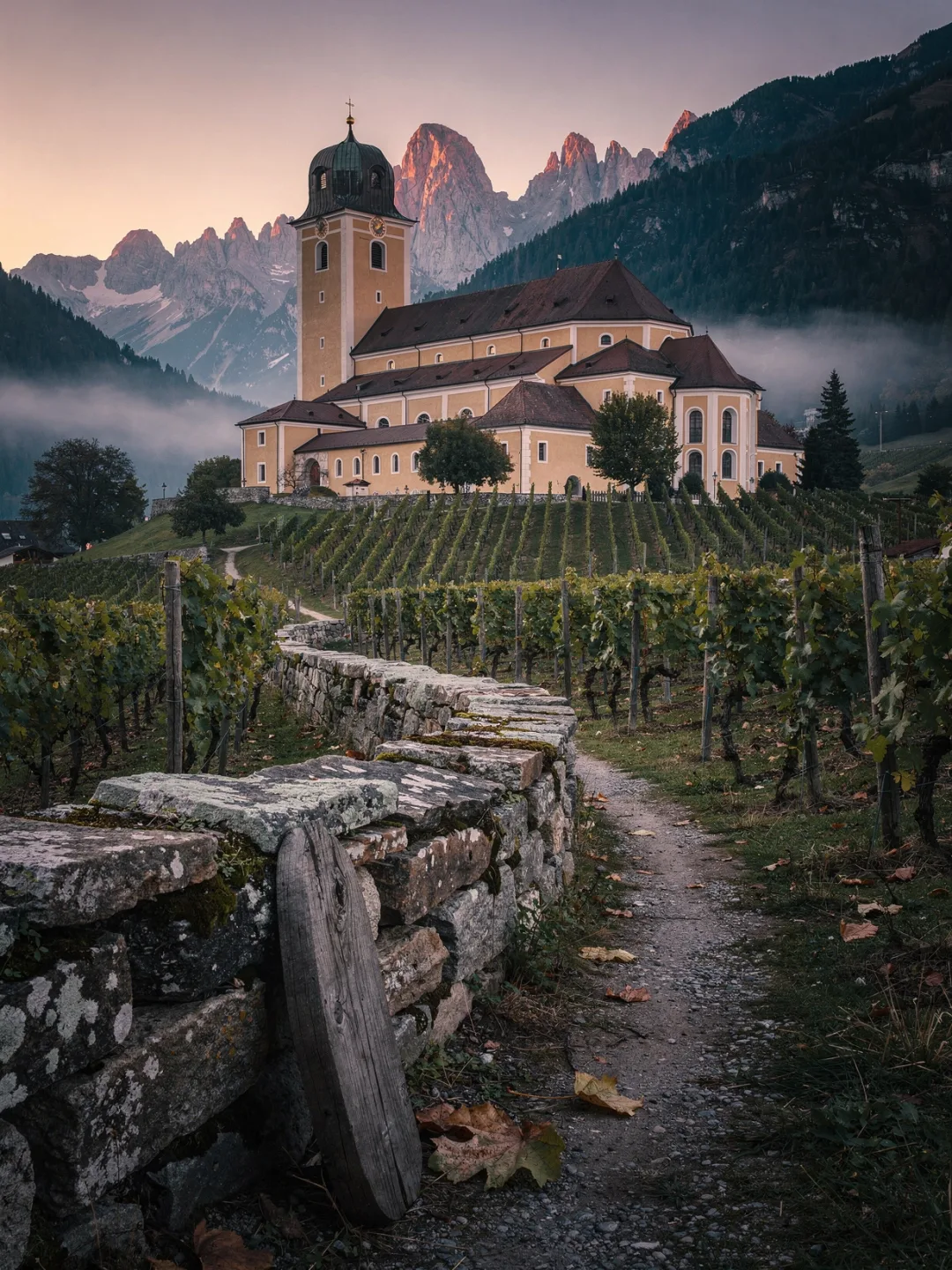
From the Rhaetians to Riserva
Region & History
Some two and a half thousand years ago, the Rhaetians planted the first vines in the valleys around Brixen. Archaeologists have found grape pips there from the Iron Age, charred yet unmistakable. The Rhaetians already knew the wooden barrel, long before Roman legions were still hauling their wine over the Alps in leather skins and clay amphorae. When the land became Roman in 15 BC, two wine cultures collided, not one meeting empty land.
The Middle Ages belonged to the monasteries. Augustinian canons founded Neustift Abbey near Brixen in 1142, and to this day the canons there press their own Sylvaner and Kerner — the oldest continuously active winery in South Tyrol, and the second-oldest in all of Italy. Already in the thirteenth century, wines here carried the name of their village, "Potzner" or "Traminer" — long before that became common practice elsewhere in Europe.
The modern era was less elegant. Quantity counted, not class. After the First World War, South Tyrol fell to Italy, and with the new border came a market that wanted quantity above all. Entire valley floors were converted to Vernatsch, shipped north in barrels, where it was poured in taverns under a foreign name. Only the quality crisis of the 1970s and 1980s forced the cooperatives to rethink.
In 1964, seven wine-growing communities joined together to form the South Tyrolean Wine Route, one of the oldest wine routes in Italy. Eleven years later, on April 14, 1975, the region received its own designation of origin, the DOC Südtirol. Today, 98.8 percent of the vineyard area falls under this protection, spread across seven subzones from Bolzano to Merano — a top figure by European standards.
What remains is a land that speaks of wine in both German and Italian at once, with producers who count Rhaetians, Bavarians, and Romans equally among their ancestors. No other wine region in Italy lies so far north.