Vernatsch & Lagrein
Grape Varieties
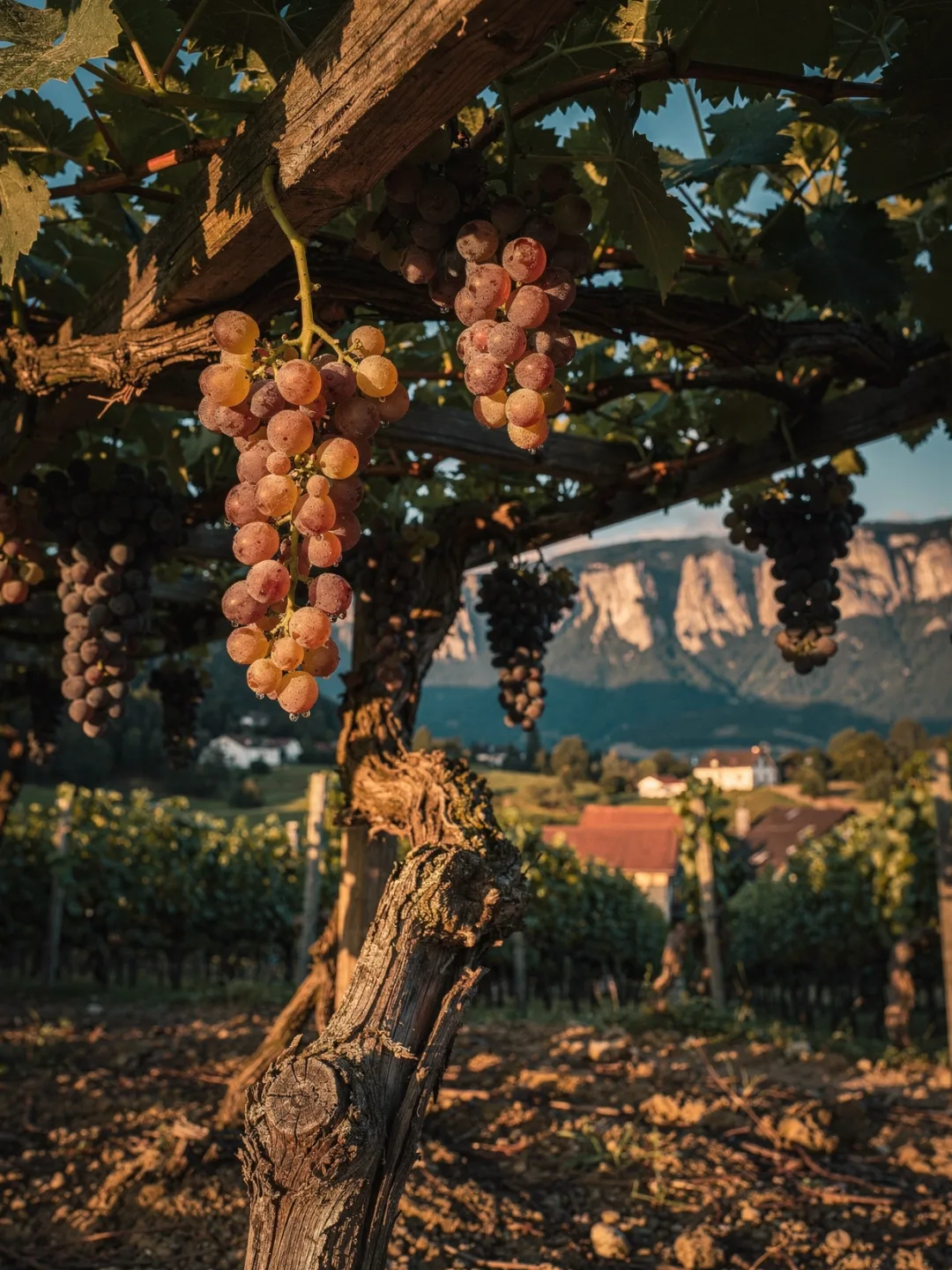
No other grape carries South Tyrol's wine history as long as Vernatsch does. As recently as the 1970s, it covered a good two-thirds of the vineyard area. Today it's barely a fifth — and yet it remains the most widely planted red grape in the region. The berry has a thin skin, little color, little tannin, so little of the rough coating that a robust red wine leaves on the gums. What remains is a pale ruby red with delicate berry fruit and, on the finish, a trace of bitter almond that you don't expect and never forget afterward.
Where Vernatsch stays pale, Lagrein turns dark. The grape is considered South Tyrol's oldest indigenous variety. As early as 1379, a document from Tramin mentions "bonum Lagrinum," and forty years later "lägrein wein" appears in Bolzano records. Its true home is the Bolzano basin, more precisely the district of Gries, where Muri-Gries Abbey remains, to this day, the benchmark for the most concentrated Lagrein wines. In the glass it is nearly black-violet, with a scent of dark forest berries and violets, alongside firm, gripping tannins that make young Lagrein wines forbidding at first.
The third variety bears the name of a village in the Bolzano lowlands: Tramin. Wine is already mentioned there around the year 1000. From there the vine wandered further. Over the centuries it traveled north, to Alsace and the Rhineland, where it eventually came to be called Gewürztraminer. Genetically it is a mutation of the ancient variety Savagnin Blanc, and today over six hundred hectares in South Tyrol are planted with it, a good eleven percent of the total vineyard area.
In the north, in the narrow Eisacktal, the story continues differently, for varieties thrive here that are otherwise at home north of the Alps. Sylvaner grows on wind-sheltered slopes, between five hundred and seven hundred meters, alongside Kerner, Müller-Thurgau, and Riesling on steep terraces. Seven white varieties are permitted to carry the designation "Südtirol Eisacktaler." No other Sylvaner-growing area in Italy comes close to these seventy hectares.
Alongside these stand the transplanted names: Weißburgunder, Chardonnay, Cabernet Sauvignon, Merlot, Blauburgunder. Today they fill the larger part of the area, and altogether South Tyrol has long since become a white wine region. And yet the image of this land still hinges on three native names: pale Vernatsch, dark Lagrein, and fragrant Gewürztraminer from Tramin.