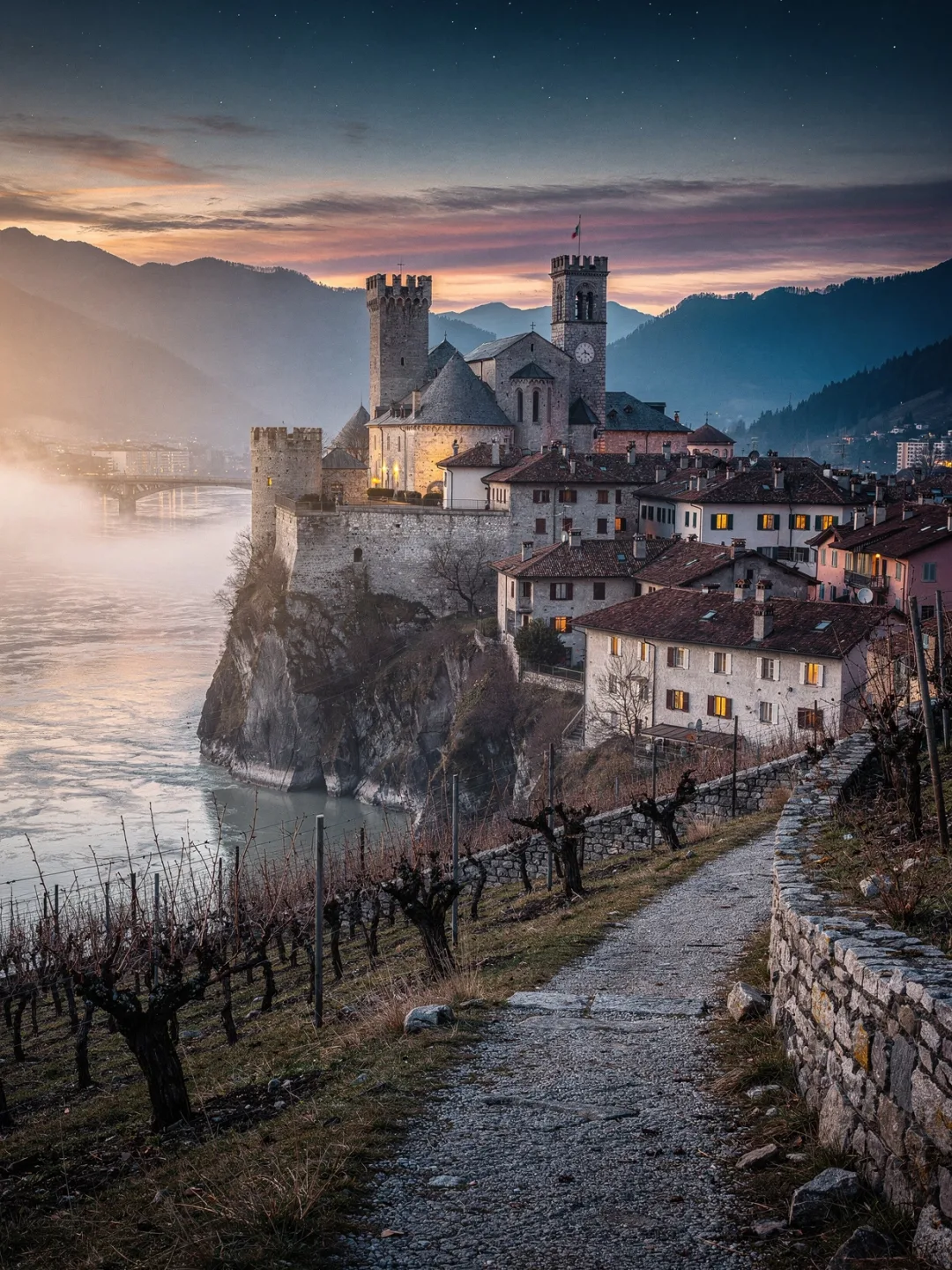
Prince-Bishopric to Ferrari
Region & History
The Romans were already planting vines here. At this point, the Adige Valley is only a few hundred meters wide, a narrow channel between the Dolomites and the Brenta Group. Since antiquity, traders, armies and pilgrims have passed through it, and viticulture traveled upstream with them into the side valleys. For the people of the mountains, wine was no luxury. It was one of the few crops that could actually yield anything on such steep slopes.
Politically, the region was a special case for eleven hundred years. The Bishop of Trento ruled his own territory within the Holy Roman Empire, with its own laws and its own power of taxation. The Habsburgs, as territorial lords, had a say, but real power remained with the prince-bishop. That changed in 1803: the prince-bishopric was dissolved, its territory fell to Austria and became part of Tyrol.
What followed changed viticulture more than any century before it. In 1874, the Tyrolean provincial parliament in Innsbruck founded the Landwirtschaftliche Lehranstalt San Michele all'Adige, the agricultural teaching institute, with oenologist Edmund Mach as its first director. For the first time, winemakers here learned systematically why a wine succeeds or fails, not from experience alone, but from analysis. The school still exists today, as the Fondazione Edmund Mach, and continues to train cellar masters.
Only a few decades later came the second turning point. It began with a single idea. In 1902, Giulio Ferrari started producing sparkling wine in the city of Trento modeled on Champagne, using Chardonnay, a grape variety almost unknown in the valley at the time, and years of aging on the lees. His craft is known today as Trentodoc. Every bottle still matures according to his principle: slowly and undisturbed, in the mountain rather than in the cellar.
In 1919, Trentino became Italian, sealed by the Treaty of Saint-Germain after the First World War. Fifty years later, in 1971, Teroldego Rotaliano and the broader Trentino DOC received official protection. In 1993, Ferrari's idea became its own appellation: Trento DOC, exclusively for sparkling wine made by the classic method, never for still wines. From the Roman vine to the protected bottle, it was a long road. But it was always the same one.