Teroldego & Marzemino
Grape Varieties
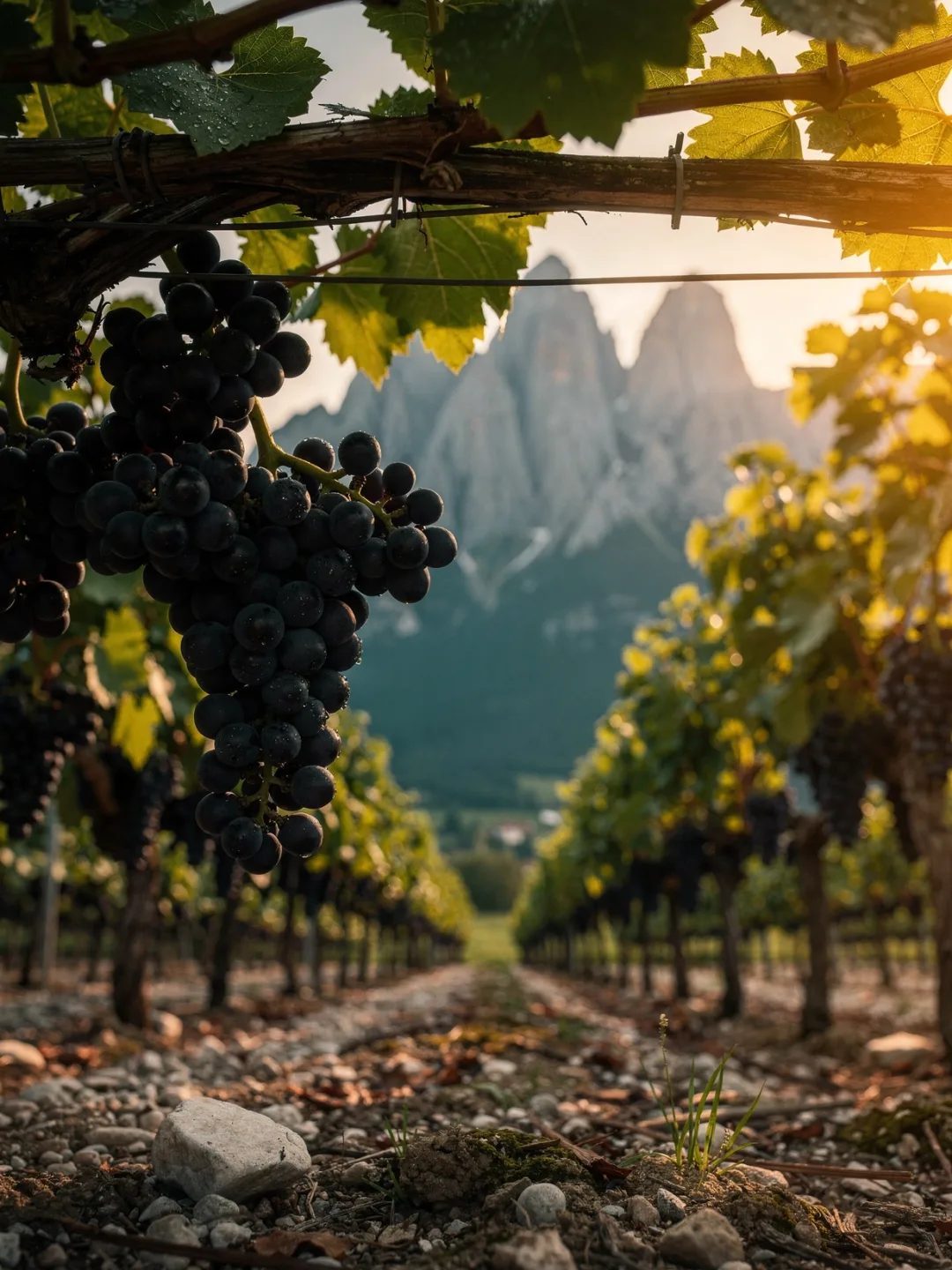
One variety dominates the valley like no other. Teroldego grows almost exclusively on a single plain, the Campo Rotaliano near Mezzolombardo, a gravel fan between the Adige and Noce rivers. The berries are small and thick-skinned, the color in the glass almost impenetrably dark. There's hardly any mistaking it. Where the name comes from remains disputed to this day. Some derive it from Tiroler Gold. Others point to the village of Teroldeghe near Mezzolombardo, already mentioned in a 1480 sales contract for Teroldego wine.
The vine is traditionally trained on the Pergola Trentina, an overhead canopy under which the grapes hang as if in an arbor. This protects them from the damp, cool air that settles over the flat valley floor at night, giving rot little chance to take hold. The effort is considerable, as every row is pruned and tied by hand. That's why some estates are now switching to wire-trained systems like Guyot. But on the Campo Rotaliano, where Teroldego takes its name, the pergola remains the rule.
The region's second great red grape presents itself quite differently. Marzemino is lighter, softer, with fine tannin and a scent of violets and blackcurrant. Its home is the Vallagarina south of Trento, especially the hills around Isera. There, the subzone "d'Isera" produces wines at the Trentino Superiore level. It became famous through a single opera scene: in Mozart's Don Giovanni, the title character calls for "Eccellente marzimino!" at his final feast, in the historic spelling of Lorenzo da Ponte's libretto.
Among the whites, there is only one native variety: Nosiola. The name comes from nocciola, meaning hazelnut, and that's exactly what a dry Nosiola from the Valle dei Laghi around the village of Toblino smells of. There, in a narrow side valley with its own microclimate, the grapes grow on stony slopes above small lakes. The same grape, dried, provides the base for Vino Santo, the region's sweet passito wine.
Two more varieties shape Trentino without many drinkers realizing it. Chardonnay, Pinot Nero, Pinot Bianco and Pinot Meunier grow on cool slopes specifically for Trentodoc, the sparkling wine made by the classic method. Up in the Val di Cembra, meanwhile, on terraces of red porphyry rising to nearly nine hundred meters, Müller-Thurgau thrives, a variety hardly taken seriously anywhere else in Italy. Here, with the great swing between day and night temperatures, it produces fragrant, almost alpine white wines.