Etruscans, monks, DOC
Region & History
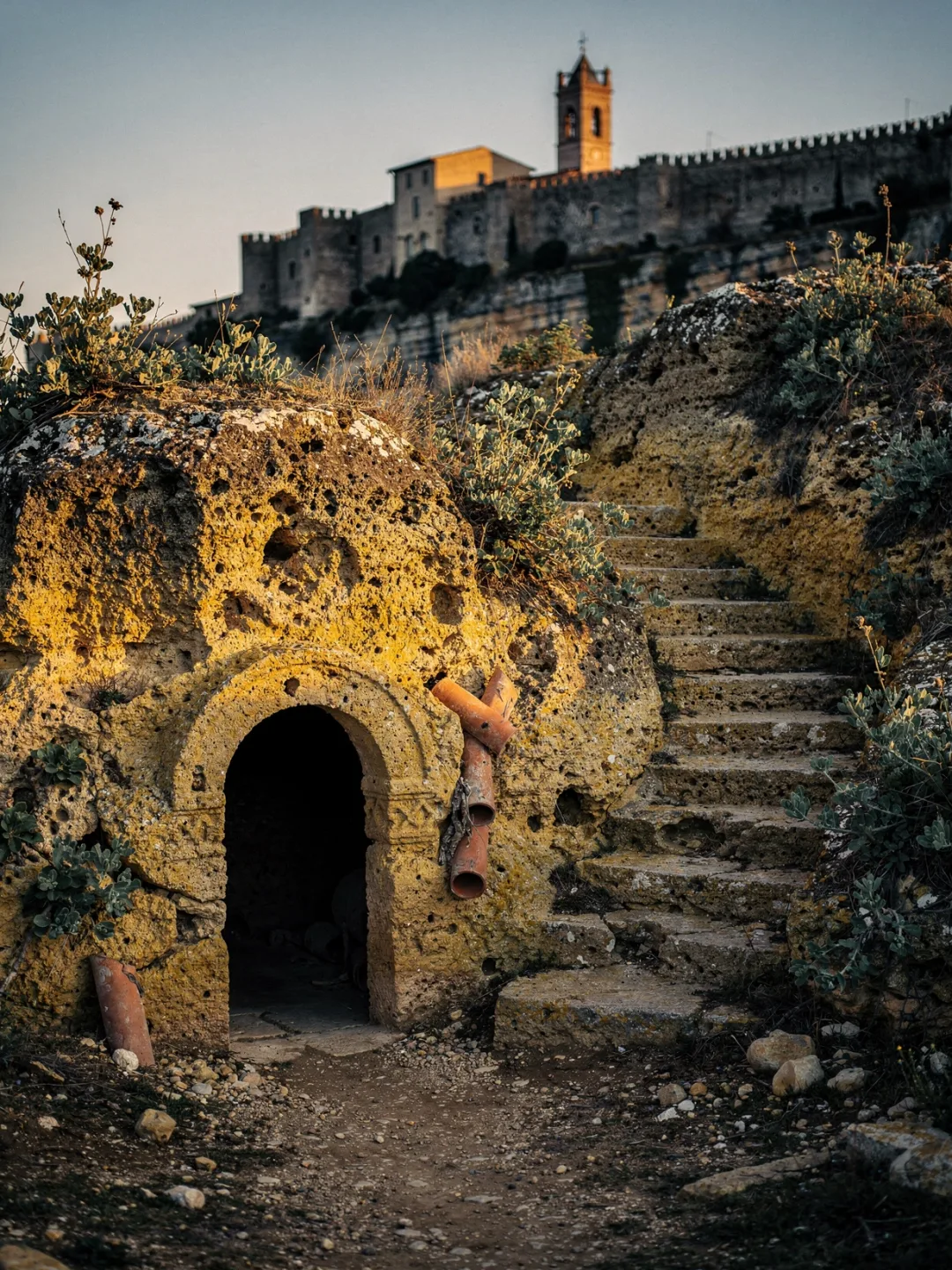
Where Orvieto now perches on its tuff-stone outcrop, the Etruscans founded the city of Velzna in the tenth century BC. They recognized at once what the volcanic soil meant for winegrowing. The Greeks later named the place Oinarea, meaning where the wine flows. That was no coincidence. Beneath the city, they dug cellars into the soft tuff on three levels: pressing happened up top, must ran down a floor through clay pipes to ferment, and finished wine aged below at a constant temperature.
Later, popes who often resided in Orvieto for months at a time drank the same wine, and even paid for art with it. In the contract of 1500, Luca Signorelli secured as much Orvieto wine as he wanted for painting the frescoes in the Cappella di San Brizio in the cathedral, alongside money and grain. As early as 1496, Pinturicchio had been paid in grain and the necessary wine. For centuries, Orvieto was sweetish, a style known as abboccato. Only in the nineteenth century did tastes shift toward dry, and in 1931 the growing area was officially delimited.
The story of Sagrantino began quite differently in the east, around Montefalco. The vine likely arrived from Asia Minor in the fourteenth century, brought by Franciscan monks. Its name echoes the word 'sacrament,' and that's no accident: farming families pressed a sweet passito from a few vines in their own gardens for Christmas and Easter. The oldest record dates to 1549. By 1575, a vineyard with four Sagrantino pergolas was already listed in the land registry.
In the west, in Torgiano, the modern story only began after the war. Giorgio Lungarotti restructured the family estate starting in the late fifties and bottled his first Rubesco in 1962. In 1968, Torgiano became Umbria's very first DOC. In 1990, Torgiano Rosso Riserva followed as the region's first DOCG, years before Montefalco could even join the conversation.
At that point, dry Sagrantino barely existed. Only in 1972 did a winery in Foligno vinify it fully dry for the first time; the DOC came in 1979, the DOCG in 1992. The real push came from 1989 onward, through a research project by the Caprai family with the University of Milan: clone selection, soil mapped plot by plot, ultimately yielding three clones rich in color and tannin. In 1996, their wine '25 Anni' earned three glasses from Gambero Rosso.