Greeks to This Day
Region & History
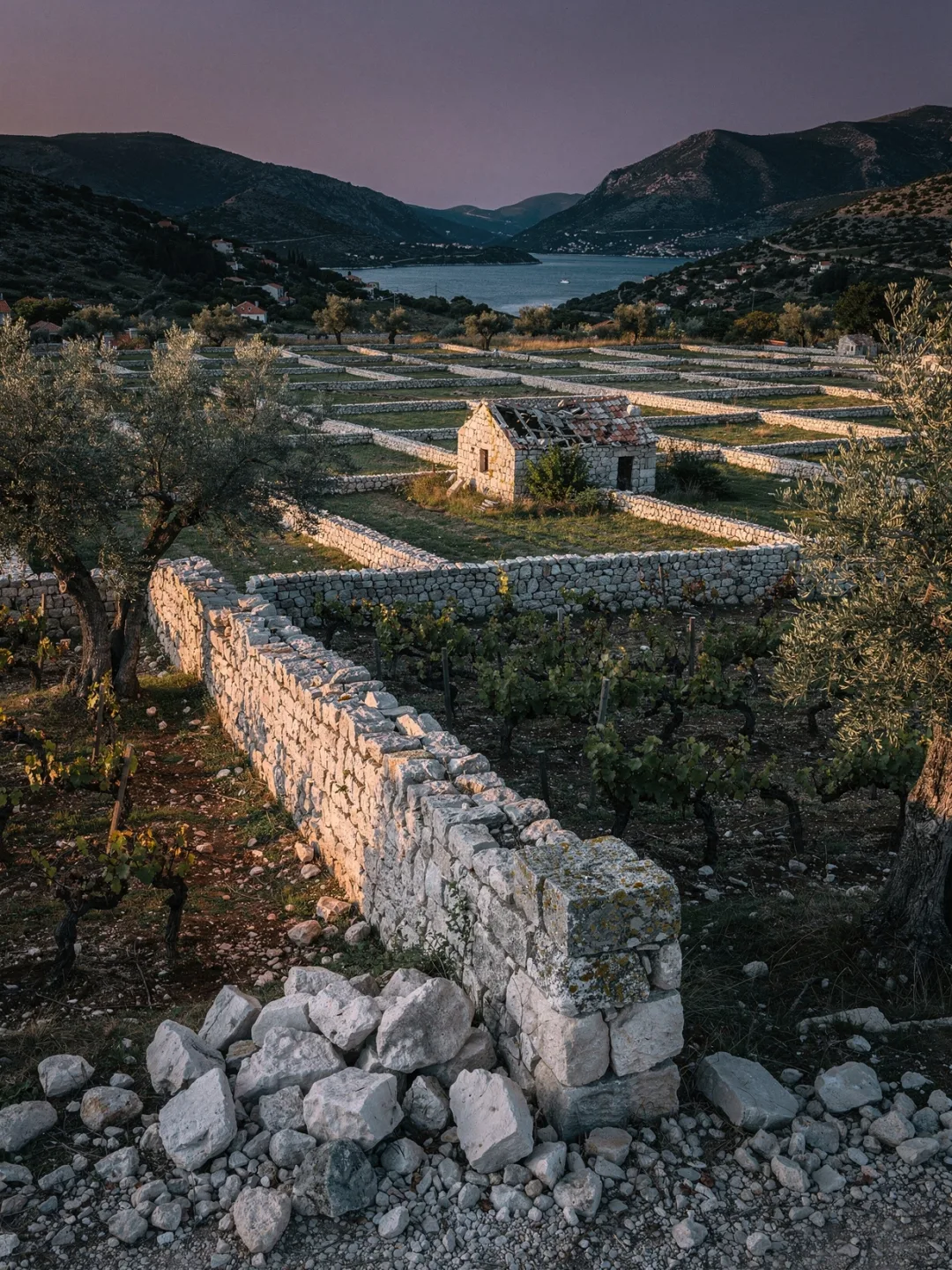
Anyone driving across Hvar today sees stone walls that the Greeks themselves first laid. Settlers from Paros founded the city of Pharos around 385 BC on the plain of Stari Grad, dividing the land into rectangular plots bordered by dry stone walls. This division, called the Chora, still stands almost unchanged after twenty-four centuries, still planted with vines and olives, and since 2008 a UNESCO World Heritage Site. In the same century, the tyrant Dionysius of Syracuse founded a second Greek colony on the neighboring island of Vis: Issa. Its wine, an ancient historian later wrote, was unmatched.
The Romans took over the vineyards when they conquered the coast, expanding on what the Greeks had started. Diocletian, born near what is now Split, had a massive palace built there around 305 AD and retired into it. Beneath his former living quarters, cellar vaults still remain today. Archaeologists found an ancient press for wine and oil there, both stored directly beneath a Roman emperor's bed.
For centuries, rulers came and went, but winemaking endured. Venice controlled large stretches of the coast. The Republic of Dubrovnik, meanwhile, bought the Pelješac peninsula in 1333 and planted vines there itself. Only phylloxera ended this long stretch of stability. Starting in 1894, it ate its way through the vineyards of northern Dalmatia and further south. Over the following two decades, around 350,000 people left the region, many bound for America, including California, where a grape called Zinfandel had long since taken root, its Croatian origins only revealed a century later through DNA analysis.
In 1961, Dingač became the first officially recognized, protected wine region in Croatia, followed in 1967 by Postup and the white wine from Čara and Smokvica on Korčula. Before that, cooperatives had mostly bottled wine in large quantities and mediocre quality. The new place names forced individual sites to stand on their own.
The war of 1991 to 1995 also reached the coast, with the siege of Dubrovnik just one bay away from Pelješac. Many vineyards lay abandoned for years afterward. The next major turning point came in 2001. Geneticists found nine old vines of an almost forgotten variety called Crljenak Kaštelanski in Kaštela near Split, and its DNA proved identical to Zinfandel. In 2013, Croatia joined the EU. Since then, Dingač, Postup, and the other Dalmatian sites have held protected designation of origin status under European law.