Plavac Mali & Co.
Grape Varieties
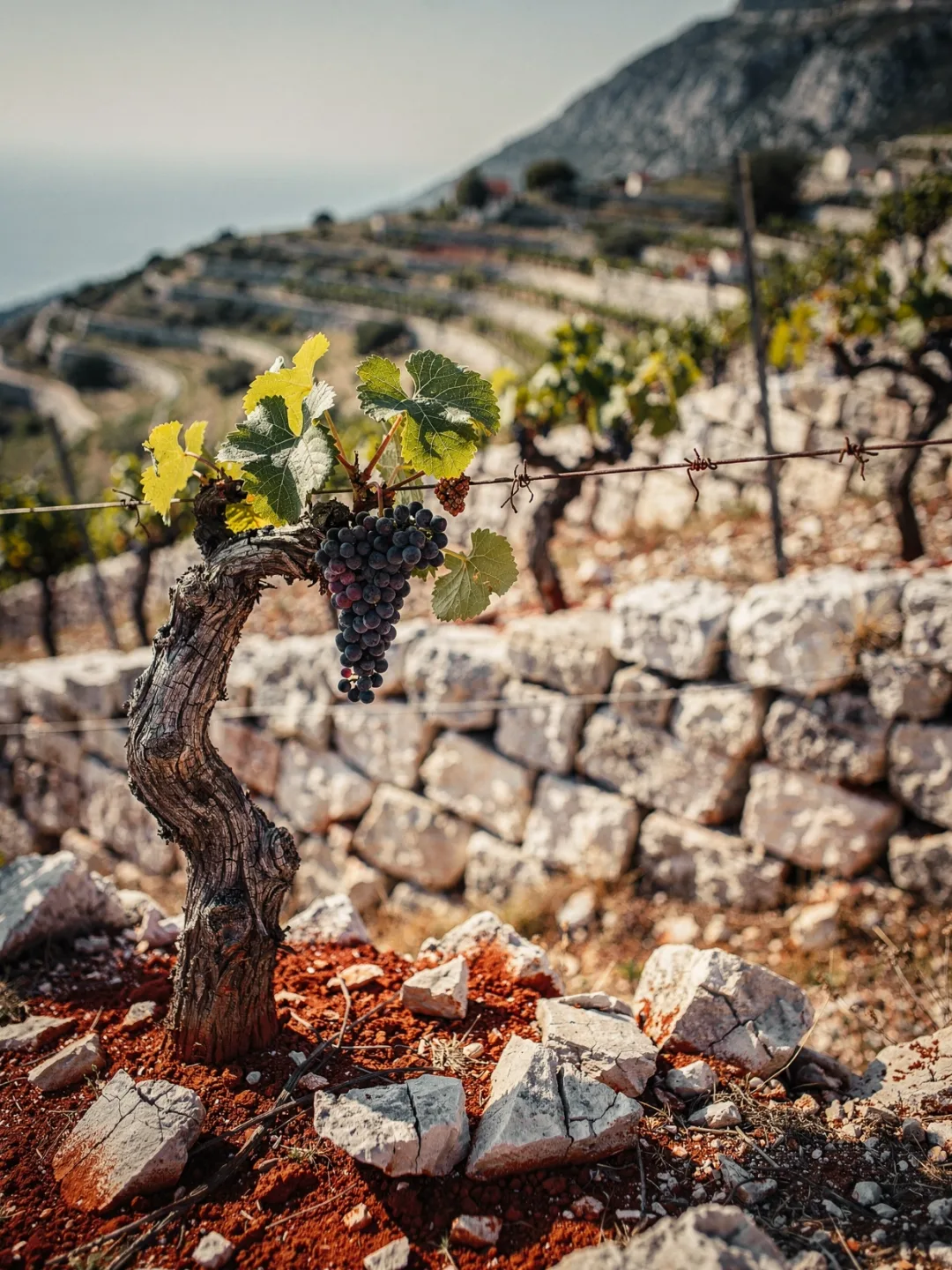
A single variety defines the red wines of the entire coast: Plavac Mali. It grows on nearly every island and every steep slope between Split and Dubrovnik, ripening unpredictably, with shriveled raisins often hanging right next to still-green berries on the same cluster. Pick too early, and the wine turns sour. Pick too late, and you end up with sixteen percent alcohol or more. Both happen, often in the same vineyard.
For a long time, Plavac Mali was thought to be its own ancient variety, until geneticists at the University of California disproved this around the turn of the millennium. It's actually a natural cross between two other Croatian grapes, Crljenak Kaštelanski and Dobričić from the island of Šolta. Crljenak Kaštelanski carries an even older name, Tribidrag, named after the Greek word for early-ripening, first appearing in the records of a priest from Vodice in 1444. Genetically, as a 2001 DNA analysis showed, it is identical to California's Zinfandel and Italy's Primitivo.
Plavac Mali grows most densely on the steep slopes of Dingač and Postup on Pelješac. There it produces heavy, nearly black wines with plenty of tannin and little acidity. They taste of carob, dried fig, and dark cherry.
On Korčula, a different, white variety dominates: Pošip, protected under its own name since 1967 and the first white designation of origin in all of Croatia. In Lumbarda, a few kilometers away, an even rarer curiosity grows. Grk has only female flowers. It cannot self-pollinate, so winemakers plant Plavac Mali between the rows as a living pollen donor, since only the sandy soil of Lumbarda seems to suit the vine at all. On Vis, Vugava grows, reportedly already pressed by the Greeks of the city of Issa. Near Primošten, behind miles of dry stone walls, the robust red wine Babić ripens in reddish, stony earth.