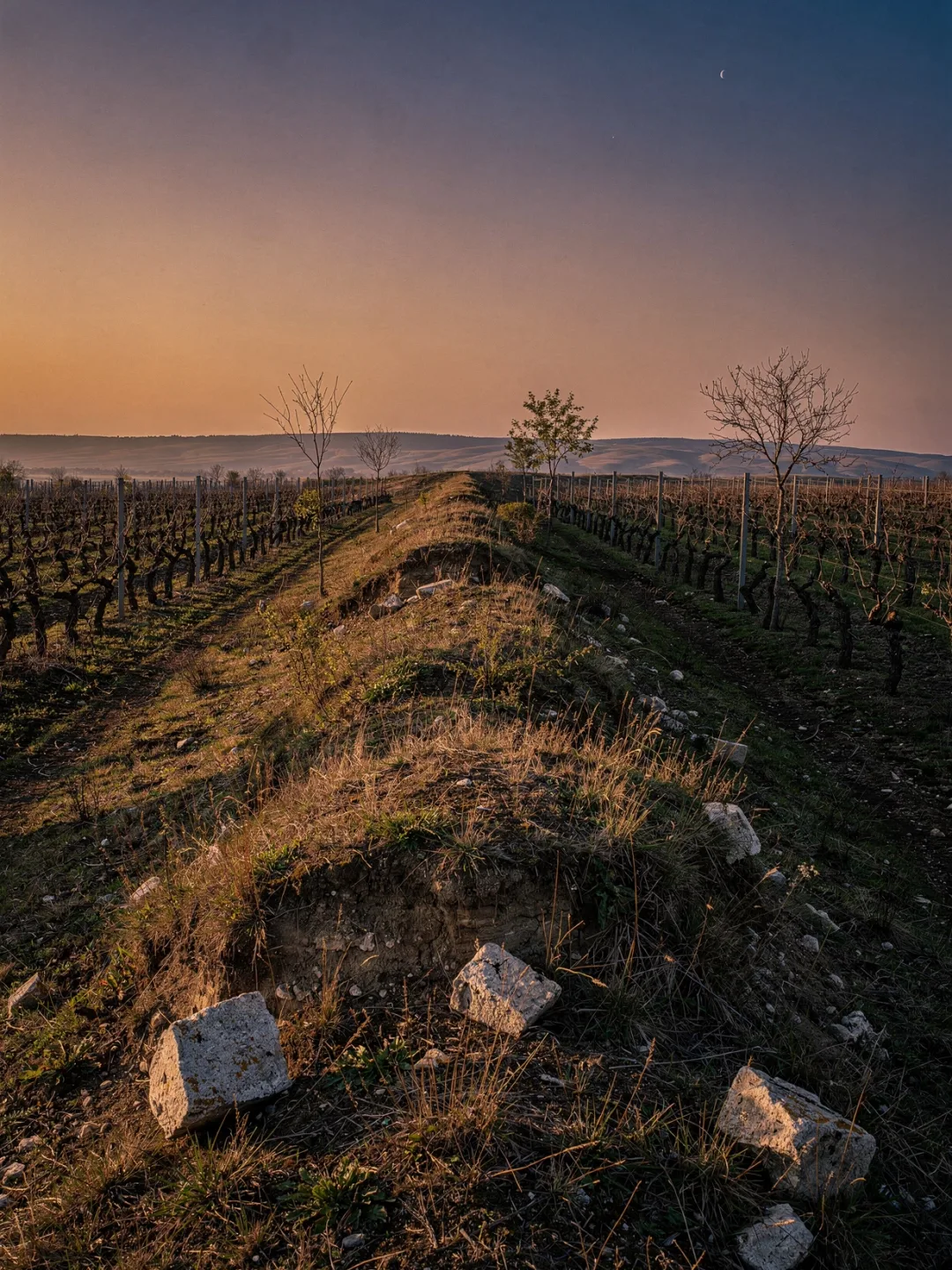
Earthen Rampart & Gagauz
Region & History
An earthen rampart runs through the steppe in southern Moldova. It's barely knee-high, in many places nearly invisible from a distance, and yet it carries an imperial name, the name of the entire region. Medieval documents simply called it Troian, after an old legendary figure. Only 19th-century Romanian scholars reinterpreted it as the work of Emperor Trajan, even though the rampart had already stood for centuries by then. It was likely built in late antiquity.
It runs from the Prut near Cahul eastward to Lake Sasyk in what is now Ukraine. Those who farmed the land there had themselves come from far away: the Gagauz, a Turkic-speaking, Orthodox people, migrated from Dobruja into the Bugeac steppe in the 19th century, after the Russian Empire had the area resettled. Bulgarians arrived around the same time, which is why the district of Taraclia remains majority Bulgarian to this day. Both peoples brought winemaking with them, even though the soil was dry and promised little.
Another chapter of the region began in 1975. Near Cahul, the Vinia Traian winery opened, right in the middle of vineyards along the river, just seven kilometers from the slopes of the Bugeac steppe. The Soviet Union built huge combines for mass-produced wine. After independence in 1991, the Soviet market collapsed, and in 2006 Russia imposed an import ban on Moldovan wine, officially over alleged adulteration, but in reality for political reasons. Over a hundred wineries had to close at the time. A second embargo followed in 2013.
In the end, solid law replaced sheer resignation. The 2006 wine law created the PGI, the protected geographical indication, and divided the country into three wine regions: Codru in the center, Ștefan Vodă in the southeast, and Valul lui Traian in the south. Since the 2014 agreement with the EU, the name has also been protected there. Moldova is not an EU member and continues to apply its own wine law. What was once a nameless stretch of land thus became a region with its own seal.