From Beetham to Milne
Region & History
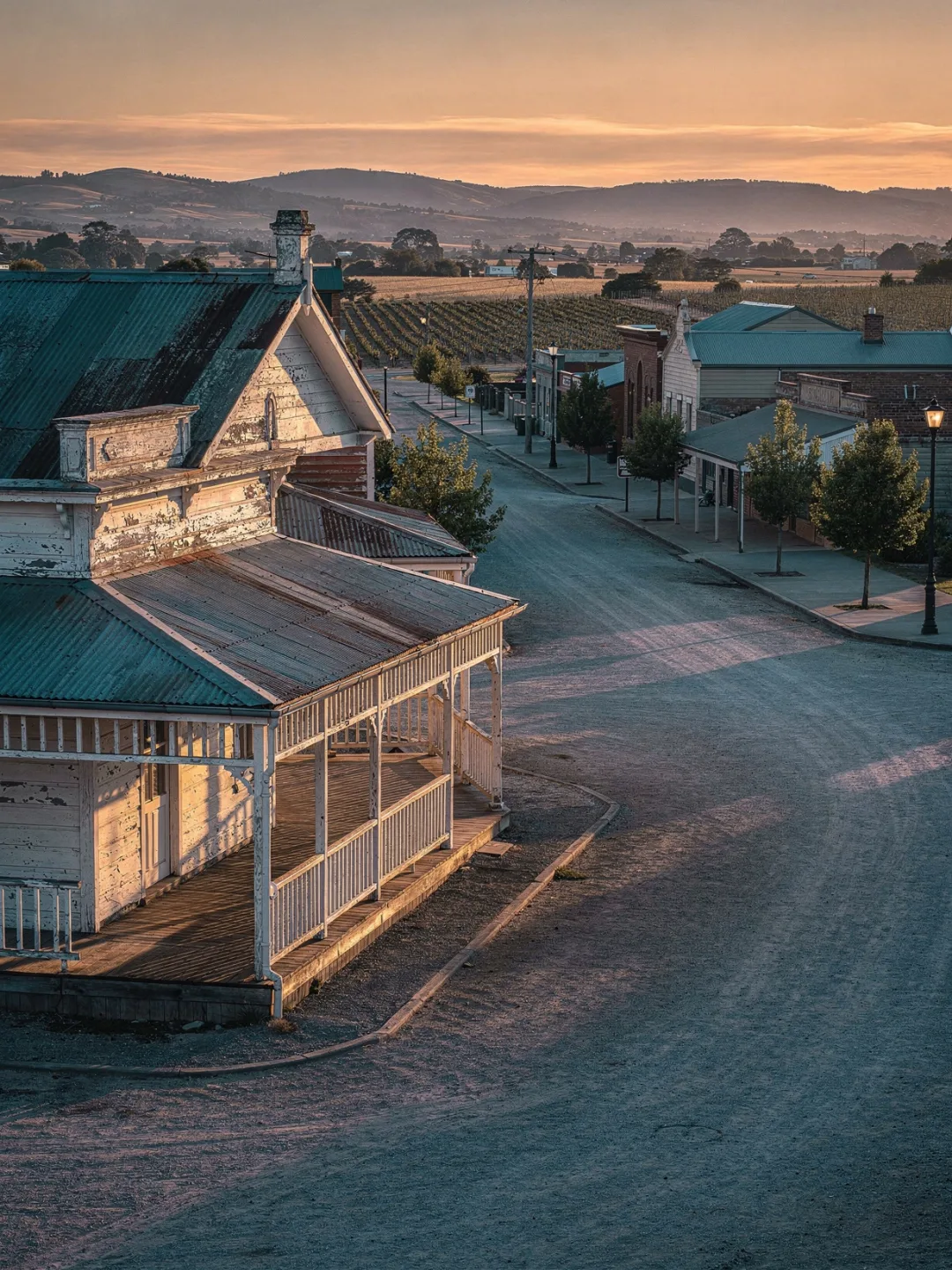
In 1879, businessman John Martin draws a straight line across an empty pasture in the south of the Wairarapa and names it after himself. He's brought back names from a trip around the world: Panama, Suez, Venice, New York. He assigns them to the streets of his new town. From the central square, they still radiate outward today in the pattern of a Union Jack — a layout that has remained unchanged for almost a hundred and fifty years. No one is planting a vineyard here yet.
Wine had existed in the Wairarapa before this, though not on this particular plot. In 1883, William and Hermance Beetham, a married couple, plant Pinot Noir and Hermitage — as Syrah was then known — near Lansdowne, close to what is now Masterton. He's English, she's French, and both are convinced of the country's potential. Twelve years later, government adviser Romeo Bragato, originally from Dalmatia, tastes the red wine from Lansdowne. Afterward, he declares the Wairarapa exceptionally well suited to viticulture. It makes no difference. Within a few years, Masterton votes itself dry, and the vines of Lansdowne are pulled out.
For nearly eighty years, little grows here beyond grass for sheep. That changes in 1978, when soil scientist Derek Milne maps the region's soils on behalf of a government research agency. The task is really about agriculture, not wine. He finds flat gravel terraces, low rainfall, and long, dry autumns, and it strikes him how closely this resembles the climate of Burgundy. A year later, Neil McCallum plants the first vines of Dry River. In 1980, Milne himself founds Martinborough Vineyard on the Martinborough Terrace, and soon after, Ata Rangi, Te Kairanga, and Chifney join in. Five wineries in two years — that's the real beginning.
The name doesn't become official until 2018. New Zealand's trademark office registers Martinborough as a protected geographical indication for wine, administered by the Wairarapa Wine Growers' Association. There's no authority dictating grape varieties or yields. New Zealand simply requires that at least eighty-five percent of the grapes actually come from the region if its name appears on the label. Today, more than twenty wineries lie within walking or cycling distance of the historic town center, whose streets still trace the pattern of a Union Jack. Every November, Toast Martinborough, a festival running since 1992, transforms the town's vineyard grounds for a day into live music and food stalls.