Springs and Vines
Region & History
The Romans already knew what bubbled up beneath the Anninger. Around the year 50 AD, they established a settlement called Aquae on the site of present-day Baden, soon renamed Aquae Pannoniae under Emperor Claudius and recorded in the Roman road register, the Itinerarium Antonini. Soldiers of the Fifteenth Legion from nearby Carnuntum dedicated an altar there to the spring nymphs before the year 114. Where legionaries bathed, vines soon grew too. From the very start, the valley bound the two together.
An old legend tells of three brothers. Perchtold, Guntram, and Gumpold are said to have built fortified estates against Hungarian incursions on behalf of a Babenberg duke, and the villages still bear their names today: Perchtoldsdorf, Guntramsdorf, Gumpoldskirchen. Little of this is documented, and genuine records are lacking. Gumpoldskirchen only becomes historically traceable in 1140, presumably named after a real founder called Gumpold. Even in this first mention, though, winegrowing already stood at its center.
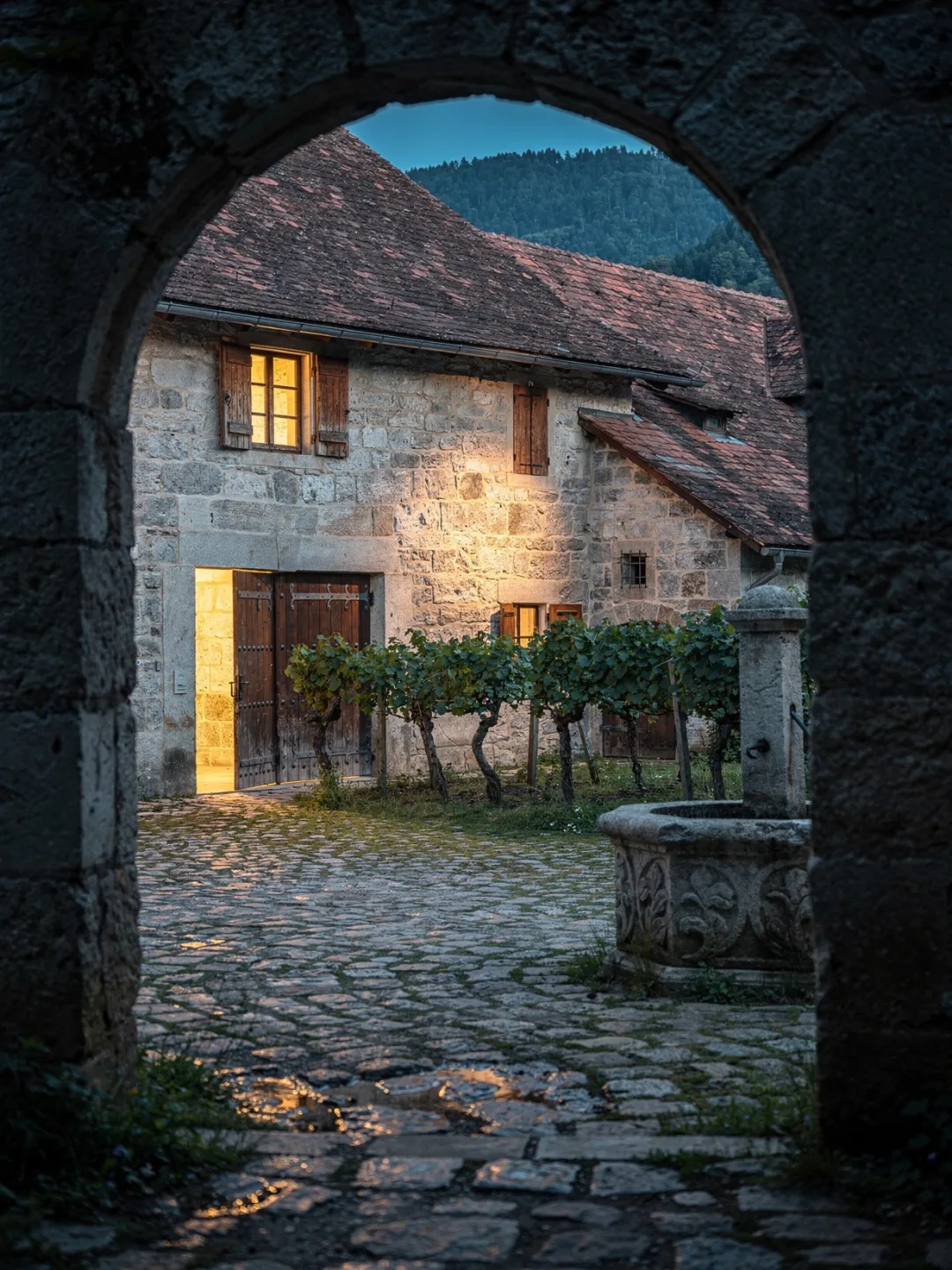
Just a year later, in 1141, Margrave Leopold IV gifted the village of Thallern to Heiligenkreuz Abbey, a Cistercian monastery. The monks established a wine estate there, modeled on Clos de Vougeot, the Burgundian property of their mother house. For almost 870 years, the Freigut Thallern remained in monastic hands, until it passed to three winegrowers in 2009 — one of the longest continuously cultivated wine estates in Austria.
In the 16th century, barrels rolled from here all the way to Silesia, Bohemia, and Bavaria, drunk by bishops, Habsburgs, and the military commander Wallenstein. Centuries later, another kind of spring made the area famous: from 1793, Baden became a spa town for the Viennese nobility, and by 1833 it was even the official imperial summer residence. Anyone strolling through the spa gardens in the evening was drinking the wine of the surrounding hills.
In 1842, the merchant Robert Schlumberger married into Vienna and leased vineyards in Vöslau. Behind his own house, he planted the first Cabernet Sauvignon and Merlot vines ever grown in Austria. It was a bold move in a country that had until then known almost only native grape varieties. In 1878, he was ennobled for it as Edler von Goldeck.
The region only took its current shape in 1985, when wine law merged the separate areas of Gumpoldskirchen and Bad Vöslau into the Thermenregion. Nearly forty years later, starting with the 2023 vintage, it became a DAC — the last of Austria's wine regions to gain that status. Begun as a Roman bath around 50 AD, officially classified as a wine region only in 2023 — nearly two millennia lie in between.