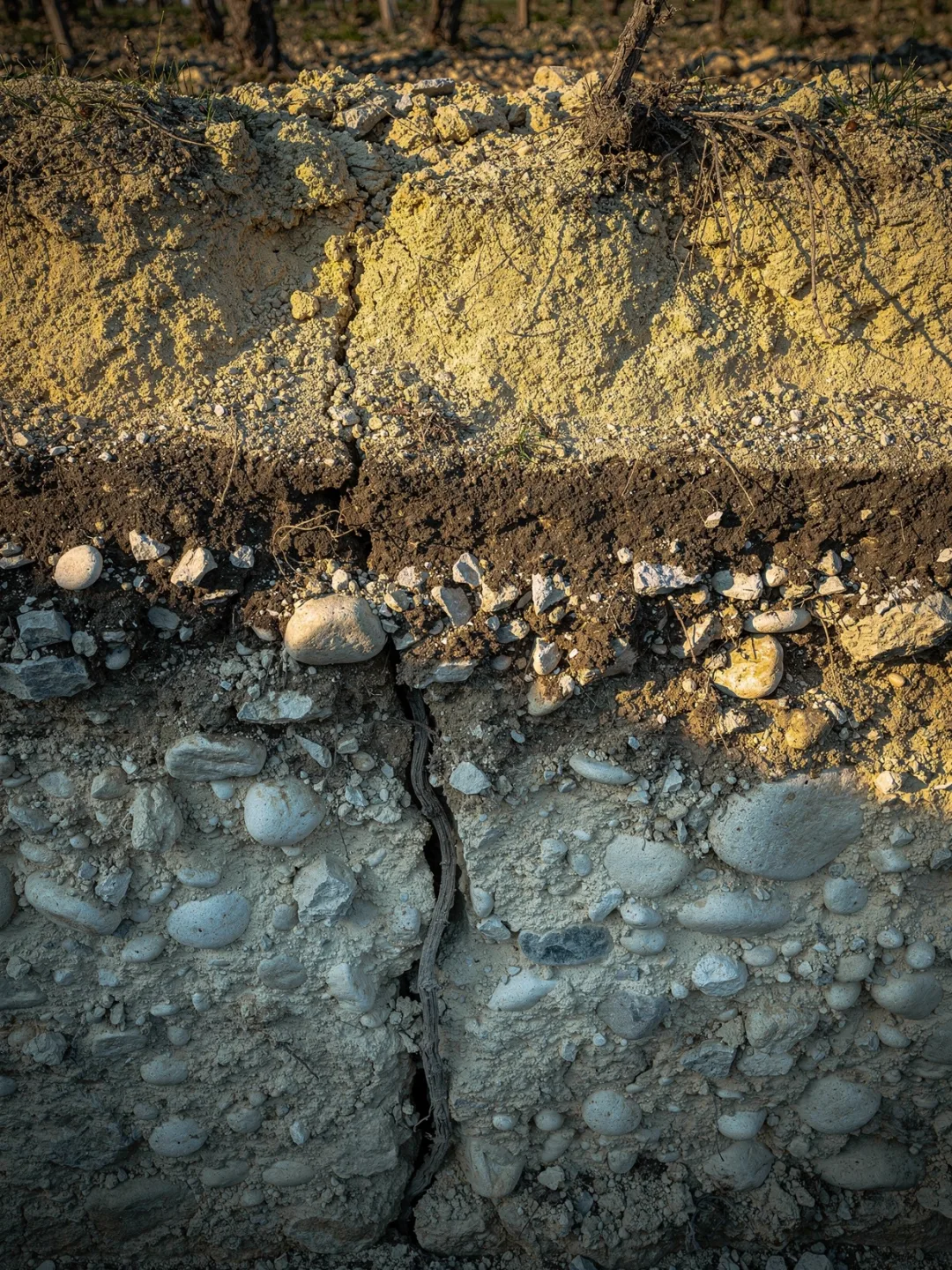
Loess & Conglomerate
Soils
Dig a hole on the western slope of the Traisental. After the very first spadeful, you'll see fine, pale dust: loess, carried here by wind over thousands of years. It's now the most common topsoil across the whole region.
For a vine's roots, this is a stroke of luck. The dust is loose enough that water and air pass through with ease, calcareous enough to keep the pH high, and it warms quickly in spring. As a result, the vines bud early and gain extra time to ripen.
Dig deeper, around half a meter down, and things get stonier. On the western slopes, the loess increasingly mixes with fragments of a hard, lime-cemented rock: the Hollenburg-Karlstetten Conglomerate, which runs like a kind of backbone from south to north through the Traisental.
This rock has its own history. It formed around 15 million years ago, when the proto-Traisen washed gravel and sand from the Alps into the foreland. Lime later cemented the material into solid rock, interspersed with occasional marl layers. Where it reaches the surface, vine roots must practically force their way through it.
This effort comes at a cost, and with a reward. The root grows more slowly, but it goes deep; whatever water it finds down there is enough even in dry summers. Wines from these slopes often come across as more angular and mineral than those from the open loess soil in the valley floor, a difference you can smell in the glass long before you've ever seen the rock. Some even mistake this minerality for tartrate crystals, the ones found at the bottom of a bottle. But that's simply crystallized acid and has nothing to do with the rock in the vineyard.
The terrain grows rougher toward the slope, and generations of winegrowers have built countless small and tiny terraces there, some barely wider than two rows of vines. Machines can hardly reach them. Anyone harvesting here mostly still does it by hand, simply because the slope leaves no other option.
Fine-grained, calcareous wind-blown dust. Covers most of the vineyards on the valley floor and the gentler slopes.
The root: Loose and easy to penetrate — fine roots spread through it instantly after every rain.