From legions to Heuriger
Region & History
Legend has it that in the third century, Emperor Probus had his legions plant vines in the province of Pannonia so the soldiers stationed at the edge of the empire wouldn't have to go without wine. There's no proof of this. What is certain is that by the time the first documents mentioning vineyards around the city started piling up in the twelfth century, viticulture was already firmly rooted here.
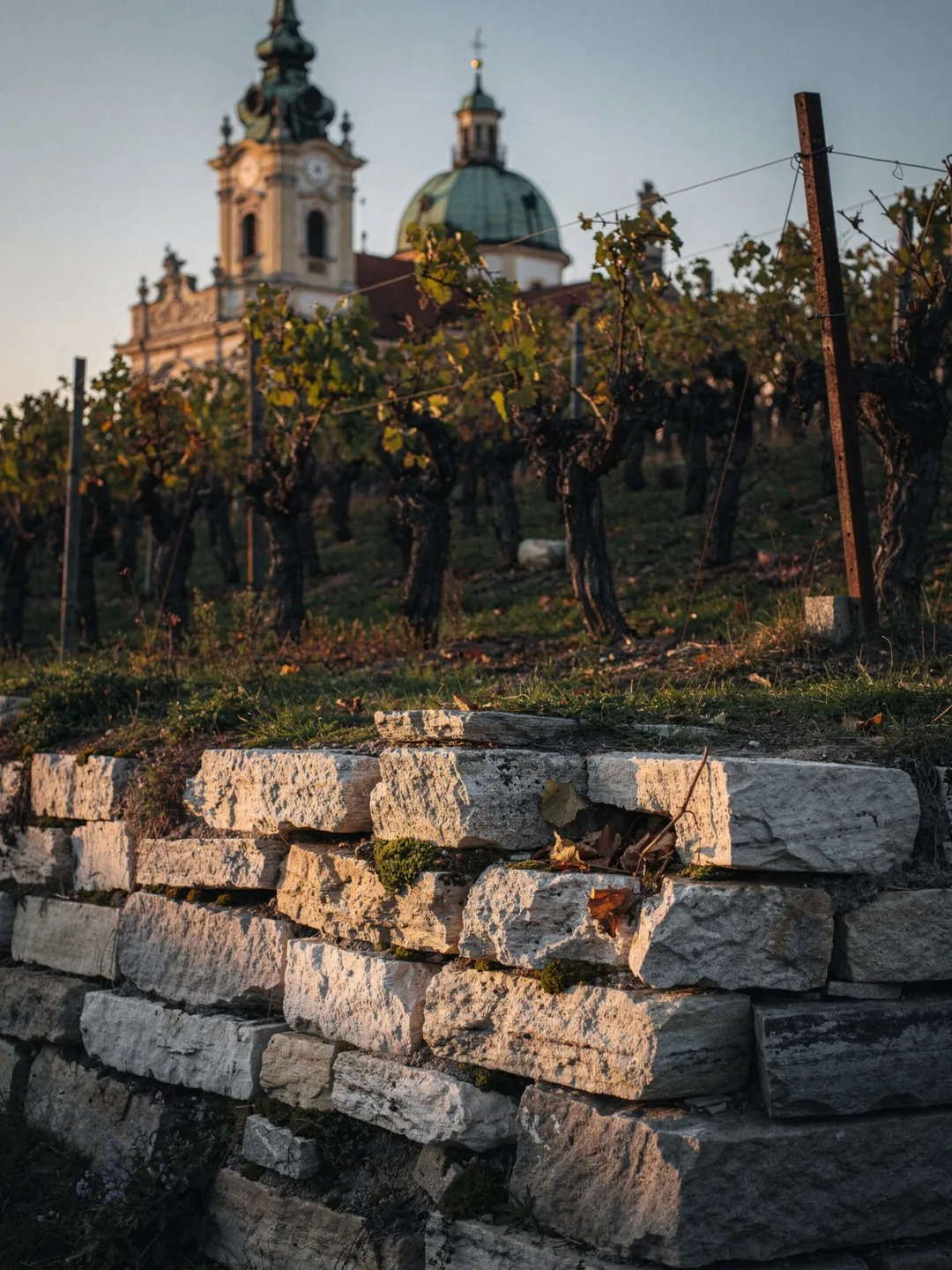
Two forces drove it forward after that. In 1114, Margrave Leopold III laid the foundation stone for Klosterneuburg Monastery, and wine from its own vineyard was already flowing at the church consecration in 1136. The monastery grew into one of the largest landowners in the area, with vineyard sites in Kahlenbergerdorf, Nussdorf, Heiligenstadt, Grinzing, and Sievering. In 1155, the Babenberg duke Henry II, known as Jasomirgott, moved his residence to Vienna, a year before the Privilegium Minus elevated the March of Austria to an independent duchy. The vines grew right alongside the city.
For a long time, winegrowing in Vienna was simply agriculture, with no special name attached. That changed in August 1784, when Emperor Joseph II issued a Circular Decree: from then on, everyone was allowed to sell their own home-produced food, including wine and must, at any time and at any price, without needing a license. That single sentence gave rise to the Buschenschank. And because these taverns mainly poured wine from the most recent, the "heurige," vintage, the tradition became known as the Heuriger.
In 1878, the Schrammel brothers gave the whole thing a soundtrack. Their string quartet played for the first time in the suburban Heurigen, and the Schrammelmusik that emerged from it still hangs over the garden taverns of Grinzing and Nussdorf today. In the twentieth century, the growing city ate into many old vineyards. Vineyard land in Wieden and Landstraße turned into city blocks. What remained was mainly the ring of hills to the northwest and south.
Vienna protected what was left in 2013. With the DAC regulation for Wiener Gemischter Satz, the city gained its own protected designation of origin — the only one in the world that applies to a mixed field blend rather than a single grape variety. Today, vines once again grow on roughly seven hundred hectares within the city limits, tended by around four hundred wineries. No other city of a million-plus people in the world can say the same.