1907 to Today
Region & History
Wine was already being traded around Setúbal back in the thirteenth century, long before anyone bothered to measure it officially. It wasn't until 1907 that the Portuguese state drew a boundary around the hills of the Serra da Arrábida and officially named the area Região Demarcada do Moscatel de Setúbal — the second-oldest demarcated region in the country, after the much earlier Douro. The following year, Dom Manuel II signed the accompanying regulations. He was Portugal's last king. Two years later the monarchy fell, but the Moscatel remained.
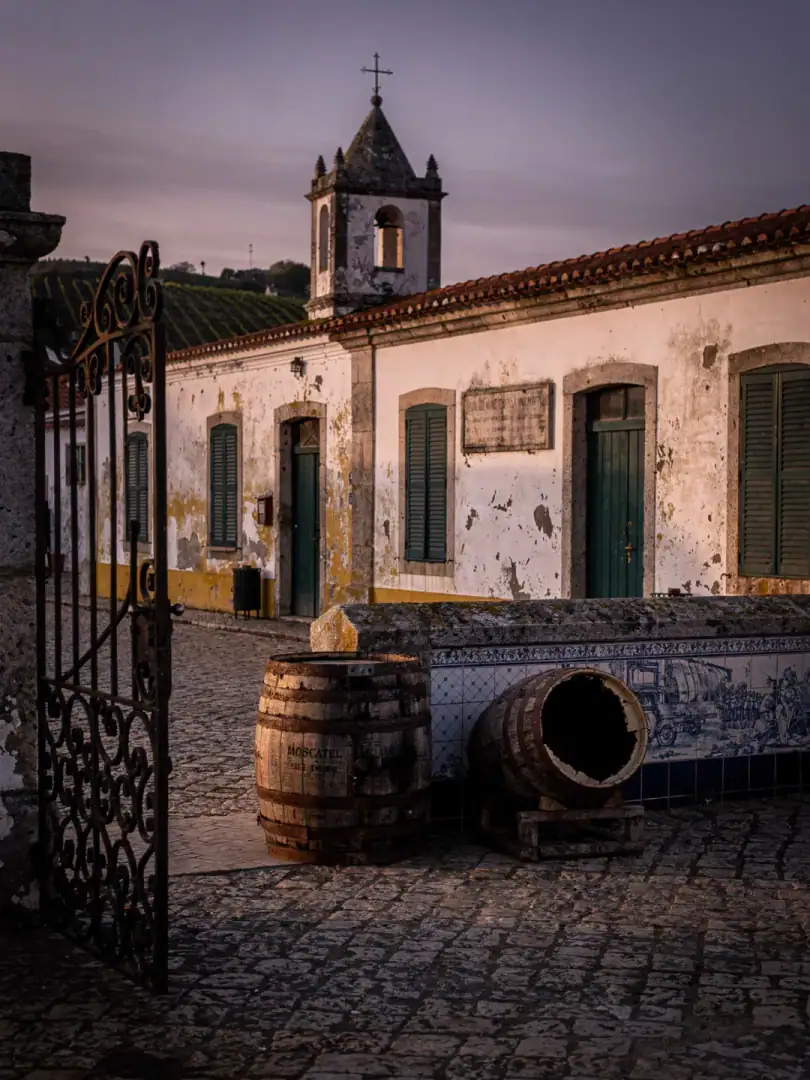
In 1834, José Maria da Fonseca founded his estate in Azeitão, initially intended just for sweet Moscatel. Fifteen years later he released the first Moscatel de Setúbal under his own name, and in 1850 came Periquita, the very first bottled Portuguese red wine. Palmela Superior followed in 1866. Over three decades, a single family had almost single-handedly built an entire winemaking style.
The region's red wines had a harder time earning their own classification. For a long time they were only classified as Indicação de Proveniência Regulamentada, a preliminary tier lacking the weight of a true designation of origin. That changed only with Decreto-Lei No. 326/97 of 26 November 1997: Palmela became a Denominação de Origem Controlada, absorbing the previously separate Arrábida zone in the process. Since then, this journey's two wine worlds have carried two names under one roof: Palmela for the reds, Setúbal for the Moscatel.
Today EU law protects both names as a geographical indication, since May 2024 under Regulation (EU) 2024/1143. It sounds like bureaucracy, but it's the reason no bottle from Andalusia is allowed to say 'Moscatel de Setúbal,' even though the same grape variety ripens there too. The 1907 boundary still largely holds: the area around Azeitão, Palmela, and part of Sesimbra, barely larger than a mid-sized German city.
José Maria da Fonseca has bottled wine continuously ever since, through phylloxera, two world wars, a dictatorship, and EU accession — nearly two hundred years without a break. Few wine estates in Europe can claim that. In Setúbal, this isn't a museum piece; it's simply business as usual.