Castelão & Moscatel
Grape Varieties
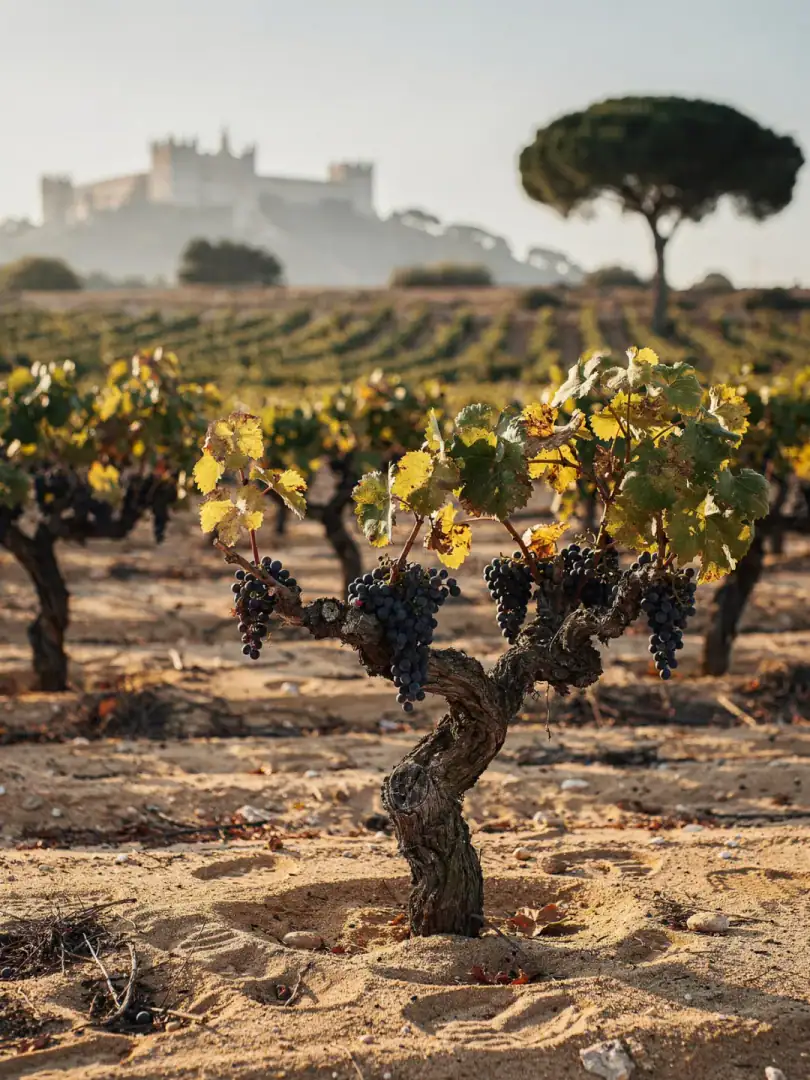
A single red grape carries the wines of Palmela: Castelão, at home for generations on the sandy plains between Palmela and Pegões. The DOC Palmela sets a firm threshold here: at least 66.7 percent of the must must come from this variety — two-thirds, not a round number, but non-negotiable. The rest is usually shared between Trincadeira and a little Alfrocheiro.
The grape only got its current name late in the game. For a long time it was simply called Periquita, after the Cova da Periquita vineyard in Azeitão that José Maria da Fonseca planted in the nineteenth century. The wine from there became so famous that its nickname was applied to the whole grape variety. Official catalogues only later filed it under Castelão.
Castelão is picky about soil, but not in the way you'd expect. On the heavy clay-limestone soil of the Arrábida, its roots stay shallow. They hit water just below the surface, and the resulting wine turns thin and lacking in backbone. In the loose sand of Palmela, by contrast, the roots dig meters deep. They only find water late in summer, and it's precisely this detour that gives the finished wine its structure.
The second major variety here is white: Moscatel Graúdo, also known as Muscat of Alexandria, a close relative of Muskateller. To carry the Moscatel de Setúbal label, a wine needs at least 85 percent of this grape. If the share falls between 67 and 85 percent, the label simply reads 'Setúbal.' Large, loose-clustered berries, plenty of aroma, low acidity — ideal for sweet wine, unsuited to an everyday dry style.
Alongside it there's Moscatel Roxo, a pink-skinned variant with a rose-petal-like fragrance, finer and more elegant than its white relative. It nearly disappeared entirely. Phylloxera almost wiped it out in the nineteenth century, and nobody replanted it. José Maria da Fonseca put the variety back in the ground, other producers followed, and today it grows again in Azeitão's vineyards, though rarely.