Tithes and Irrigation Channels
Region & History
Long before the Romans arrived, vines already grew in the Rhône Valley. Finds in Valais date back to the eighth century BC. It wasn't until fifteen BC that Roman legions subdued the valley between the Alps, and what they brought wasn't so much the vine itself as the knowledge of how to turn it into something drinkable. The Rhône Valley already knew wine before them.
The oldest written mention of vines anywhere in Switzerland comes from Valais. It appears in a document from the Abbey of Saint-Maurice, dated to the year 516. Shortly after, in 585, Bishop Heliodorus moved his seat from Octodurus, today's Martigny, to Sedunum, today's Sion. An invasion by the Lombards had forced his hand, and from then on, power over the valley and its vineyards remained largely in the hands of the Church for a long time.
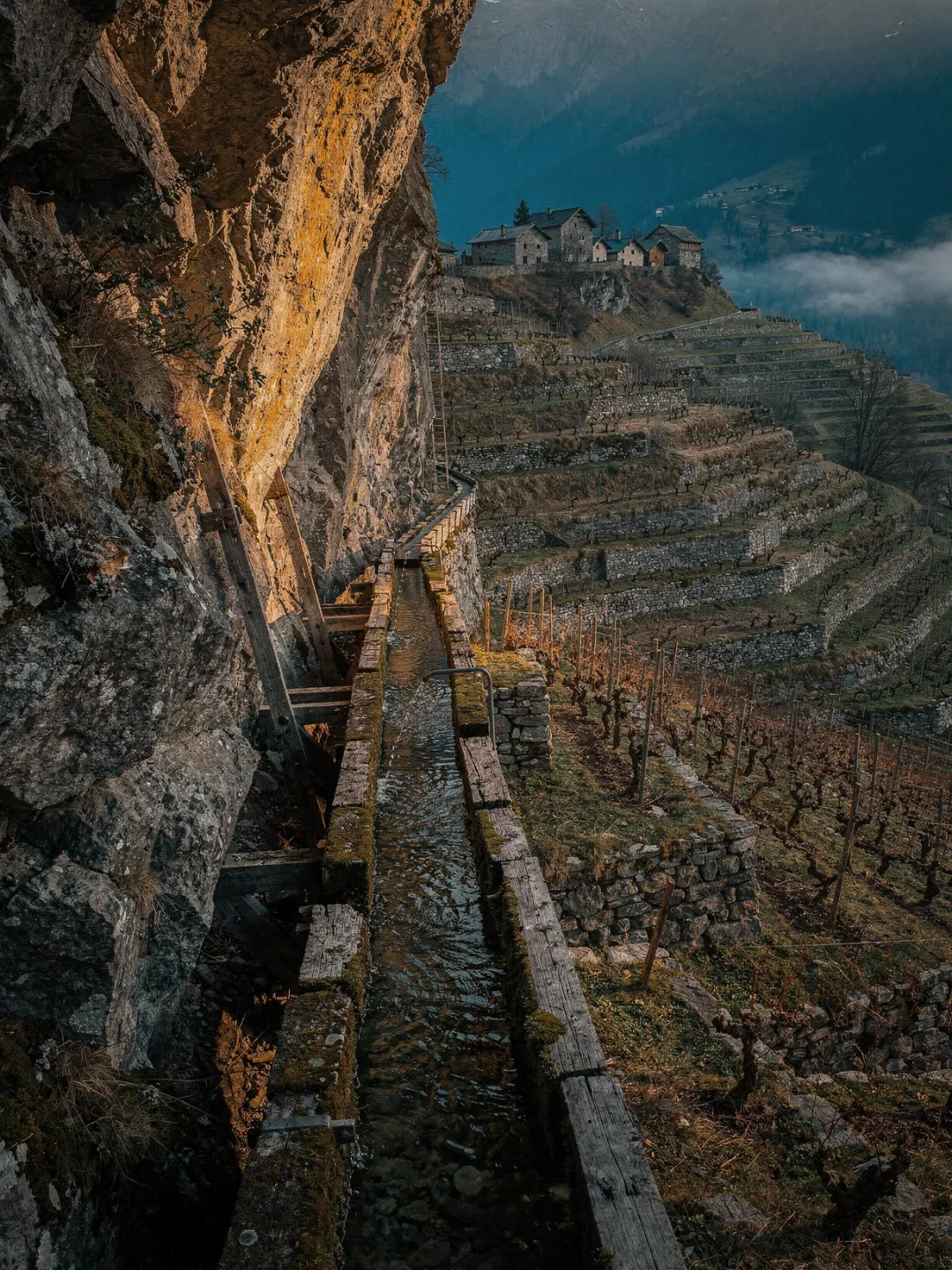
In the Middle Ages, almost every vineyard belonged to a lord, whether secular or ecclesiastical, never to the one who actually worked it. Farming families planted and harvested. Yet every year they still had to hand over the tithe, a tenth of the yield, with no room for negotiation. Water remained scarce nonetheless, since summers in Valais are hot and dry, and rainfall tends to get trapped by the high peaks. From the thirteenth century onward, the Valaisans built the suonen, known in French as bisses. Narrow channels, often stretching for kilometers, carried glacial water through bare rock to the vineyard slopes. They carved them into the stone by hand, meter by meter, century after century. At their peak, these channels totaled more than eighteen hundred kilometers.
The name Dôle, today the best-known Valais blend made from Pinot Noir and Gamay, first appears in 1854, and in 1990 the canton became one of the first in Switzerland to introduce a system of controlled designations of origin, the AOC Valais. Since then, it has been regulated which grape may grow where.
Little remains of the Church's influence in the vineyards today, but the handiwork endures everywhere. Over three thousand kilometers of dry stone walls support the terraces between Martigny and Upper Valais, stacked by bare hands, in places rising twenty meters high. Since no machine can fit into these narrow parcels, they're still tended by hand to this day. What was once a tithe paid to a distant lord is now labor invested in one's own name on the label.