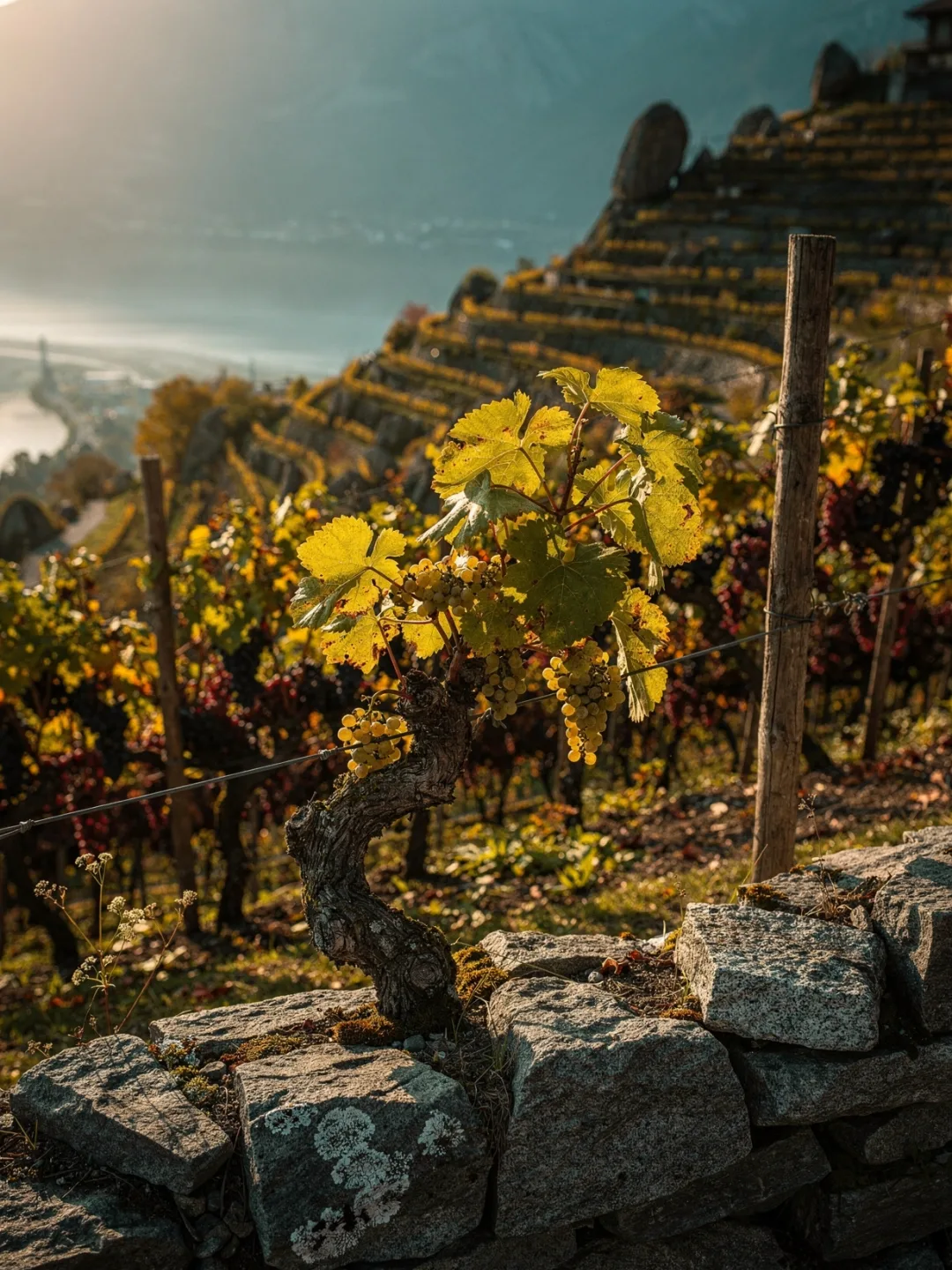
From Fendant to Cornalin
Grape Varieties
Nowhere in Switzerland do so many different grapes grow as in Valais. Over fifty varieties are planted across roughly five thousand hectares of vineyard, a good dozen of which exist nowhere else in the world. Yet four varieties define the picture: Pinot Noir, Chasselas, Gamay, and Sylvaner together cover eighty-five percent of the area. The remainder is split among more than fifty other names.
The most widely planted is Chasselas, known in Valais simply as Fendant: a good seven hundred sixty hectares, mostly down in the valley. The name comes from the French fendre, meaning to split, because its berries don't burst when pressed but rather melt away. The wine itself is light and quiet, with barely any pronounced aromatics. But it expresses its terroir so honestly that you can almost guess the vineyard, sometimes tasting of wet stone, sometimes floral.
Among the red varieties, Pinot Noir leads with over thirteen hundred hectares, nearly double the Gamay's roughly five hundred. Together they form the Dôle, the traditional Valais assemblage, a blend of two varieties. On limestone soils, it becomes a light, fruity wine. On the granite around Martigny and Fully, however, it turns denser, with notes of cherry and peony. Two grapes, one wine.
The true star among the white varieties is Petite Arvine, documented since 1602 in Molignon near Sion and still found almost exclusively in Valais today. It produces wines with notes of mango and grapefruit and a finish that carries a subtle salinity. No one has yet fully explained this effect. Still, anyone who has tasted a glass recognizes it instantly.
In Vétroz, Amigne today belongs almost to a single commune, even though it was first mentioned in 1686 in Sierre. Its sweetness level is indicated on the label with small bee symbols, ranging from dry to lusciously sweet. Even more particular is Cornalin, known until the 1970s as Landrote or Rouge du Pays. It demands the best, sunniest sites, ripens late, is sensitive to magnesium deficiency, and its yield fluctuates sharply from year to year.
Despite the similar name, Humagne Rouge is not related to Amigne but is instead a natural crossing of Cornalin and an unknown variety. In the glass, it carries aromas of withered vine leaves and elderberry. Far up the valley, in Visperterminen, Heida ripens instead, called Païen in Lower Valais, at up to eleven hundred fifty meters above sea level, higher than anywhere else in Europe.