Poetovio to Jeruzalem
Region & History
Long before anyone used the word terroir, the interplay of soil and taste, vines grew on the sunny slopes near Ptuj. Celts and Illyrians planted them first, and the Romans built upon that legacy, naming the town Poetovio. Under Emperor Trajan it was granted town rights in the year 103. It grew into one of the largest cities in what is now Slovenia, with its own Mithras cult and, at times, up to forty thousand people in the surrounding area. Ptuj is still considered the oldest town in the country.
Wine culture never broke off since then. In 1239 Minorite friars founded a monastery in the middle of town, with a wine cellar beneath it, and from that day on wine has been pressed in Ptuj without interruption. The operation is known today as Ptujska klet and produces brands such as Pullus and Haložan. Deep in its archive lies a single bottle from 1917, filled with grapes from the Haloze hills. Cellar master and mayor Jožef Ornig laid it down at the time. His son Pavel walled up the archive during the Second World War so that looters wouldn't find it. The wine is called Zlata trta and is considered the oldest surviving Slovenian wine of all.
Northeast of Ptuj, a hill tells a different story. Teutonic Knights are said to have brought back an image of the Virgin Mary from a pilgrimage to the Holy Land and built a tower for it on this hill, named after the city they came from: Jeruzalem. Three different versions of this legend survive, and none can be proven. What is documented, however, is that feudal lords were already leasing vineyards here in the fourteenth century, and a view from 1681 shows the hills between Ljutomer and Ormož already fully covered in vines.
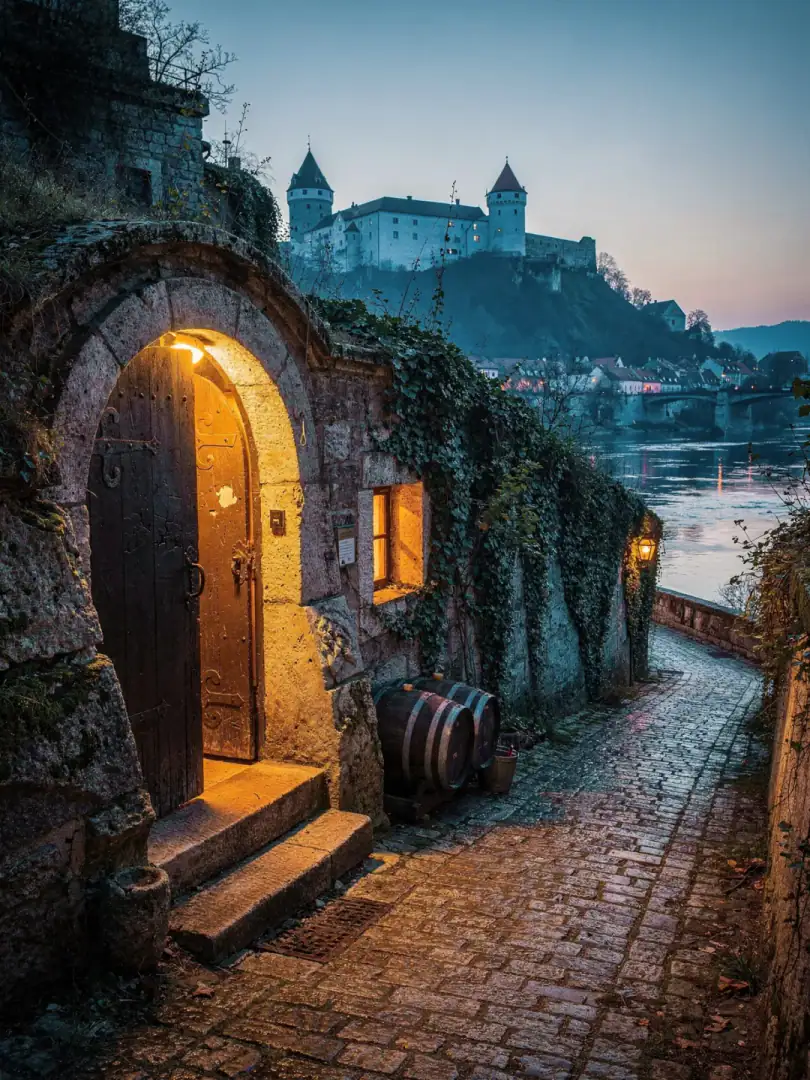
These steep slopes were not terraced back then. That only began after 1965, around the hamlets of Slamnjak, Ilovci and Železne dveri, and the Jeruzalem-Ormož cooperative drove the work forward into the late 1980s. In 1976, the municipality of Ljutomer placed the Ljutomerski ribniki landscape park in Jeruzalemske gorice under protection, and in 1992 Ormož followed with its own park. Together they now comprise 581 hectares of vineyard, a third of it terraced. Small stone Zidanice still stand between the rows today, where winegrowing families pour their own wine.
The most recent chapter began with bubbles rather than grapes. In 1852, a winemaker named Kleinošek from Gornja Radgona, who had previously learned the craft in Champagne, sold the first Slovenian sparkling wine made by the classic method. The area was long administered in six separate districts, from Ljutomer-Ormož to Šmarje-Virštanj. It wasn't until 2006 that they were merged into a single wine region: Štajerska Slovenija.