Médulas & Corullón
Region & History
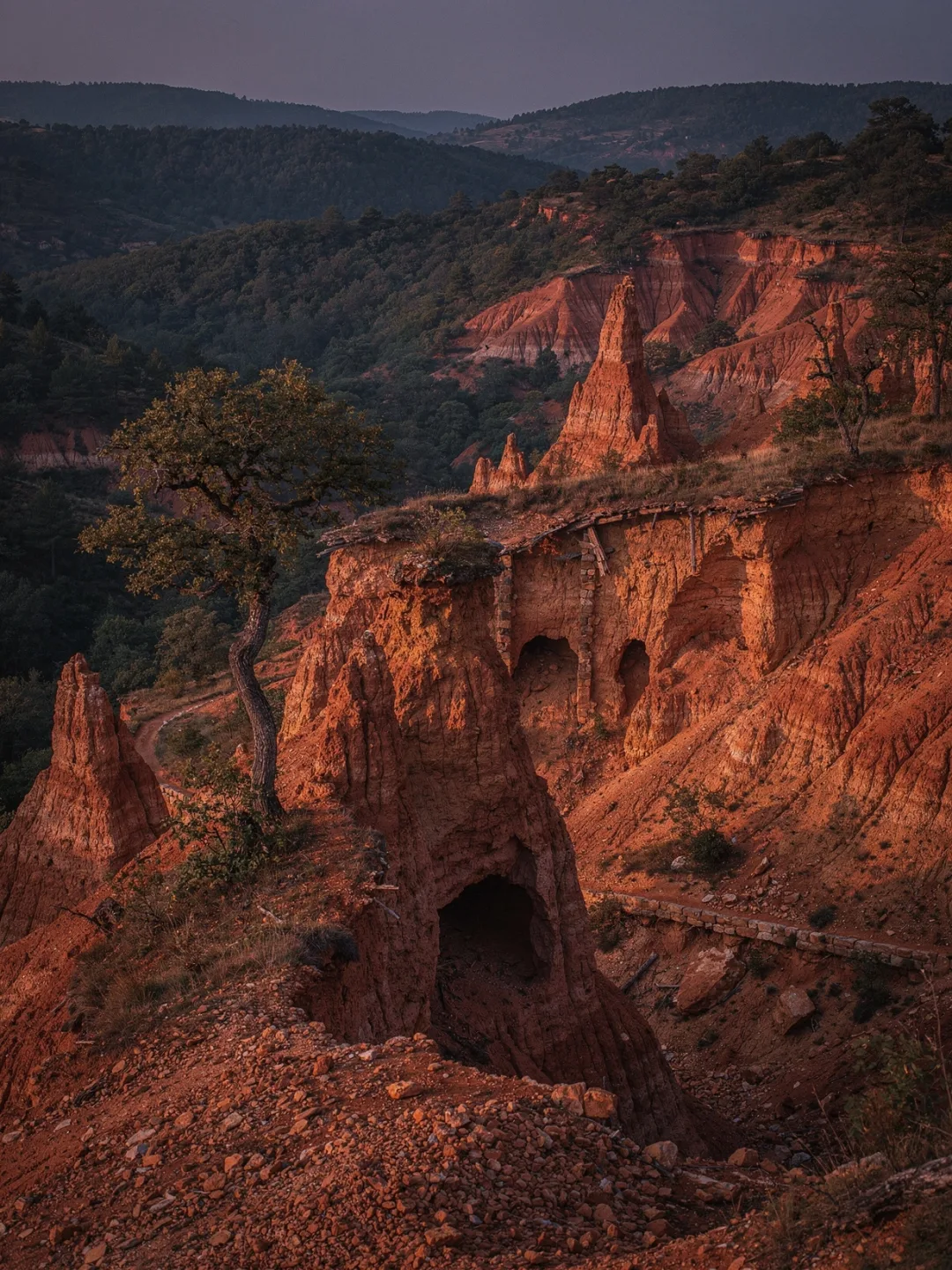
South of Ponferrada, red rock towers gape from the landscape, as if bitten out of a mountain. That's essentially what happened. Starting in the first century, the Romans channeled water through a network of canals onto the hillsides, washing gold out of the rock — Las Médulas became the largest open-pit mine in the entire Roman Empire. Nearby, the same settlers planted vines. Even the writer Pliny the Elder mentioned vineyards in this area. When the gold ran out, the wine remained.
Nearly a thousand years later, faith gave the next reason to plant. Carracedo Monastery, founded around 990 and run by Cistercians from 1203, managed vineyards stretching from Galicia to León, supplying monks and pilgrims alike. Through Villafranca del Bierzo passed those on the Camino de Santiago who still faced the last, toughest mountains before Galicia. The town still carries the nickname 'little Compostela' today. Pilgrims too sick to continue could pass through the Puerta del Perdón here and receive the same indulgence as at the actual destination.
Then came phylloxera, and the collapse was brutal. Around 1889, Bierzo still had roughly six thousand hectares of vines. Two decades later, after the laborious replanting on American rootstocks, only about a fifth of that remained. Entire villages emigrated. What was left, cooperatives from the 1960s onward mostly sold as anonymous bulk wine to merchants who bottled it elsewhere under different names. Only on November 11, 1989, did the region get its own Denominación de Origen, headquartered in Cacabelos — and with it, finally the right to put its own name on the label.
For a long time, little changed on the ground. The real turning point came only in 1999. Álvaro Palacios, from Rioja, founded Bodega Descendientes de J. Palacios together with his nephew Ricardo Pérez Palacios in an old stone cellar in Villafranca del Bierzo. Both searched Corullón for ancient Mencía vines on slate slopes that almost no one wanted anymore, since the yields were too low. From these lean parcels came not mass-market wines, but dense, expensive bottles that critics soon compared to great Burgundy crus.
This new appreciation got its own set of rules in 2020. DO Bierzo became the first Spanish appellation ever to introduce a classification by commune, site, and single parcel: Vino de Villa, Vino de Paraje, Viña Clasificada — openly modeled on Burgundy and Piedmont. Anyone buying a bottle labeled Corullón instead of just Bierzo today is buying a single place, not an entire region.