Mencía & Godello
Grape Varieties
Seventy percent of the planted area in Bierzo carries just one single grape: Mencía. For a long time, legend held that it was related to Cabernet Franc, supposedly brought by French pilgrims along the Camino de Santiago. DNA analysis from the Universidad Politécnica de Madrid put that to rest: genetically, Mencía is identical to the Portuguese variety Jaén from the Dão, and has nothing to do with Cabernet Franc. The grape is an independent native of the northwestern Iberian Peninsula.
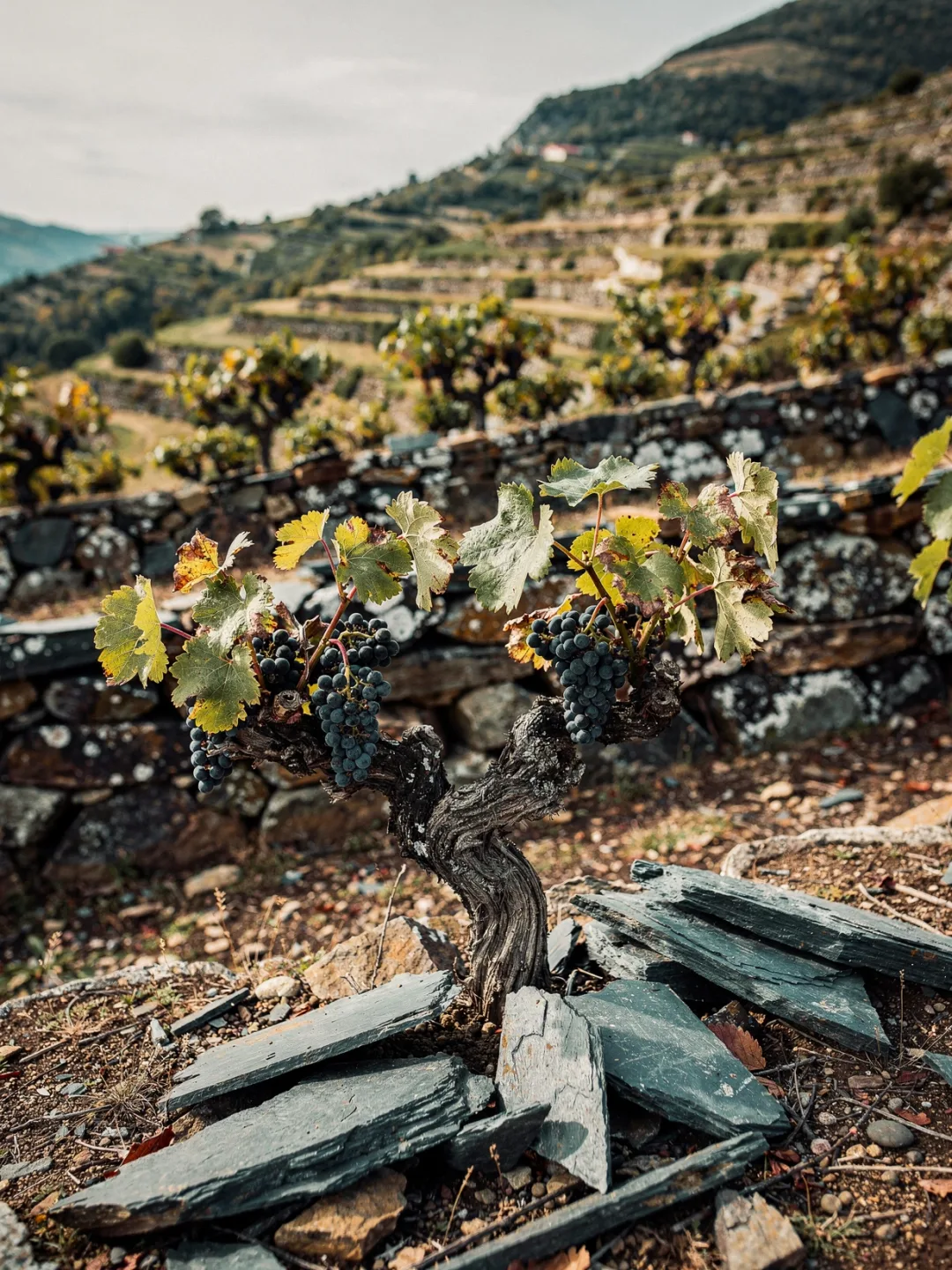
Where it grows makes all the difference. On the steep slate slopes around Corullón, Mencía produces small, thick-skinned berries with deep color and firm tannin. Down in the broad river plain, by contrast, the grapes grow looser and paler, with less bite. Between these two extremes lies practically the entire range of the region. The same name appears on the label, but two rather different wines end up in the glass, depending on how high and how steep the vineyard sat.
Alongside Mencía stand a few supporting players that almost nobody knows. Garnacha Tintorera even stains the flesh red, not just the skin, and was traditionally used mainly to make thin bulk wine look more robust. Estaladiña and Merenzao, meanwhile, survive on only a few hectares, nearly forgotten. A handful of winemakers now deliberately preserve them because they give the wine a spice that Mencía alone can't provide.
Among the white varieties, Godello takes center stage, today accounting for roughly seventeen percent of the area. After phylloxera, the variety nearly vanished. In the 1970s, neighboring Valdeorras had only a few hundred vines left, until the rescue program ReViVal, launched in 1976 by agricultural engineers Horacio Fernández and Luis Hidalgo, systematically sought out old, scattered Godello vines and propagated them anew. Without this program, the aromatic Godello white wines of Bierzo simply wouldn't exist today.
The remainder of the white palette is shared among three outsiders. Doña Blanca, also known as Moza Fresca or Malvasía del Bierzo, buds late and produces lean, austere wines with a short finish. Palomino, otherwise best known from Sherry, supplied neutral everyday bulk white wine here for decades. Malvasía makes up barely a tenth of a percent of the area. Where it's blended in, it adds a floral note none of the other varieties can match.