Giants and phylloxera
Region & History
The Romans were already planting vines here. Excavations from the twelfth century show that winegrowing on the plateau south of Toledo never truly stopped since. Even so, it took until September 1932 before the name La Mancha first appeared officially as a designation of origin in the Gaceta de Madrid. That was the same year as Rioja. This makes it one of the oldest protected wine regions in Spain altogether.
The new status didn't last long. Civil war and its aftermath brought the project to a virtual standstill, and it wasn't until 1973 that the region got its own Consejo Regulador, its regulatory body. Three years later, in 1976, a ministerial order approved the first complete set of regulations. What in 1932 had been merely an entry in the official gazette only then became something you could print on a bottle.
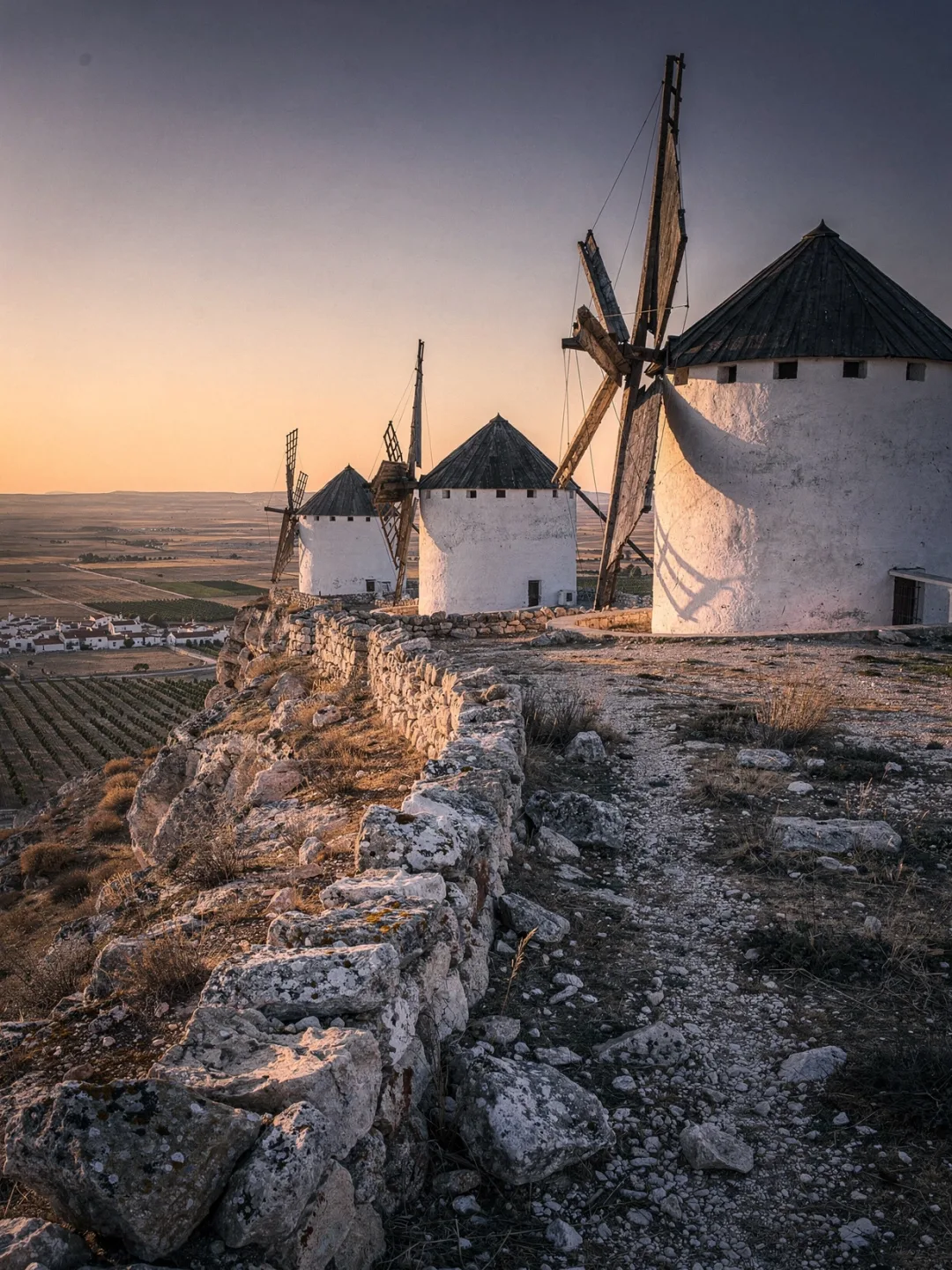
More famous than any decree, in any case, is another document: Miguel de Cervantes' novel about Don Quixote. As early as 1575, Philip II's Relaciones Topográficas recorded the windmills on the ridge above Campo de Criptana, and these very mills gave Cervantes the image for Don Quixote's battle against imagined giants. El Toboso, home of the fictional Dulcinea, and Puerto Lápice, where the knight spent his first night as a knight, both lie right in the middle of today's growing zone. A wine region whose oldest calling card is a fictional character — that's a rare thing indeed.
The real boom came from a pest. When phylloxera began destroying France's vineyards from the 1860s onward, La Mancha's dry, sandy-chalky soils resisted the infestation longer than most others. Within a few decades, Tomelloso transformed from a grain-farming village into a winegrowing monoculture. Usable roads were scarce, so residents dug their cellars right beneath their houses: by hand, up to twelve meters deep into the rock, to house thousands of clay vessels called tinajas. More than two thousand such cave cellars still lie beneath the town today.
Necessity later turned into greatness. In 1961, winegrowers in Tomelloso founded the Cooperativa Virgen de las Viñas, today the largest wine cooperative in Europe with around two thousand members and well over one hundred million liters produced annually. Four hundred years separate the windmill from the cellar cooperative, and yet both tell the same story: a bare plain where people made a great deal out of very little.