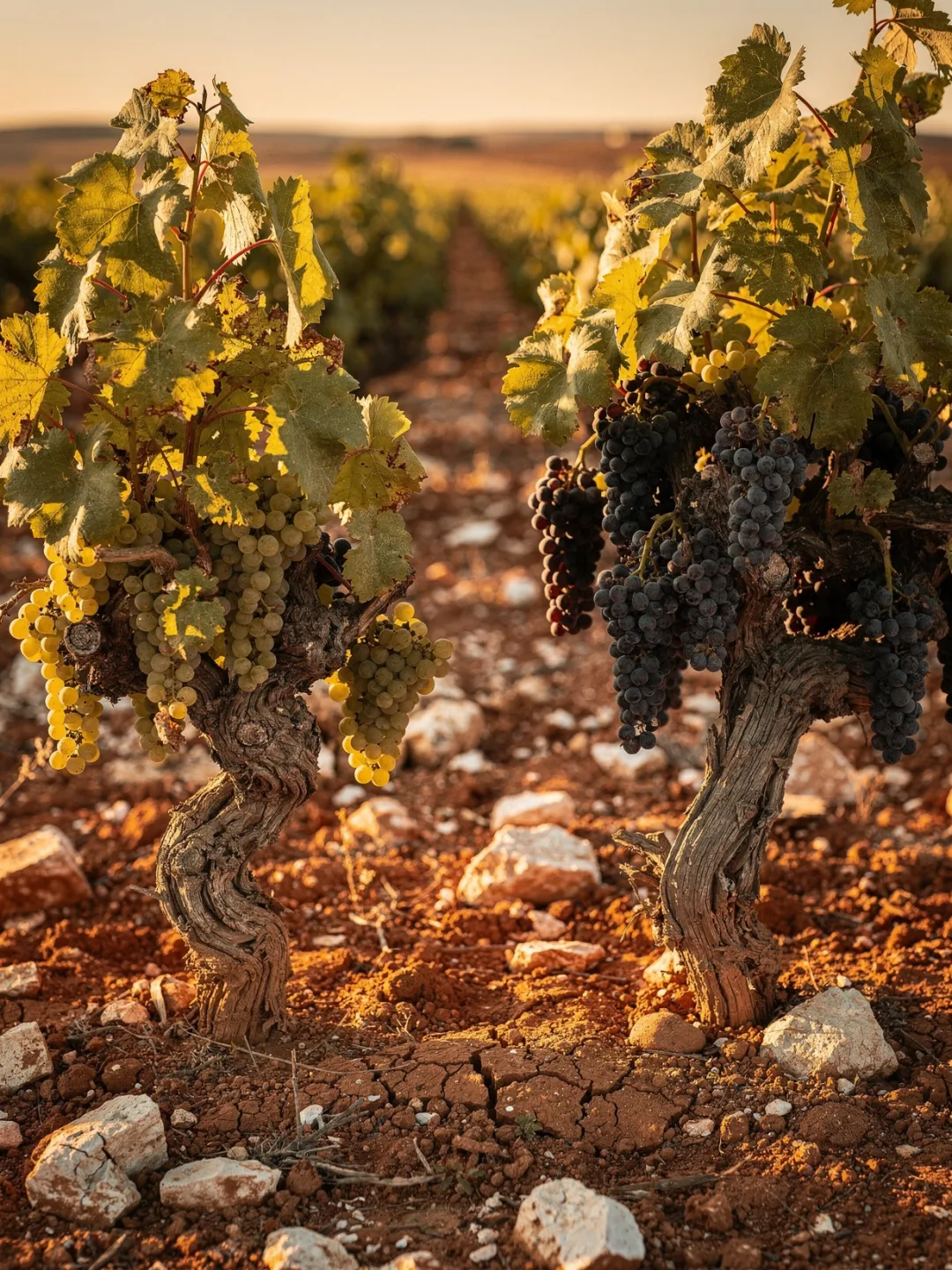
Airén & Cencibel
Grape Varieties
A single white grape variety today covers more area than all other varieties of the Denominación combined. Airén stood at 79,235 hectares in 2025, just under fifty-five percent of La Mancha's entire registered vineyard area. It tolerates drought. Hardly any other vine could. That's precisely what made it the most widely planted white grape variety in the world for decades.
It reached its peak in 2004 with around three hundred and six thousand hectares in Spain alone. Practically the entire world's plantings of this variety stood here at that time, yet a large share of it never made it to market as bottled wine — instead it went to the distilleries, as a base for brandy or as grape juice concentrate for other beverages, since Airén delivered above all volume, not necessarily character.
Among the red varieties, Cencibel leads the way — the name Tempranillo has always gone by here. With 28,307 hectares and just under twenty percent of the area, it stands far ahead of any other red grape in the region. It ripens early, tolerates the plain's heat well, and yields wines with dark fruit, noticeable tannin, and, due to intense sun exposure, often above-average alcohol content.
Beyond that, the regulations permit a long list of further varieties. Among the whites, these include Macabeo, Chardonnay, and Sauvignon Blanc; among the reds, Garnacha Tinta, Garnacha Tintorera, Syrah, Cabernet Sauvignon, and the actually Valencian Bobal. Anyone wanting to label a bottle with the name of a single variety, however, must prove that it makes up at least eighty-six percent of the wine. Anything less counts as a blend.
White winemaking in particular has become modern. Until the 1980s, Airén often fermented uncontrolled in the summer heat and quickly turned oxidative and dull. With temperature-controlled steel tanks, that changed completely: fermented cool, the same grape suddenly shows citrus fruit, white blossom, and a remarkably lively freshness. What was once raw material for the still, some winegrowers now proudly bottle as a single varietal.