Tirage & Barrique
Production
In the cellar, the paths of Franschhoek's white wines diverge right at fermentation. Old Semillon and Chardonnay vines are often fermented with their own wild yeast in used oak barrels rather than stainless steel tanks. It takes longer and carries more risk, but it gives the wine depth. None of this happens by chance. After fermentation, the wine often rests on its lees for months and is stirred regularly, a process that lends it fullness and a slightly creamy texture. Here, time stands in for technique.
Cap Classique follows an entirely different path. Its base wine of Chardonnay and Pinot Noir is first vinified like an ordinary still wine, dry and rather lean. Only then comes the decisive step: sugar and yeast are added, the wine is bottled, and sealed right there. The second fermentation takes place entirely inside that bottle. A year of patience pays off.
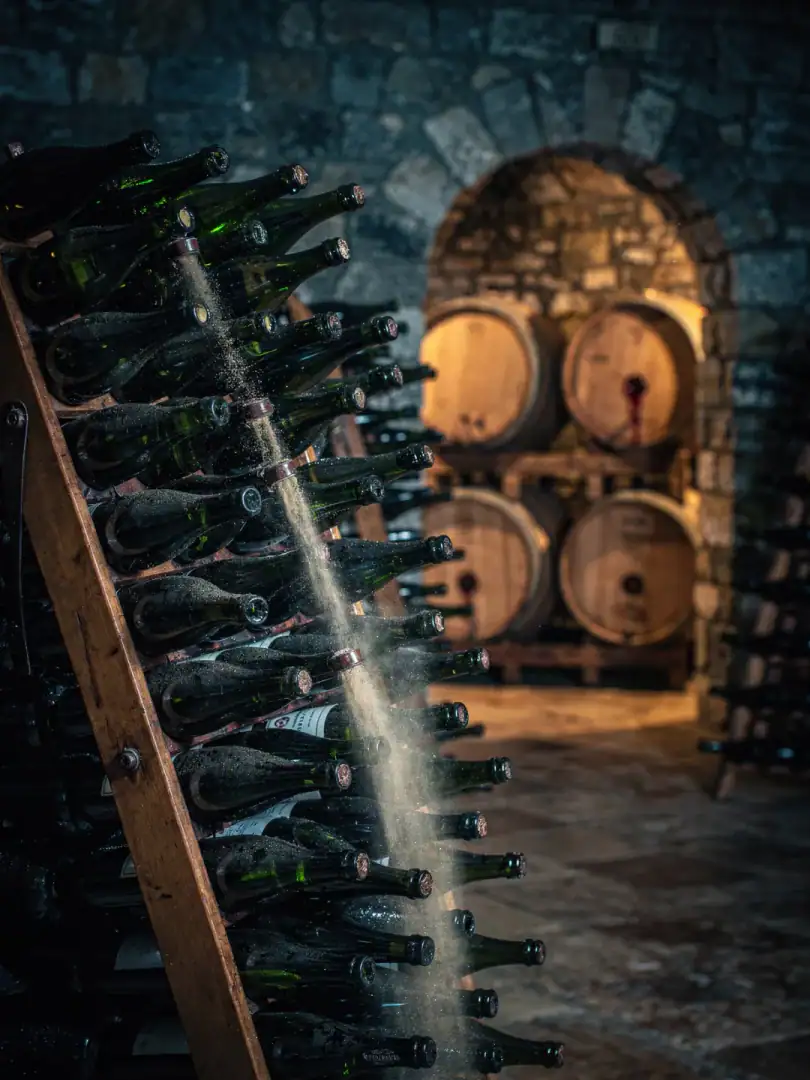
Because the resulting carbon dioxide can't escape, it stays locked in the wine and later turns into fine bubbles upon opening. Afterward, the bottle rests on the dead yeast, at least twelve months since the 2023 vintage, often considerably longer. This is where the toasty, bread-like notes develop that set a good Cap Classique apart from a simple sparkling wine.
At the end, the bottle is tilted and slowly turned upside down until the yeast collects in the neck. That neck is frozen, the plug of yeast shoots out upon opening, and a small dosage of wine and a touch of sugar then determines the final sweetness.
The South African industry only coined the name for this method in 1992, after the terms Champagne and Champenoise were legally banned for its use. The Cabrière estate, named after the Huguenot Pierre Jourdan, had already been working exactly this way since 1986.