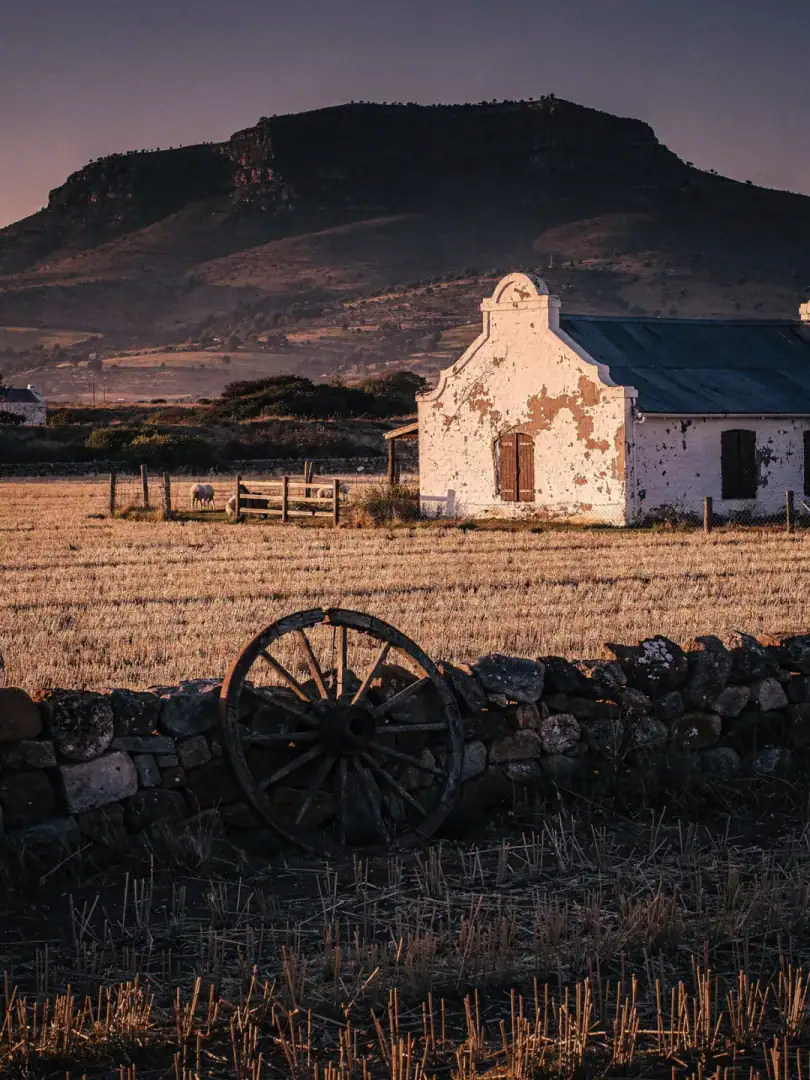
Wheatland becomes wine land
Region & History
Wheat came before wine. In the late seventeenth century, Dutch farmers settled the plain north of the Cape Colony because wheat and sheep made more economic sense here than vines. Jan van Riebeeck gave the area its name: Het Zwarte Land, the black land, after the Renosterbos, a tough shrub that looks dark from a distance after rain, almost as if scorched. To this day, the Swartland supplies about a fifth of South Africa's wheat, and vines long remained a side concern.
For most of the twentieth century, little changed. Grapes from the Swartland went to cooperatives and to the KWV, the state-backed industry giant. There they became bulk wine and base wine for brandy, shipped out nameless in tanker trucks. Whoever planted here planted for volume, and the old, unirrigated bush vines from the thirties and forties survived simply because no one bothered to pull them out.
That only began to shift in the late nineties. Charles Back of Fairview started searching the hills around the Paardeberg for old vine material. Shortly after, Eben Sadie moved to the Swartland, convinced that these forgotten bush vines could produce more than bulk wine. In 1999 he founded Sadie Family Wines. His first Columella vintage appeared in 2000, barely five thousand bottles, followed two years later by the white Palladius. In 2010, Sadie joined Adi Badenhorst, Chris and Andrea Mullineux, and Callie Louw of Porseleinberg to found the Swartland Independent Producers. Out of this grew the Swartland Revolution, a festival held six times through 2015.
What united the group was an attitude, not a formula: one hundred percent estate-grown fruit, spontaneous fermentation, no added water, minimal new oak. Sulfur remained permitted, but only in moderation. This was radical in a country whose wine law — Wine of Origin, overseen by the Wine and Spirit Board since 1973 — still governs mainly provenance, not cellar practice. If an origin appears on the label, one hundred percent of the grapes must genuinely come from there.
Today, the Swartland counts as its own district within the Coastal Region, with wards including Paardeberg, Riebeeksrivier, and Porseleinberg. In barely twenty years, wheat country became one of the most talked-about wine addresses in the New World.