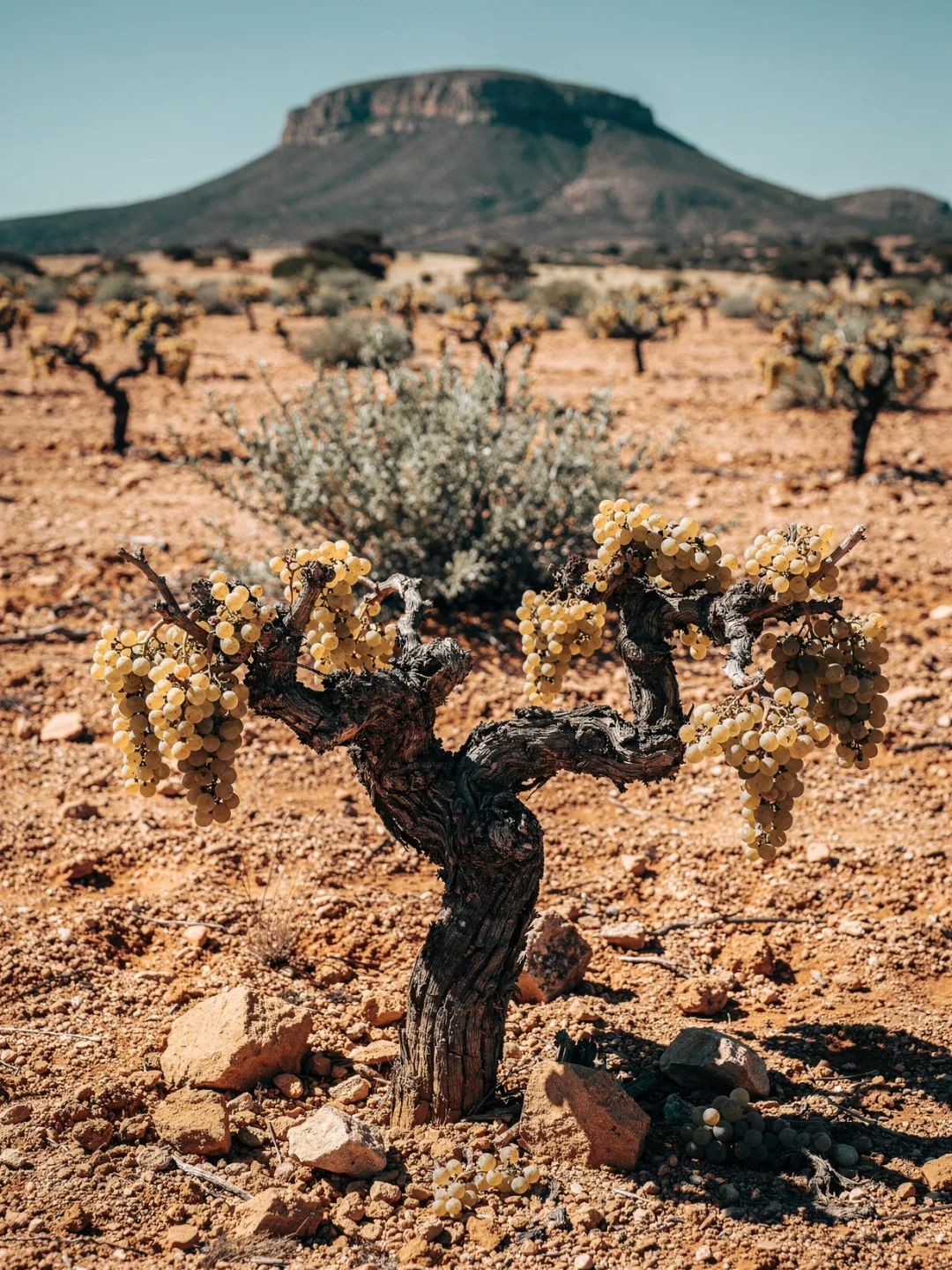
Chenin & old bush vines
Grape Varieties
A quarter of the Swartland's vineyard area carries a single white variety: Chenin Blanc, called simply Steen here for generations. Many vines stand as bush vines in the ground, free-standing without wire or stake. Some are over forty, a few over eighty years old.
A bush vine grows compact, barely knee-high, and shades its own grapes. This protects them from the afternoon sun. Its roots, meanwhile, reach deep enough to manage entirely without irrigation. Colombar and Sauvignon Blanc fill additional large areas, mostly destined for simpler wines and the brandy still. Grenache Blanc, Clairette, and Viognier, by contrast, grow in smaller parcels for white Rhône-style blends, such as Sadie's Palladius, which brings together eleven varieties from seventeen parcels.
Among reds, Pinotage even outstrips the more prestigious Syrah in planted area. Pinotage is a South African crossing of Pinot Noir and Cinsault, created in 1925 at Stellenbosch University — grown in the Swartland, but not invented here. Yet it is Syrah, often called Shiraz, that stands for the region's new reputation, usually blended with Grenache, Mourvèdre, Carignan, and the old, almost forgotten Cinsault. Sadie's Columella blends exactly these varieties from eight different Swartland vineyards into a single, dense red wine.
This blend is no fashion statement but a deliberate borrowing from the southern Rhône, whose warm, dry climate resembles that of the Swartland. Mourvèdre needs particular warmth to ripen at all, and finds it more reliably in the iron-rich soil of the Paardeberg than almost anywhere else at the Cape. Cinsault, by contrast, brings lightness and perfume, exactly where the other varieties can turn heavy and high in alcohol.
What unites all these vines is their age, not their origin. Since its official founding in 2016, the Old Vine Project has certified vineyards of thirty-five years and older with its own seal, Certified Heritage Vineyards. It is in the Swartland especially that such vineyards turn up in abundance.