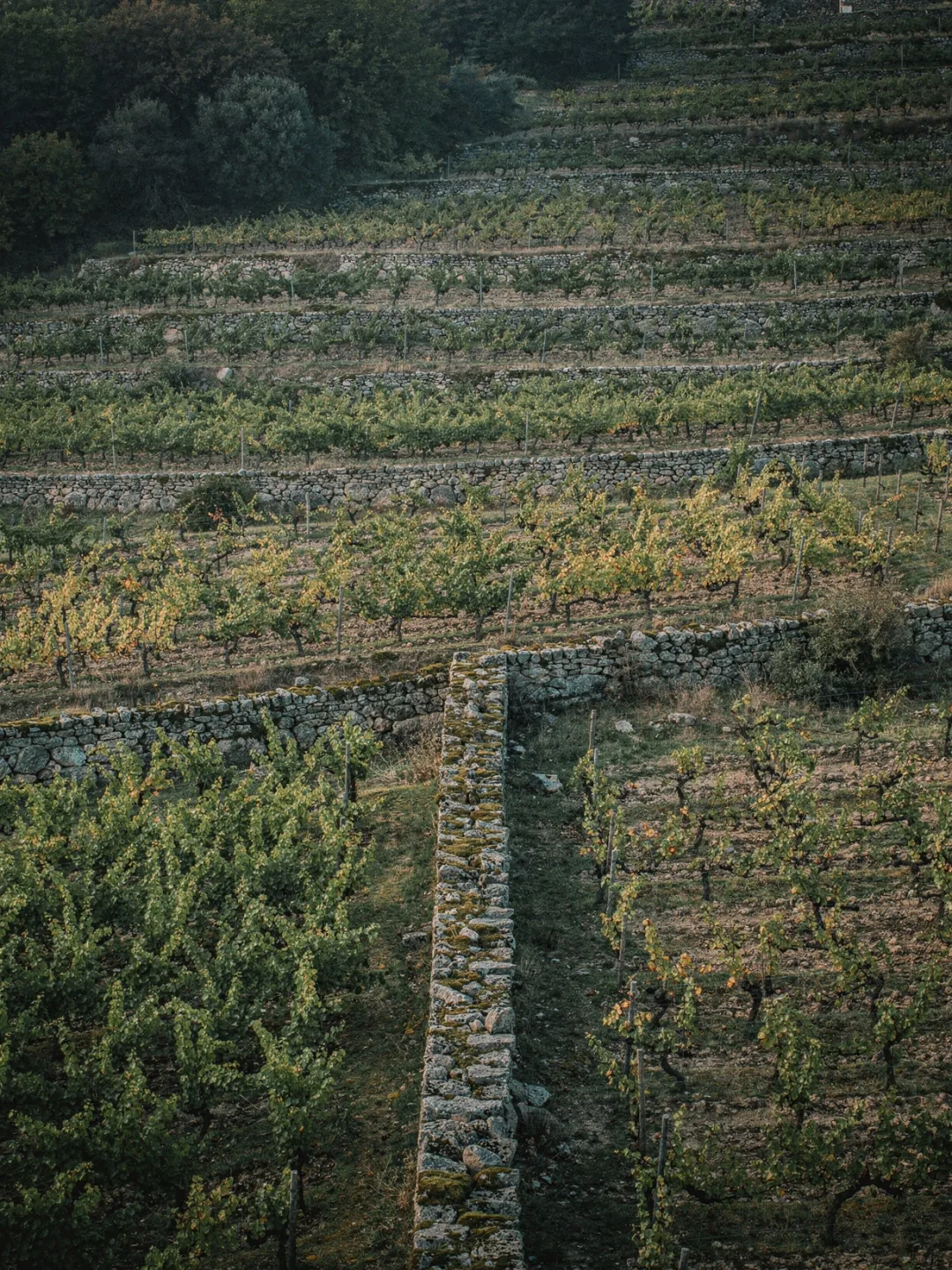
Site beats variety
Vineyard Sites and Cru Systems
Within a protected region of origin, there's often an even finer map: individual vineyard sites whose names alone justify a higher price. This fine-grained structure is known as a vineyard site or cru system.
Burgundy as the strictest example
Nowhere is this fragmentation as pronounced as in Burgundy. There, every single parcel, often just a few hectares in size, is assigned to one of four quality tiers: Regional, Village, Premier Cru, and, at the very top, Grand Cru. The famous Romanée-Conti vineyard measures barely one and a half hectares. Yet it's still one of the most expensive vineyards in the world. Just a narrow wall away, a neighboring parcel begins. Officially, it's classified as a simple Village site and fetches only a fraction of the price.
This fine-grained structure largely emerged in the Middle Ages, thanks to monasteries such as Cîteaux. Over generations, the monks carefully observed which parcel reliably produced better wine and meticulously recorded these boundaries. Today's legal classification from 1936 essentially just gave official confirmation to these centuries-old observations. It invented nothing new.
Bordeaux ranks by château, not by soil
Bordeaux took a different path in 1855. At the request of Emperor Napoleon III for the Paris World's Fair, trading houses ranked the red wines of the Médoc according to their market prices at the time. They created five rankings, from Premier Cru to Cinquième Cru. What was classified here wasn't a plot of land, as in Burgundy, but a château, an estate with its own name and brand. A château may since expand its own vineyards or purchase additional land without losing its rank, as long as the name stays the same.
This 1855 classification remains almost unchanged to this day, even though ownership, soil quality, and wine styles have shifted repeatedly since then. Only once, in 1973, was a change permitted. At that time, Château Mouton Rothschild was promoted from second to first rank. This rigidity makes the Bordeaux classification almost as much a historical monument as a reliable measure of present-day quality.
Germany, Italy, and other paths of their own
Germany has no unified national vineyard classification system. Instead, there's the private classification of the Verband Deutscher Prädikatsweingüter, or VDP, with the tiers Gutswein, Ortswein, Erste Lage, and Große Lage. Only a strictly selected circle of member estates may use these terms. This makes the system voluntary, yet effective. Italy, meanwhile, is increasingly supplementing its DOCG regions with so-called Menzioni Geografiche Aggiuntive, additional geographical indications. This allows Piedmont, for instance, to name its best Barolo and Barbaresco sites individually.
Champagne uses yet another principle, the so-called Échelle des Crus. It's a historical ranking of entire villages rather than individual parcels. Seventeen communes there are classified as Grand Cru, another forty as Premier Cru. How differently these systems can look despite a similar goal says a great deal. There is no single correct way to separate great sites from average ones. There are only different traditions, each suited to its own country.
Why a site is even allowed to cost more
Behind every one of these systems lies the same economic logic. A classification makes quality differences visible that would otherwise only be recognized by experts with years of experience. For buyers, the name of a site replaces part of their own assessment, much like a quality seal. That's precisely why a wine from a Grand Cru site can cost several times more than a neighboring Village wine, even though both might come from the same grape variety and the same vintage.
Critics point out that such systems can also become frozen in time. A classification, once granted, is rarely reviewed again, even as climate change or new farming practices have long since begun affecting actual quality. A good site remains formally good, even if a neighboring slope now produces better grapes thanks to improved management. Vineyard site systems are therefore more of a useful map of the past than an up-to-date measuring instrument.
What a beginner can take away from this
Anyone reading these terms for the first time doesn't need to memorize them. A single rule of thumb is entirely enough to start with. The more precisely a name identifies a single site, the more likely the higher price is worth it. A wine that only names an entire region can still be good. It simply promises less about the exact place the grapes truly come from.